Rafeeq Shamil, Shiroodi Setareh, Schwarz Michael H, Nitin Nitin, Ovissipour Reza
Virginia Seafood Agricultural Research and Extension Center, Virginia Tech, Hampton, VA 23669, USA.
Center for Coastal Studies (Coastal@VT), Virginia Tech, Blacksburg, VA 24061, USA.
Foods. 2020 Sep 16;9(9):1306. doi: 10.3390/foods9091306.
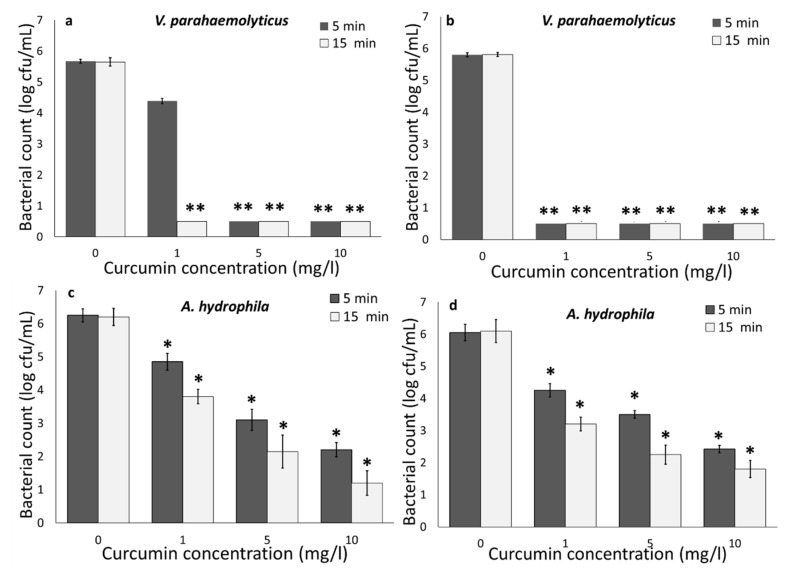
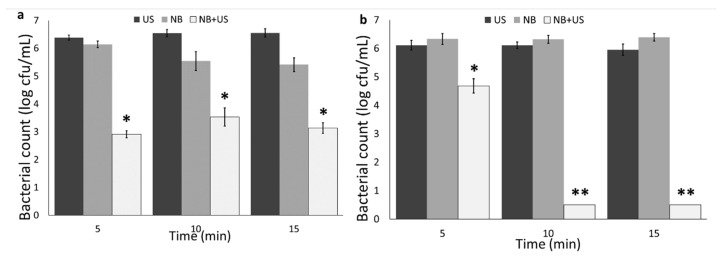
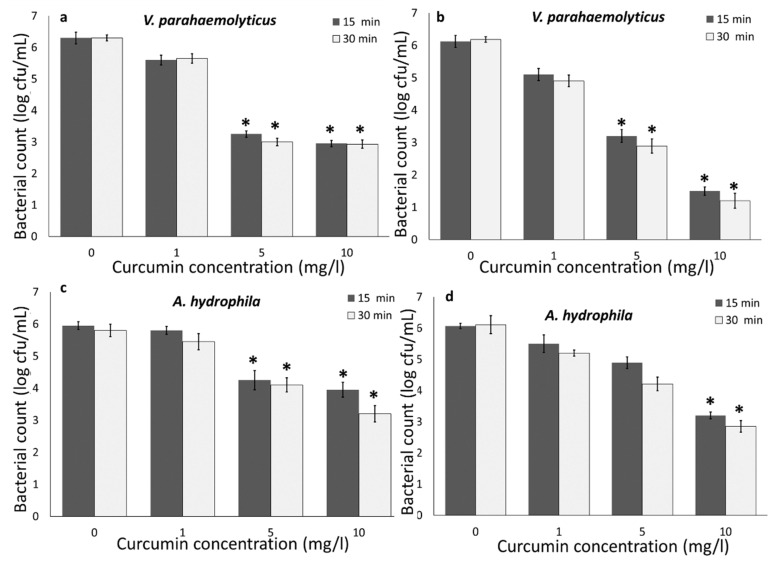
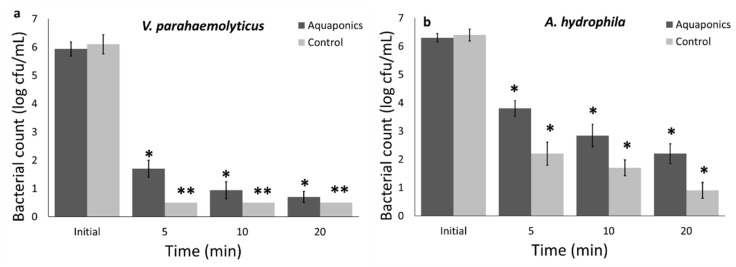
The antimicrobial efficacy of novel photodynamic inactivation and nanobubble technologies was evaluated against and as two important aquatic microbial pathogens. Photodynamic inactivation results showed that LED (470 nm) and UV-A (400 nm)-activated curcumin caused a complete reduction in at 4 and 22 °C, and a greater than 2 log cfu/mL reduction in , which was curcumin concentration-dependent ( < 0.05). Furthermore, the photodynamic approach caused a greater than 6 log cfu/mL reduction and more than 4 log cfu/mL of reduction in aquaponic water samples ( < 0.05). Our results with the nanobubble technology showed that the nanobubbles alone did not significantly reduce bacteria ( > 0.05). However, a greater than 6 log cfu/mL reduction and a greater than 3 log cfu/mL of reduction were achieved when nanobubble technology was combined with ultrasound ( < 0.05). The findings described in this study illustrate the potential of applying photodynamic inactivation and nanobubble-ultrasound antimicrobial approaches as alternative novel methods for inactivating fish and shellfish pathogens.
评估了新型光动力灭活和纳米气泡技术对两种重要的水生微生物病原体([此处原文缺失两种病原体名称])的抗菌效果。光动力灭活结果表明,LED(470纳米)和UV-A(400纳米)激活的姜黄素在4℃和22℃时可使([此处原文缺失相关菌名])完全减少,并且使([此处原文缺失相关菌名])减少超过2个对数菌落形成单位/毫升,这与姜黄素浓度相关(P<0.05)。此外,光动力方法使水培水样中的([此处原文缺失相关菌名])减少超过6个对数菌落形成单位/毫升,([此处原文缺失相关菌名])减少超过4个对数菌落形成单位/毫升(P<0.05)。我们使用纳米气泡技术的结果表明,单独的纳米气泡不会显著减少细菌数量(P>0.05)。然而,当纳米气泡技术与超声联合使用时,([此处原文缺失相关菌名])减少超过6个对数菌落形成单位/毫升,([此处原文缺失相关菌名])减少超过3个对数菌落形成单位/毫升(P<0.05)。本研究中描述的结果说明了应用光动力灭活和纳米气泡-超声抗菌方法作为灭活鱼类和贝类病原体的替代新方法的潜力。