Martínez-González Nahara Anani, Keizer Ellen, Plate Andreas, Coenen Samuel, Valeri Fabio, Verbakel Jan Yvan Jos, Rosemann Thomas, Neuner-Jehle Stefan, Senn Oliver
Institute of Primary Care, University of Zurich and University Hospital of Zurich, Pestalozzistrasse 24, CH-8091 Zurich, Switzerland.
Department of Health Sciences and Medicine, University of Lucerne, Frohburgstrasse 3, PO Box 4466, CH-6002 Lucerne, Switzerland.
Antibiotics (Basel). 2020 Sep 16;9(9):610. doi: 10.3390/antibiotics9090610.
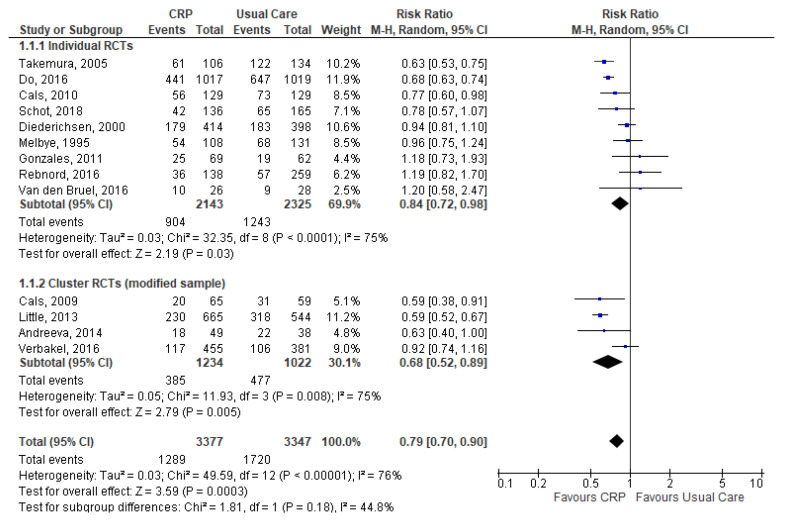
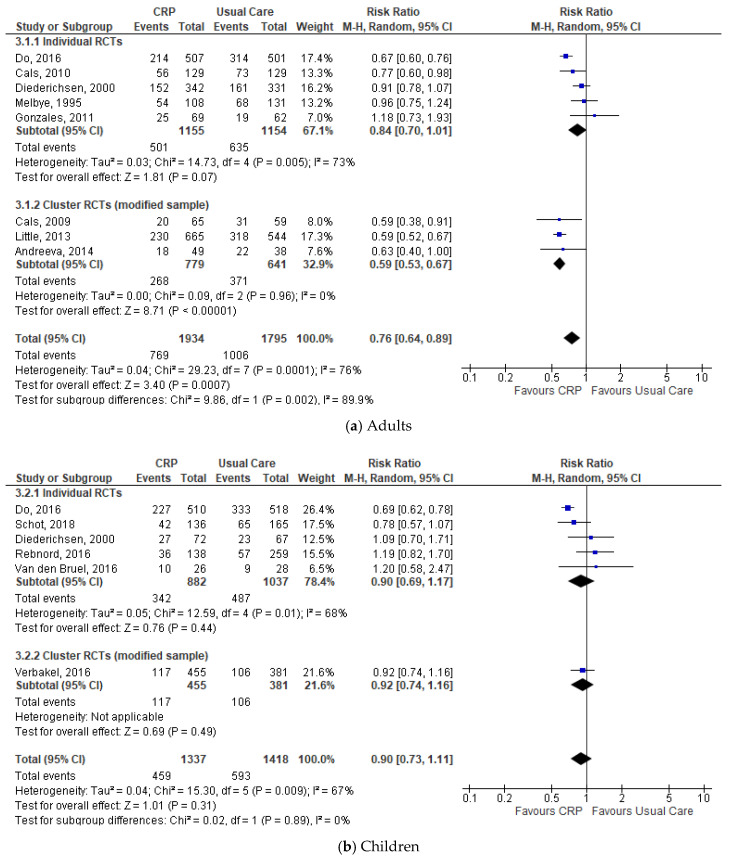
C-reactive protein (CRP) point-of-care testing (POCT) is increasingly being promoted to reduce diagnostic uncertainty and enhance antibiotic stewardship. In primary care, respiratory tract infections (RTIs) are the most common reason for inappropriate antibiotic prescribing, which is a major driver for antibiotic resistance. We systematically reviewed the available evidence on the impact of CRP-POCT on antibiotic prescribing for RTIs in primary care. Thirteen moderate to high-quality studies comprising 9844 participants met our inclusion criteria. Meta-analyses showed that CRP-POCT significantly reduced immediate antibiotic prescribing at the index consultation compared with usual care (RR 0.79, 95%CI 0.70 to 0.90, = 0.0003, I = 76%) but not during 28-day ( = 7) follow-up. The immediate effect was sustained at 12 months ( = 1). In children, CRP-POCT reduced antibiotic prescribing when CRP (cut-off) guidance was provided ( = 2). Meta-analyses showed significantly higher rates of re-consultation within 30 days ( = 8, 1 significant). Clinical recovery, resolution of symptoms, and hospital admissions were not significantly different between CRP-POCT and usual care. CRP-POCT can reduce immediate antibiotic prescribing for RTIs in primary care (number needed to (NNT) for benefit = 8) at the expense of increased re-consultations (NNT for harm = 27). The increase in re-consultations and longer-term effects of CRP-POCT need further evaluation. Overall, the benefits of CRP-POCT outweigh the potential harms (NNTnet = 11).
即时检测C反应蛋白(CRP)越来越多地被推广以减少诊断的不确定性并加强抗生素管理。在初级医疗保健中,呼吸道感染(RTIs)是不适当开具抗生素处方的最常见原因,而这是抗生素耐药性的一个主要驱动因素。我们系统地回顾了关于CRP即时检测对初级医疗保健中RTIs抗生素处方影响的现有证据。13项包括9844名参与者的中高质量研究符合我们的纳入标准。荟萃分析表明,与常规护理相比,CRP即时检测在初次会诊时显著减少了即时抗生素处方(RR 0.79,95%CI 0.70至0.90,P = 0.0003,I² = 76%),但在28天(n = 7)随访期间并非如此。即时效果在12个月时持续存在(n = 1)。在儿童中,当提供CRP(临界值)指导时,CRP即时检测减少了抗生素处方(n = 2)。荟萃分析显示30天内再次会诊的发生率显著更高(n = 8,1项显著)。CRP即时检测和常规护理在临床恢复、症状缓解及住院方面无显著差异。CRP即时检测可减少初级医疗保健中RTIs的即时抗生素处方(获益所需治疗人数(NNT) = 8),代价是再次会诊增加(危害所需治疗人数(NNT) = 27)。CRP即时检测导致的再次会诊增加及长期影响需要进一步评估。总体而言,CRP即时检测的益处超过潜在危害(净NNT = 11)。