Department of Global Health and Social Medicine, Harvard Medical School, 641 Huntington Avenue, Boston, MA, USA.
Partners In Health / Socios En Salud, Lima, Peru.
BMC Infect Dis. 2020 Sep 18;20(1):686. doi: 10.1186/s12879-020-05416-6.
There is limited research to guide TB treatment specifically in pregnant women and few studies have described the presentation of TB in pregnant women. We aimed to understand TB presentation and treatment outcomes in pregnant women in a low HIV burden setting. We describe a cohort of women of childbearing age treated for TB disease in Lima, Peru, and compare clinical presentation and treatment outcomes among pregnant and non-pregnant women between 2009 and 2012, including 36 pregnant women.
This is a prospective cohort study. Subjects were recruited from across 106 public health centers in Lima, Peru. Baseline demographic, medical history, and drug-susceptibility test results were collected. We used descriptive statistics to describe demographic and clinical characteristics of the women using Pearson chi-squared, Fisher's exact tests, or Kruskal-Wallis.
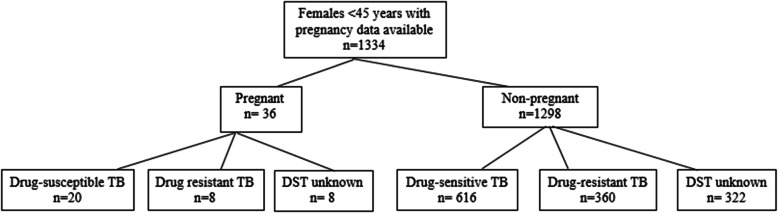
Among 4500 individuals with pulmonary TB disease, 1334 women were included in analysis with 36 (2.69%) pregnant women. Pregnant women had similar demographics, past medical histories, and clinical presentation to non-pregnant women, except being more likely to be married (p = 0.01) and have cardiac disease (p = 0.04) and less likely to have weight loss (p = 0.05). Twenty (71.4%) pregnant women had pan-susceptible TB compared with 616 (63.1%) non-pregnant women; four (14.3%) pregnant women had mono-resistant TB compared with 154 (15.8%) non-pregnant women; and four (14.3%) pregnant women had multi-drug-resistant TB compared with 140 (14.3%) of non-pregnant women (p = 0.53). Twenty-eight (96.6%) pregnant women had a successful outcome (cure, completed treatment, treatment ended early by clinical team) while one (3.4%) had an unsuccessful outcome (treatment failed) and 1074 (97.3%) non-pregnant women had a successful outcome while 30 (2.7%) had an unsuccessful outcome (p = 0.56).
In this cohort with low HIV co-infection, we found high TB treatment success rates in both pregnant and non-pregnant women, irrespective of drug-susceptibility profiles. If treated appropriately, pregnant women with TB disease can have successful outcomes.
针对孕妇的结核病治疗的相关研究十分有限,且鲜有研究描述孕妇结核病的临床表现。我们旨在了解在低艾滋病毒负担环境下孕妇结核病的临床表现和治疗结局。我们描述了在秘鲁利马的一个育龄妇女结核病治疗队列,并比较了 2009 年至 2012 年间孕妇和非孕妇的临床表现和治疗结局,其中包括 36 名孕妇。
这是一项前瞻性队列研究。研究对象来自秘鲁利马的 106 个公共卫生中心。收集了基线人口统计学、病史和药敏试验结果。我们使用描述性统计来描述女性的人口统计学和临床特征,使用 Pearson 卡方检验、Fisher 确切检验或 Kruskal-Wallis 检验。
在 4500 名患有肺结核的个体中,有 1334 名女性被纳入分析,其中 36 名(2.69%)为孕妇。与非孕妇相比,孕妇的人口统计学、既往病史和临床表现相似,但更有可能已婚(p=0.01),患有心脏病(p=0.04),体重减轻的可能性更小(p=0.05)。20 名(71.4%)孕妇为全敏感结核病,616 名(63.1%)非孕妇为全敏感结核病;4 名(14.3%)孕妇为单耐药结核病,154 名(15.8%)非孕妇为单耐药结核病;4 名(14.3%)孕妇为耐多药结核病,140 名(14.3%)非孕妇为耐多药结核病(p=0.53)。28 名(96.6%)孕妇治疗结局成功(治愈、完成治疗、治疗团队提前终止),1 名(3.4%)治疗结局失败,1074 名(97.3%)非孕妇治疗结局成功,30 名(2.7%)治疗结局失败(p=0.56)。
在本队列中,艾滋病毒合并感染率低,我们发现无论药敏谱如何,孕妇和非孕妇的结核病治疗成功率均较高。如果治疗得当,患有结核病的孕妇可以获得成功的治疗结局。