Aakjær Andersen Camilla, Brodersen John, Davidsen Annette Sofie, Graumann Ole, Jensen Martin Bach B
Center for General Practice, Aalborg University, Aalborg, Denmark
Research Unit for General Practice and Section of General Practice, Department of Public Health, Faculty of Health Sciences, University of Copenhagen, Copenhagen, Denmark.
BMJ Open. 2020 Sep 17;10(9):e037664. doi: 10.1136/bmjopen-2020-037664.
To describe how general practitioners (GPs) use point-of-care ultrasonography (POCUS) and how it influences the diagnostic process and treatment of patients.
Prospective observational study using an online questionnaire before and after POCUS.
Office-based general practice.
Twenty GPs consecutively recruited all patients examined with POCUS in 1 month.
We estimated the use of POCUS through the indication for use, the frequency of use, the time consumption, the extent of modification of the examination and the findings.The influence on the diagnostic process was estimated through change in the tentative diagnoses, change in confidence, the ability to produce ultrasound images and the relationship between confidence and organs scanned or tentative diagnoses.The influence of POCUS on patient treatment was estimated through change in plan for the patient, change in patient's treatment and the relationship between such changes and certain findings.
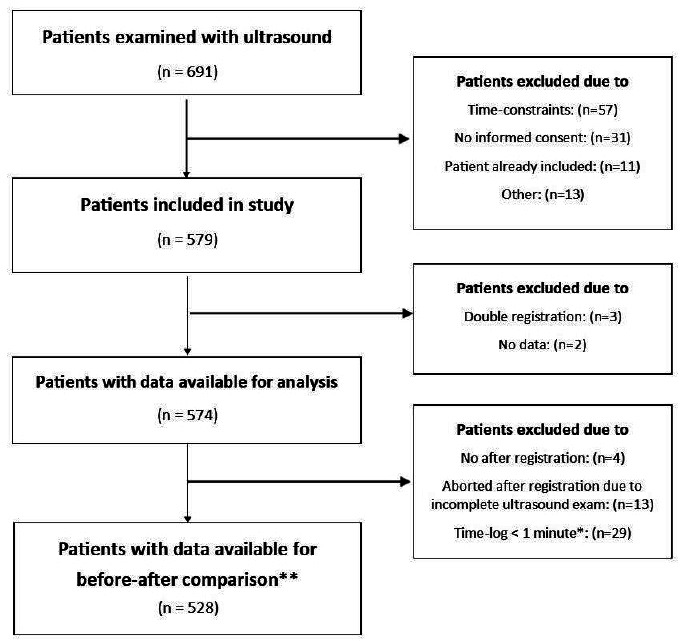
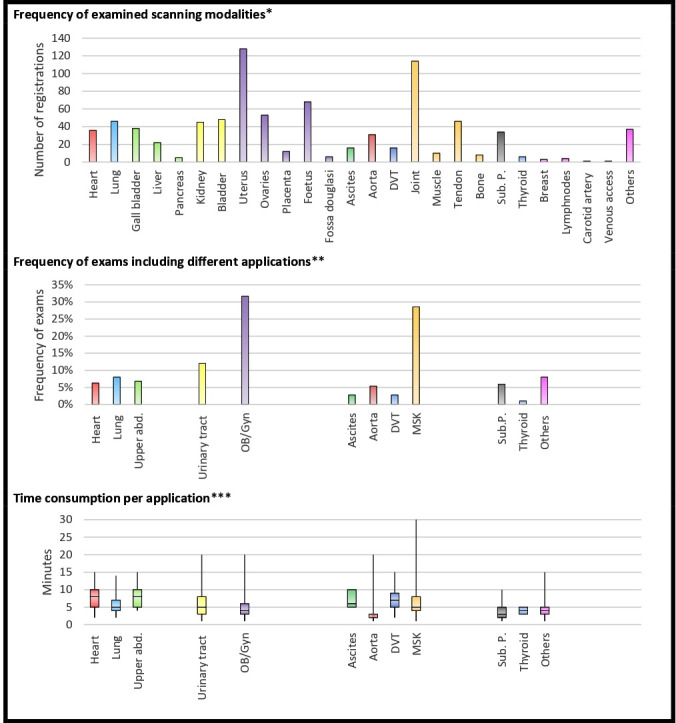
The GPs included 574 patients in the study. POCUS was used in patient consultations with a median frequency of 8.6% (IQR: 4.9-12.6). Many different organs were scanned covering more than 100 different tentative diagnoses. The median time taken to perform POCUS was 5 min (IQR: 3-8). Across applications and GPs, POCUS entailed a change in diagnoses in 49.4% of patients; increased confidence in a diagnosis in 89.2% of patients; a change in the management plan for 50.9% of patients including an absolute reduction in intended referrals to secondary care from 49.2% to 25.6%; and a change in treatment for 26.5% of patients.
The clinical utilisation of POCUS was highly variable among the GPs included in this study in terms of the indication for performing POCUS, examined scanning modalities and frequency of use. Overall, using POCUS altered the GPs' diagnostic process and clinical decision-making in nearly three out of four consultations.
NCT03375333.
描述全科医生(GP)如何使用即时超声检查(POCUS)以及它如何影响患者的诊断过程和治疗。
在POCUS前后使用在线问卷进行前瞻性观察研究。
基于办公室的全科医疗。
20名全科医生在1个月内连续招募了所有接受POCUS检查的患者。
我们通过使用指征、使用频率、时间消耗、检查修改程度和检查结果来评估POCUS的使用情况。通过初步诊断的变化、信心的变化、生成超声图像的能力以及信心与扫描器官或初步诊断之间的关系来评估对诊断过程的影响。通过患者治疗计划的变化、患者治疗的变化以及这些变化与某些检查结果之间的关系来评估POCUS对患者治疗的影响。
全科医生在研究中纳入了574名患者。POCUS在患者会诊中的使用频率中位数为8.6%(四分位间距:4.9 - 12.6)。扫描了许多不同的器官,涵盖100多种不同的初步诊断。进行POCUS的中位时间为5分钟(四分位间距:3 - 8)。在所有应用和全科医生中,POCUS使49.4%的患者诊断发生了变化;89.2%的患者对诊断的信心增强;50.9%的患者治疗管理计划发生了变化,包括转诊至二级医疗的预期绝对比例从49.2%降至25.6%;26.5%的患者治疗发生了变化。
在本研究纳入的全科医生中,POCUS的临床应用在进行POCUS的指征、检查扫描方式和使用频率方面差异很大。总体而言,使用POCUS在近四分之三的会诊中改变了全科医生的诊断过程和临床决策。
NCT03375333。