Mchome Bariki, Swai Patricia, Wu Chunsen, Katanga Johnson, Kahesa Crispin, Manongi Rachel, Mwaiselage Julius D, Kjaer Susanne, Rasch Vibeke, Linde Ditte Søndergaard
Department of Obstetrics and Gynaecology, Kilimanjaro Christian Medical Centre, Moshi, United Republic of Tanzania.
Department of Clinical Research, University of Southern Denmark, Odense, Denmark.
BMJ Open. 2020 Sep 18;10(9):e038531. doi: 10.1136/bmjopen-2020-038531.
Cervical cancer is a major cause of death among women in Eastern Africa, and the distribution of human papillomavirus (HPV) according to HIV status is inadequately characterised in this region. In order to guide future cervical cancer preventive strategies that involve HPV testing, the Comprehensive Cervical Cancer Prevention in Tanzania (CONCEPT) study was established in 2015. The CONCEPT cohort aims to investigate the natural history of HPV and determine acquisition and persistence patterns of high-risk (HR) HPV among HIV-positive and HIV-negative women. Further, the influence of lifestyle and sexual/reproductive factors will be investigated. The main objective of this article is to describe how the CONCEPT cohort was established.
Women aged 25-60 years were enrolled from cervical cancer screening clinics in Dar-es-Salaam and Moshi, Tanzania. Data were collected at baseline, at 14 months (first follow-up) and at 28 months (second follow-up). Biological samples included two cervical swabs for HPV DNA testing, cytology, Hybrid Capture 2, genotyping and blood samples for HIV. Visual inspection with acetic acid was performed, and sociodemographic, lifestyle and sexual/reproductive characteristics were collected through a standardised questionnaire.
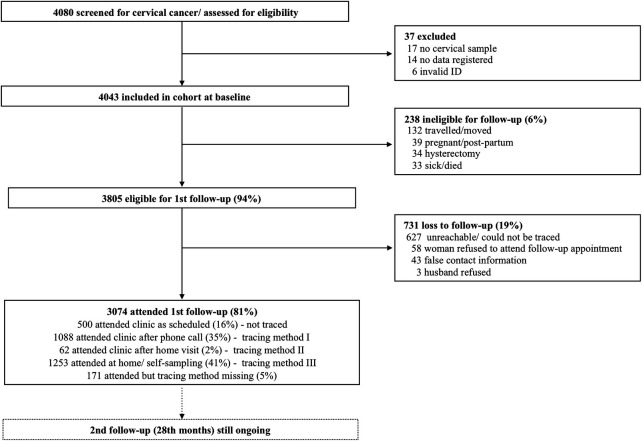
4043 women were included in the cohort from August 2015 to May 2017. At baseline, 696 (17.1%) women were HR HPV positive, and among these, 31.6% were HIV positive; 139 women (3.4%) had high-grade squamous intraepithelial lesions. 3074 women (81%) attended the first follow-up. The majority attended after receiving a phone call reminder (35%) or from home via self-samples (41%). At first follow-up, 438 (14.4%) were HR HPV positive and 30.4% of these were HIV positive.
A second follow-up is underway (17 December 2018-October 2020). We plan to integrate our data with a previous cross-sectional HPV study from Tanzania to increase the power of our findings. Researchers interested in collaborating are welcomed, either by extracting data or jointly requesting further investigation from the cohort.
宫颈癌是东非女性死亡的主要原因,而该地区根据艾滋病毒感染状况对人乳头瘤病毒(HPV)分布的特征描述尚不充分。为指导未来涉及HPV检测的宫颈癌预防策略,2015年开展了坦桑尼亚宫颈癌综合预防(CONCEPT)研究。CONCEPT队列旨在研究HPV的自然史,并确定HIV阳性和HIV阴性女性中高危(HR)HPV的感染和持续模式。此外,还将研究生活方式以及性/生殖因素的影响。本文的主要目的是描述CONCEPT队列是如何建立的。
年龄在25至60岁之间的女性从坦桑尼亚达累斯萨拉姆和莫希的宫颈癌筛查诊所招募。在基线、14个月(首次随访)和28个月(第二次随访)时收集数据。生物样本包括两支用于HPV DNA检测、细胞学检查、杂交捕获2检测、基因分型的宫颈拭子以及用于艾滋病毒检测的血液样本。进行了醋酸肉眼检查,并通过标准化问卷收集了社会人口统计学、生活方式以及性/生殖特征。
2015年8月至2017年5月,4043名女性被纳入该队列。在基线时,696名(17.1%)女性HR HPV呈阳性,其中31.6%为HIV阳性;139名女性(3.4%)患有高级别鳞状上皮内病变。3074名女性(81%)参加了首次随访。大多数人是在接到电话提醒后(35%)或通过自行在家提供样本(41%)参加的。在首次随访时,438名(14.4%)为HR HPV阳性,其中30.4%为HIV阳性。
第二次随访正在进行中(2018年12月17日至2020年10月)。我们计划将我们的数据与坦桑尼亚之前的一项HPV横断面研究的数据相结合,以增强我们研究结果的说服力。欢迎有兴趣合作的研究人员,要么提取数据,要么联合要求对该队列进行进一步调查。