Department of Cancer Prevention Services, Ocean Road Cancer Institute, Dar es Salaam, United Republic of Tanzania.
Unit of Virus, Lifestyle and Genes, Danish Cancer Society Research Center, Copenhagen, Denmark.
Int J Cancer. 2023 Feb 15;152(4):686-696. doi: 10.1002/ijc.34283. Epub 2022 Sep 22.
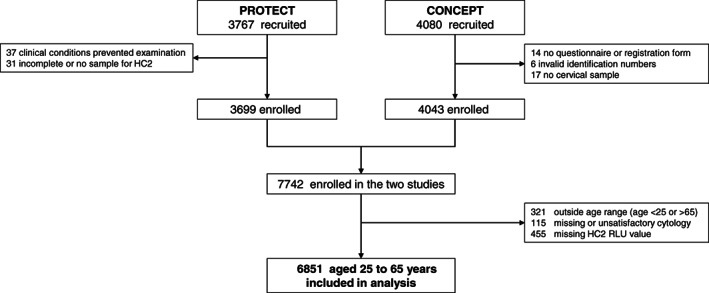
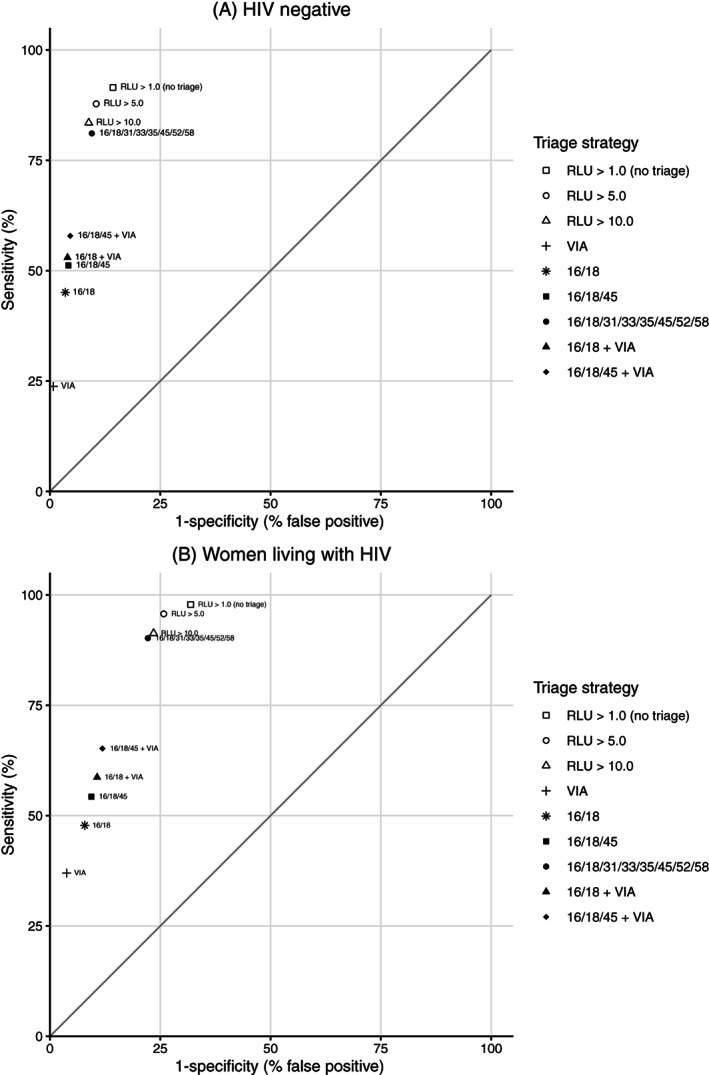
Cervical cancer is the most common female cancer in Eastern Africa, and the World Health Organization (WHO) recommends human papillomavirus (HPV)-based screening as a key element to eliminate the disease. In this cross-sectional study from Tanzania, we compared nine HPV-based cervical cancer screening strategies, including HPV testing at standard cut-off; HPV testing at increased viral load cut-offs; HPV testing with partial/extended genotyping, and HPV testing with visual inspection with acetic acid (VIA). We pooled data collected during 2008 to 2009 and 2015 to 2017 from 6851 women aged 25 to 65. Cervical cytology samples were HPV tested with Hybrid Capture 2, and HPV positive samples were genotyped with INNO-LiPA Extra II. Human immunodeficiency virus (HIV) testing and VIA were done according to local standards. We calculated sensitivity, specificity, positive and negative predictive value of screening strategies, with high-grade cytological lesions as reference, separately for women with and without HIV. HPV testing at standard cut-off (1.0 relative light units [RLU]) had highest sensitivity (HIV+: 97.8%; HIV-: 91.5%), but moderate specificity (HIV+: 68.1%; HIV-: 85.7%). Increasing the cut-off for HPV positivity to higher viral loads (5.0/10.0 RLU) increased specificity (HIV+: 74.2%-76.5%; HIV-: 89.5%-91.2%), with modest sensitivity reductions (HIV+: 91.3%-95.7%; HIV-: 83.5%-87.8%). Limiting test positivity to HPV types 16/18/31/33/35/45/52/58 improved specificity while maintaining high sensitivity (HIV+: 90.2%; HIV-: 81.1%). Triage with VIA and/or partial genotyping for HPV16/18 or HPV16/18/45 had low sensitivities (≤65%). In conclusion, HPV testing alone, or HPV testing with extended genotyping or increased viral load cut-offs, may improve cervical cancer screening in Sub-Saharan Africa.
在东非,宫颈癌是最常见的女性癌症,世界卫生组织(WHO)建议将人乳头瘤病毒(HPV)检测作为消除该疾病的关键手段。在坦桑尼亚进行的这项横断面研究中,我们比较了九种基于 HPV 的宫颈癌筛查策略,包括使用标准截断值进行 HPV 检测;使用增加的病毒载量截断值进行 HPV 检测;HPV 检测联合部分/扩展基因分型,以及 HPV 检测联合醋酸视觉检查(VIA)。我们汇总了 2008 年至 2009 年和 2015 年至 2017 年期间,来自 6851 名年龄在 25 至 65 岁之间的女性的数据。采用杂交捕获 2 法对宫颈细胞学样本进行 HPV 检测,对 HPV 阳性样本采用 INNO-LiPA Extra II 进行基因分型。根据当地标准进行人类免疫缺陷病毒(HIV)检测和 VIA。我们计算了以高级别细胞学病变为参照的筛查策略的敏感性、特异性、阳性和阴性预测值,分别针对 HIV 阳性和 HIV 阴性女性。使用标准截断值(1.0 相对光单位[RLU])进行 HPV 检测的敏感性最高(HIV+:97.8%;HIV-:91.5%),但特异性中等(HIV+:68.1%;HIV-:85.7%)。将 HPV 阳性的截断值提高到更高的病毒载量(5.0/10.0 RLU)会提高特异性(HIV+:74.2%-76.5%;HIV-:89.5%-91.2%),同时敏感性略有下降(HIV+:91.3%-95.7%;HIV-:83.5%-87.8%)。将 HPV 检测的阳性结果限制在 HPV 16/18/31/33/35/45/52/58 型可以提高特异性,同时保持高敏感性(HIV+:90.2%;HIV-:81.1%)。VIA 和/或 HPV16/18 或 HPV16/18/45 部分基因分型的分流检测敏感性较低(≤65%)。总之,在撒哈拉以南非洲,单独使用 HPV 检测或 HPV 检测联合扩展基因分型或增加病毒载量截断值可能会改善宫颈癌筛查。