Hu Zhi-Lei, Li Hai-Yin, Chang Xian, Li Yue-Yang, Liu Chen-Hao, Gao Xiao-Xin, Zhai Yu, Chen Yu-Xuan, Li Chang-Qing
Department of Orthopedics, Xinqiao Hospital, Army Military Medical University, Chongqing 400037, China.
Center of Traumatic Orthopedics, People's Liberation Army 990 Hospital, Xinyang 46400, Henan Province, China.
World J Stem Cells. 2020 Aug 26;12(8):803-813. doi: 10.4252/wjsc.v12.i8.803.
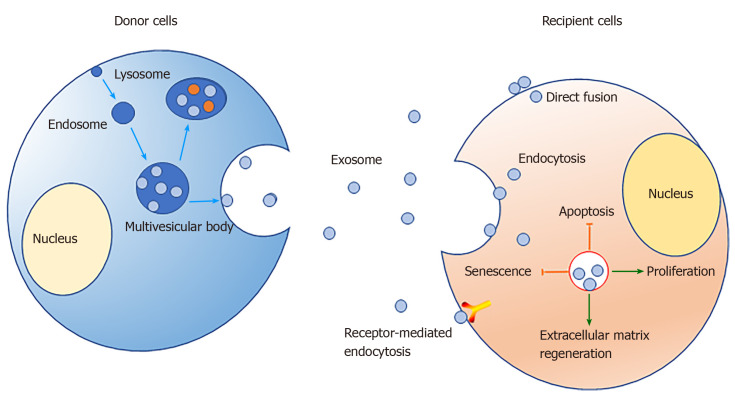
Intervertebral disc (IVD) degenerative diseases are a common problem in the world, and they cause substantial social and economic burdens for people. The current methods for treating IVD degenerative diseases mainly include surgery and conservative treatment, which cannot fundamentally restore the normal structure of the disc. With continuous research on the mechanism of degeneration and the development of regenerative medicine, rapid progress has been made in the field of regenerative medicine regarding the use of stem cell-derived exosomes, which are active biological substances used in intercellular communication, because they show a strong effect in promoting tissue regeneration. The study of exosomes in the field of IVD degeneration has just begun, and many surprising achievements have been made. This paper mainly reviews the biological characteristics of exosomes and highlights the current status of exosomes in the field of IVD degeneration, as well as future developments regarding exosomes.
椎间盘退变疾病是全球范围内的常见问题,给人们带来了巨大的社会和经济负担。目前治疗椎间盘退变疾病的方法主要包括手术和保守治疗,但这些方法无法从根本上恢复椎间盘的正常结构。随着对退变机制研究的不断深入以及再生医学的发展,在再生医学领域,利用干细胞来源的外泌体取得了快速进展,外泌体作为参与细胞间通讯的活性生物物质,在促进组织再生方面显示出强大作用。外泌体在椎间盘退变领域的研究刚刚起步,已经取得了许多令人瞩目的成果。本文主要综述外泌体的生物学特性,重点介绍外泌体在椎间盘退变领域的研究现状以及未来发展方向。