de Kort Gijs W, Bouvrie Luciënne H C, Rastogi Sanjay, Wilsens Carolus H R M
Aachen-Maastricht Institute for Biobased Materials (AMIBM), Faculty of Science and Engineering, Maastricht University, Urmonderbaan 22, 6167 RD Geleen, The Netherlands.
ACS Sustain Chem Eng. 2020 Jan 13;8(1):624-631. doi: 10.1021/acssuschemeng.9b06305. Epub 2019 Dec 10.
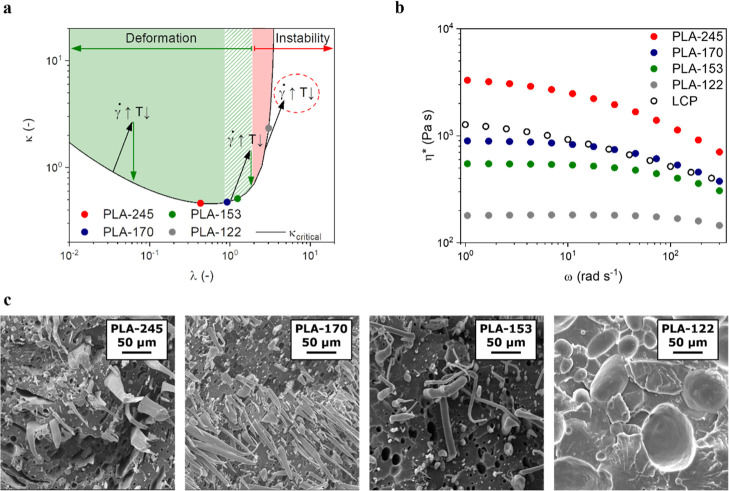
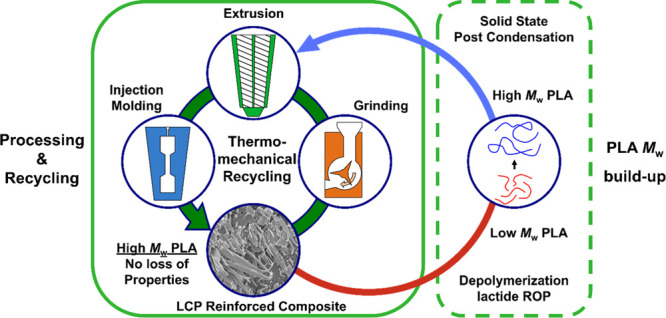
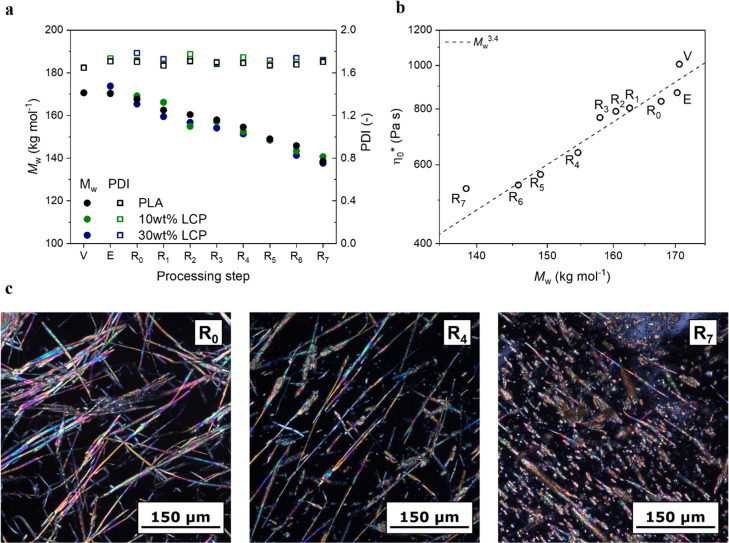
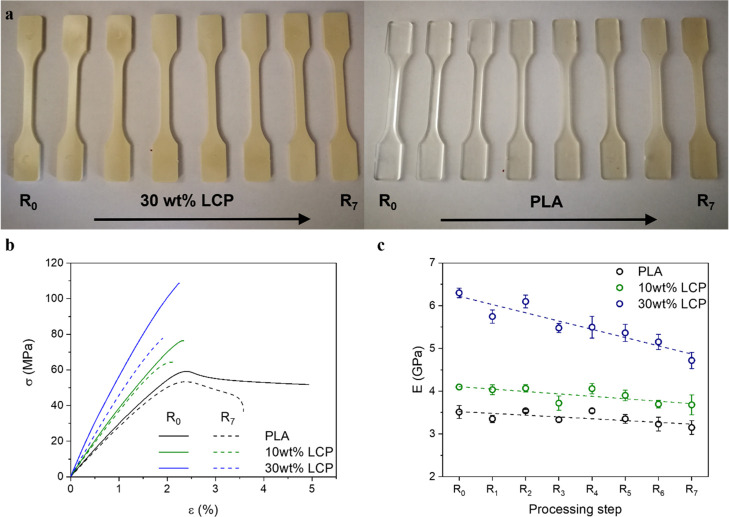
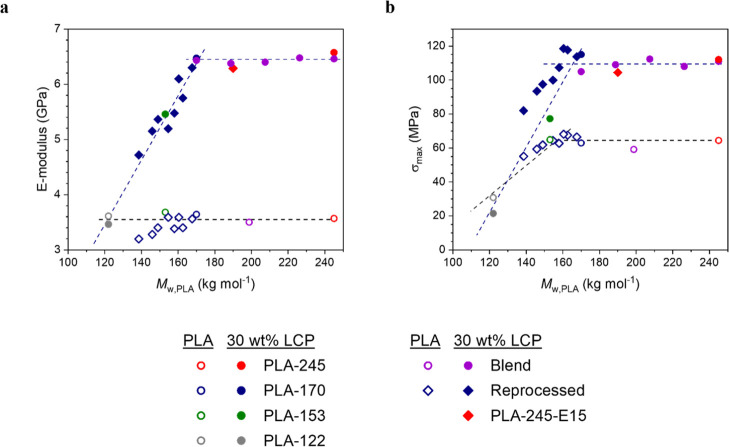
Reprocessing of reinforced composites is generally accompanied by loss of value and performance, as normally the reinforcing phase is damaged, or the matrix is lost in the process. In the search for more sustainable recyclable composite materials, we identify blends based on poly(l-lactide) (PLA) and thermotropic liquid crystalline polymers (LCP) as highly promising self-reinforced thermoplastic composites that can be recycled several times without loss in mechanical properties. For example, irrespective of the thermal history of the blend, injection molded bars of PLA containing 30 wt % LCP exhibit a tensile modulus of 6.4 GPa and tensile strength around 110 MPa, as long as the PLA matrix has a molecular weight of 170 kg mol or higher. However, after several mechanical reprocessing steps, with the gradual decrease in the molecular weight of the PLA matrix, deterioration of the mechanical performance is observed. The origin of this behavior is found in the increasing LCP to PLA viscosity ratio: at a viscosity ratio below unity, the dispersed LCP droplets are effectively deformed into the desired fibrillar morphology during injection molding. However, deformation of LCP droplets becomes increasingly challenging when the viscosity ratio exceeds unity (i.e., when the PLA matrix viscosity decreases during consecutive reprocessing), eventually resulting in a nodular morphology, a poor molecular orientation of the LCP phase, and deterioration of the mechanical performance. This molecular weight dependency effectively places a limit on the maximum number of mechanical reprocessing steps before chemical upgrading of the PLA phase is required. Therefore, a feasible route to maintain or enhance the mechanical properties of the blend, independent of the number of reprocessing cycles, is proposed.
增强复合材料的再加工通常伴随着价值和性能的损失,因为通常增强相在过程中会受损,或者基体流失。在寻找更具可持续性的可回收复合材料时,我们发现基于聚(L-丙交酯)(PLA)和热致液晶聚合物(LCP)的共混物是非常有前景的自增强热塑性复合材料,它们可以多次回收而不会损失机械性能。例如,无论共混物的热历史如何,只要PLA基体的分子量为170 kg/mol或更高,含有30 wt% LCP的PLA注塑棒材的拉伸模量为6.4 GPa,拉伸强度约为110 MPa。然而,经过几个机械再加工步骤后,随着PLA基体分子量的逐渐降低,会观察到机械性能的劣化。这种行为的根源在于LCP与PLA粘度比的增加:当粘度比低于1时,在注塑过程中,分散的LCP液滴会有效地变形为所需的纤维状形态。然而,当粘度比超过1时(即连续再加工过程中PLA基体粘度降低时),LCP液滴的变形变得越来越困难,最终导致结节状形态、LCP相分子取向不良以及机械性能劣化。这种分子量依赖性有效地限制了在需要对PLA相进行化学升级之前机械再加工步骤的最大数量。因此,提出了一种可行的途径,以保持或增强共混物的机械性能,而与再加工循环次数无关。