Subramanian Priyadarsani, Kumar Hemanth, Tiwari Bipin, Barwad Adarsh, Bagchi Soumita, Bagga Arvind, Agarwal Sanjay Kumar, Dinda Amit Kumar, Singh Geetika
Department of Pathology, All India Institute of Medical Sciences, New Delhi, India.
Department of Nephrology, All India Institute of Medical Sciences, New Delhi, India.
Kidney Int Rep. 2020 Jul 2;5(9):1551-1557. doi: 10.1016/j.ekir.2020.06.024. eCollection 2020 Sep.
The majority of primary membranous nephropathy (MN) cases are no longer considered idiopathic with the discovery of the podocytic autoantigens: phospholipase A2 receptor (PLA2R) and thrombospondin type 1 domain-containing 7A (THSD7A). Limited data on PLA2R-related MN in Indians exist in literature, and THSD7A-related MN remains undocumented in this population. We aimed to characterize the baseline PLA2R and THSD7A profile of adult and pediatric membranous nephropathy (MN) in a large Indian single-institution cohort.
A retrospective analysis of all cases of MN (primary and secondary) between 2014 and 2017 was performed with PLA2R direct immunofluorescence and THSD7A immunohistochemistry on the biopsies and anti-PLA2R enzyme-linked immunosorbent assay (ELISA) on baseline sera.
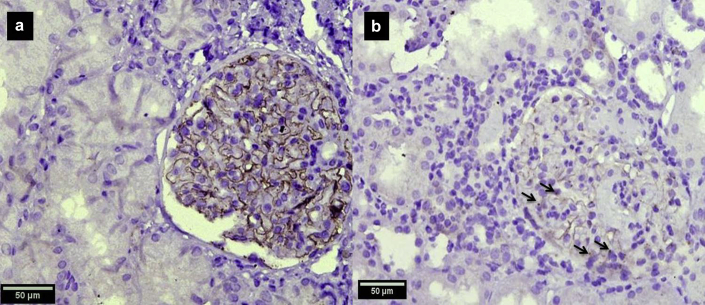
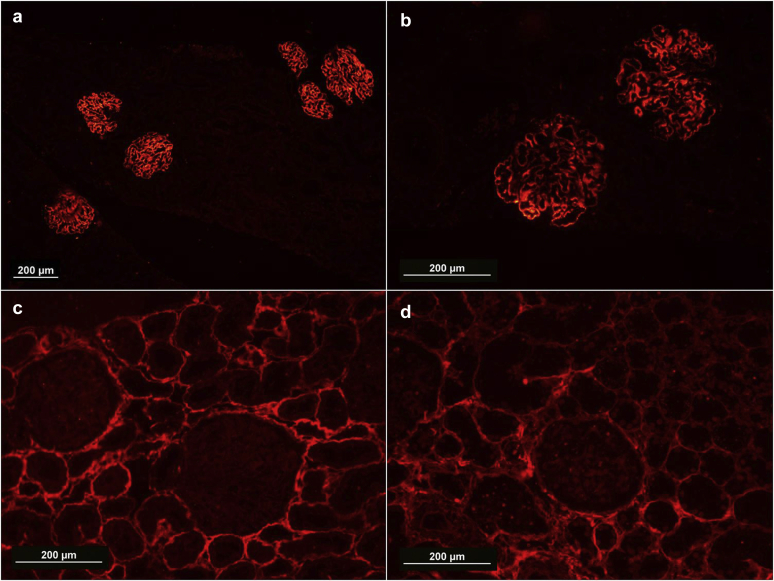
MN constituted 10% of kidney biopsies received in the study period. A total of 216 cases with adequate tissue underwent PLA2R direct immunofluorescence, and 110 of them had available sera for PLA2R ELISA. Combining both testing methods, the prevalence of PLA2R-related primary MN was 72.8%, with moderate concordance between the 2 methods (kappa 0.61). PLA2R was also detected in 16.7% cases of secondary MN, most commonly lupus MN. THSD7A immunohistochemistry performed on 176 cases showed a prevalence of 3.4% in primary MN. One case of lupus MN was also positive for THSD7A. Dual positivity (PLA2R and THSD7A) was noted in 2 cases. The large pediatric cohort tested showed a prevalence of 44% of PLA2R based on tissue testing, whereas 1 case demonstrated THSD7A positivity.
This study in a large cohort of Indian patients demonstrates prevalence rates of PLA2R- and THSD7A-related MN similar to world literature, including the substantial cohort of pediatric MN. It also confirms variation in MN in the form of outliers within PLA2R (related to tissue and serum testing), dual positivity for PLA2R and THSD7A, and PLA2R/THSD7A-positive secondary MN.
随着足细胞自身抗原——磷脂酶A2受体(PLA2R)和含血小板反应蛋白1结构域7A(THSD7A)的发现,大多数原发性膜性肾病(MN)病例不再被认为是特发性的。关于印度人群中与PLA2R相关的MN的数据有限,而与THSD7A相关的MN在该人群中仍无文献记载。我们旨在描述一个大型印度单机构队列中成人和儿童膜性肾病(MN)的基线PLA2R和THSD7A特征。
对2014年至2017年间所有MN(原发性和继发性)病例进行回顾性分析,对活检组织进行PLA2R直接免疫荧光和THSD7A免疫组织化学检测,并对基线血清进行抗PLA2R酶联免疫吸附测定(ELISA)。
MN占研究期间接受肾活检病例的10%。共有216例组织充足的病例进行了PLA2R直接免疫荧光检测,其中110例有可用血清进行PLA2R ELISA检测。结合两种检测方法,与PLA2R相关的原发性MN患病率为72.8%,两种方法之间有中度一致性(kappa 0.61)。在16.7%的继发性MN病例中也检测到PLA2R,最常见的是狼疮性MN。对176例病例进行的THSD7A免疫组织化学检测显示原发性MN患病率为3.4%。1例狼疮性MN的THSD7A也呈阳性。2例病例出现双重阳性(PLA2R和THSD7A)。对大型儿童队列进行检测显示,基于组织检测,PLA2R患病率为44%,而1例病例显示THSD7A阳性。
这项针对大量印度患者队列的研究表明,与PLA2R和THSD7A相关的MN患病率与世界文献相似,包括大量儿童MN队列。它还证实了MN存在变异,表现为PLA2R内的异常值(与组织和血清检测有关)、PLA2R和THSD7A双重阳性以及PLA2R/THSD7A阳性的继发性MN。