
运动改变海湾战争综合征和肌萎缩性脑脊髓炎/慢性疲劳综合征中的大脑激活情况。
Exercise alters brain activation in Gulf War Illness and Myalgic Encephalomyelitis/Chronic Fatigue Syndrome.
作者信息
Washington Stuart D, Rayhan Rakib U, Garner Richard, Provenzano Destie, Zajur Kristina, Addiego Florencia Martinez, VanMeter John W, Baraniuk James N
机构信息
Department of Medicine, Georgetown University Medical Center, 3900 Reservoir Rd., NW Washington, DC 20057, USA.
Department of Physiology and Biophysics, Howard University College of Medicine, Adams Building Rm 2420, 520 W Street NW, Washington, DC 20059, USA.
出版信息
Brain Commun. 2020 Aug 10;2(2):fcaa070. doi: 10.1093/braincomms/fcaa070. eCollection 2020.
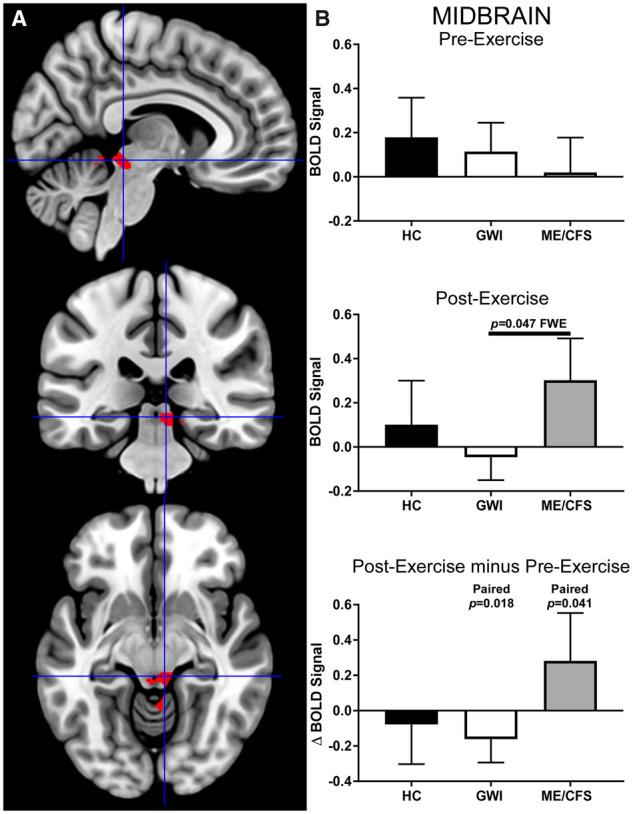
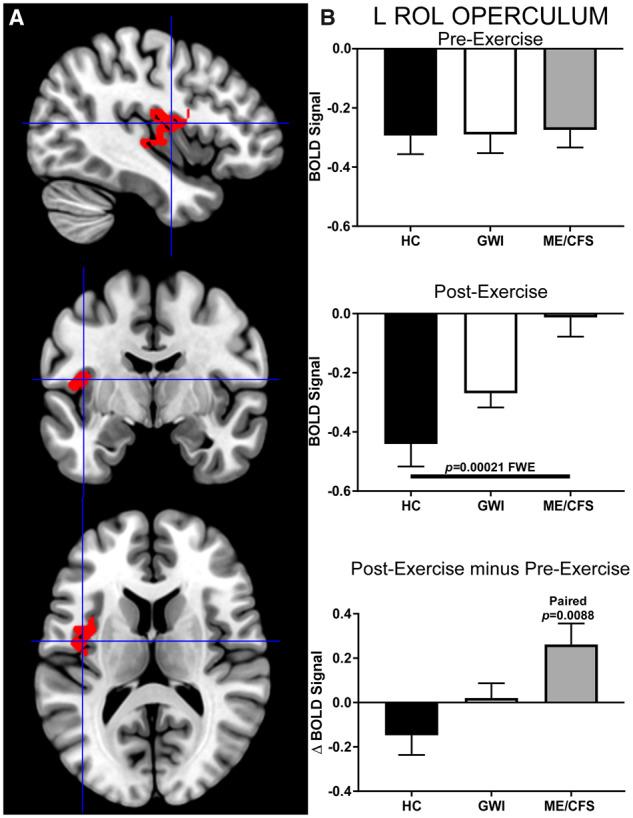
Gulf War Illness affects 25-30% of American veterans deployed to the 1990-91 Persian Gulf War and is characterized by cognitive post-exertional malaise following physical effort. Gulf War Illness remains controversial since cognitive post-exertional malaise is also present in the more common Myalgic Encephalomyelitis/Chronic Fatigue Syndrome. An objective dissociation between neural substrates for cognitive post-exertional malaise in Gulf War Illness and Myalgic Encephalomyelitis/Chronic Fatigue Syndrome would represent a biological basis for diagnostically distinguishing these two illnesses. Here, we used functional magnetic resonance imaging to measure neural activity in healthy controls and patients with Gulf War Illness and Myalgic Encephalomyelitis/Chronic Fatigue Syndrome during an N-back working memory task both before and after exercise. Whole brain activation during working memory (2-Back > 0-Back) was equal between groups prior to exercise. Exercise had no effect on neural activity in healthy controls yet caused deactivation within dorsal midbrain and cerebellar vermis in Gulf War Illness relative to Myalgic Encephalomyelitis/Chronic Fatigue Syndrome patients. Further, exercise caused increased activation among Myalgic Encephalomyelitis/Chronic Fatigue Syndrome patients within the dorsal midbrain, left operculo-insular cortex (Rolandic operculum) and right middle insula. These regions-of-interest underlie threat assessment, pain, interoception, negative emotion and vigilant attention. As they only emerge post-exercise, these regional differences likely represent neural substrates of cognitive post-exertional malaise useful for developing distinct diagnostic criteria for Gulf War Illness and Myalgic Encephalomyelitis/Chronic Fatigue Syndrome.
海湾战争综合征影响了25%至30%被部署到1990 - 1991年海湾战争的美国退伍军人,其特征是体力活动后出现认知性运动后不适。海湾战争综合征仍存在争议,因为认知性运动后不适在更常见的肌痛性脑脊髓炎/慢性疲劳综合征中也存在。海湾战争综合征和肌痛性脑脊髓炎/慢性疲劳综合征中认知性运动后不适的神经基质之间的客观分离将代表诊断区分这两种疾病的生物学基础。在这里,我们使用功能磁共振成像来测量健康对照组、海湾战争综合征患者和肌痛性脑脊髓炎/慢性疲劳综合征患者在运动前后的N - 回溯工作记忆任务中的神经活动。运动前,各组在工作记忆期间(2 - 回溯 > 0 - 回溯)的全脑激活情况相同。运动对健康对照组的神经活动没有影响,但相对于肌痛性脑脊髓炎/慢性疲劳综合征患者,运动导致海湾战争综合征患者的中脑背侧和小脑蚓部失活。此外,运动导致肌痛性脑脊髓炎/慢性疲劳综合征患者的中脑背侧、左侧岛盖皮质(中央 operculum)和右侧岛叶中部激活增加。这些感兴趣区域是威胁评估、疼痛、内感受、负面情绪和警觉注意的基础。由于它们仅在运动后出现,这些区域差异可能代表认知性运动后不适的神经基质,有助于为海湾战争综合征和肌痛性脑脊髓炎/慢性疲劳综合征制定不同的诊断标准。




 Zotero 插件