Centre for Dementia Research, School of Health and Community Studies, Leeds Beckett University, Leeds, LS1 3HE, UK.
School of Social Sciences, Leeds Beckett University, Leeds, UK.
Support Care Cancer. 2021 May;29(5):2571-2579. doi: 10.1007/s00520-020-05735-z. Epub 2020 Sep 21.
The risks of developing cancer and dementia increase as we age; however, this comorbidity remains relatively under-researched. This study reports on the challenges that people affected by comorbid cancer and dementia face when navigating engagement with cancer treatment within secondary care.
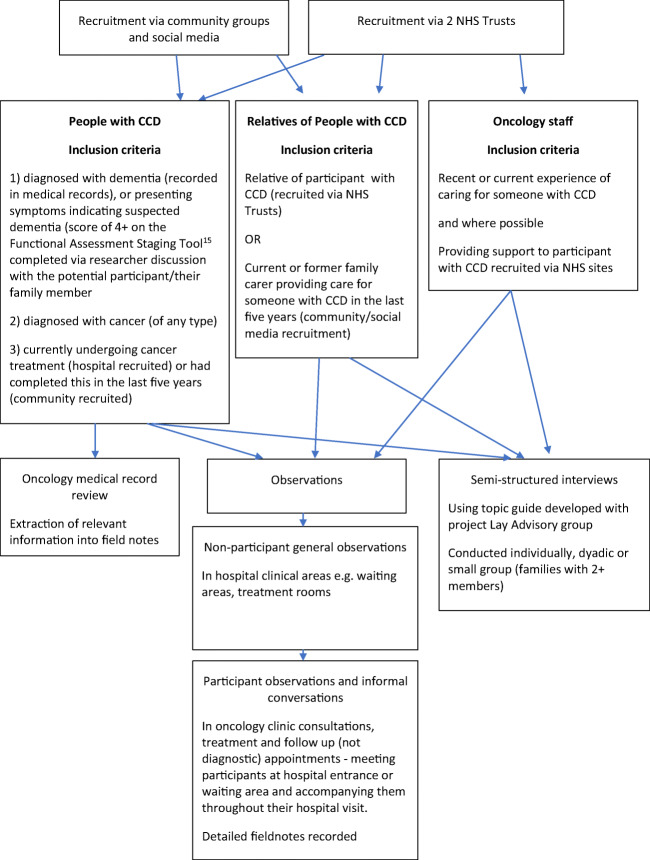
An ethnographic study recruiting 17 people with cancer and dementia, 22 relatives and 19 oncology staff in two UK National Health Service Trusts. Observations (46 h) and informal conversations were conducted during oncology appointments involving people with dementia. Semi-structured interviews (n = 37) with people living with cancer and dementia, their relatives and staff working in various roles across oncology services were also carried out. Data were analysed using ethnographically informed thematic analysis.
People with cancer and dementia experienced challenges across three areas of navigating cancer treatment and care: navigating through multiple services, appointments and layers of often complex information; repeatedly navigating transport to and from hospital; and navigating non-dementia-friendly hospital outpatient environments alongside the cognitive problems associated with dementia.
Dementia impacts patients' abilities to navigate the many practical aspects of attending hospital for cancer treatment and care. This study indicates the importance of addressing ways to improve the experience of travelling to and from the hospital, alongside extending the ongoing efforts to develop 'dementia-friendly' hospital in-patient areas and practices, to outpatient departments. Such steps will serve to improve hospital-based cancer treatment and care and more broadly outpatient appointment experiences for people with dementia and their families.
随着年龄的增长,患癌症和痴呆症的风险会增加;然而,这种合并症的研究仍然相对较少。本研究报告了患有癌症和痴呆症的人在二级保健中接受癌症治疗时所面临的挑战。
本项人种学研究在英国的两家国民保健服务信托机构中招募了 17 名患有癌症和痴呆症的患者、22 名亲属和 19 名肿瘤学工作人员。在涉及痴呆症患者的肿瘤学预约期间进行了 46 小时的观察(46 小时)和非正式对话。还对 37 名患有癌症和痴呆症的患者、他们的亲属以及在肿瘤学服务各个岗位工作的工作人员进行了半结构式访谈。使用人种学启发式主题分析对数据进行分析。
患有癌症和痴呆症的人在三个方面的癌症治疗和护理方面都遇到了挑战:在多个服务、预约和经常复杂的信息层面之间进行导航;反复往返医院的交通导航;以及在与痴呆症相关的认知问题的同时,在不适合痴呆症的医院门诊环境中导航。
痴呆症影响患者参与癌症治疗和护理的许多实际方面的能力。本研究表明,重要的是要解决改善往返医院的体验的方法,同时要进一步努力将“适合痴呆症”的医院住院区和实践扩展到门诊部门。这些措施将有助于改善基于医院的癌症治疗和护理,并更广泛地改善患有痴呆症的人和他们的家人的门诊预约体验。