Cho Hyungseok, Chung Jae-Seung, Han Ki-Ho
Department of Nanoscience and Engineering, Center for Nano Manufacturing, Inje University, Gimhae 50834, Korea.
Department of Urology, Haeundae Paik Hospital, Inje University, Busan 48108, Korea.
Micromachines (Basel). 2020 Sep 19;11(9):870. doi: 10.3390/mi11090870.
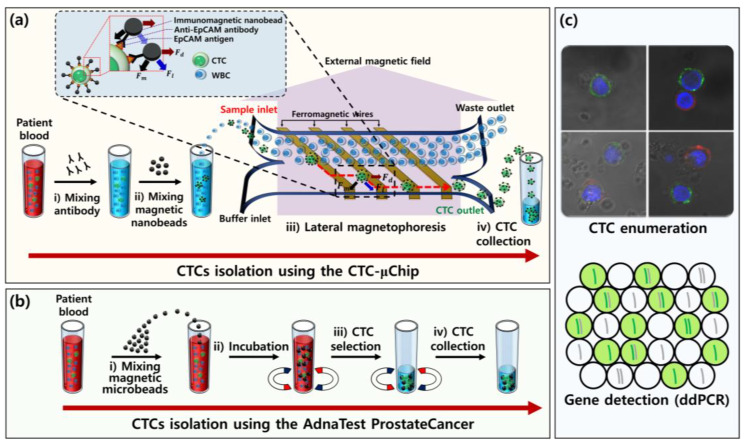
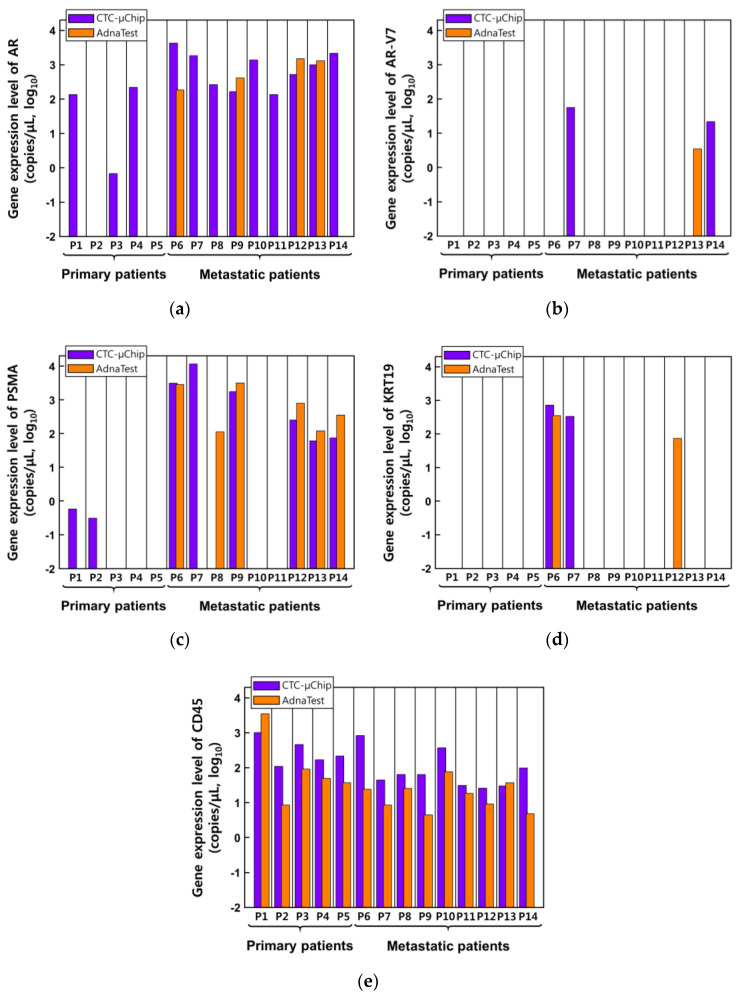
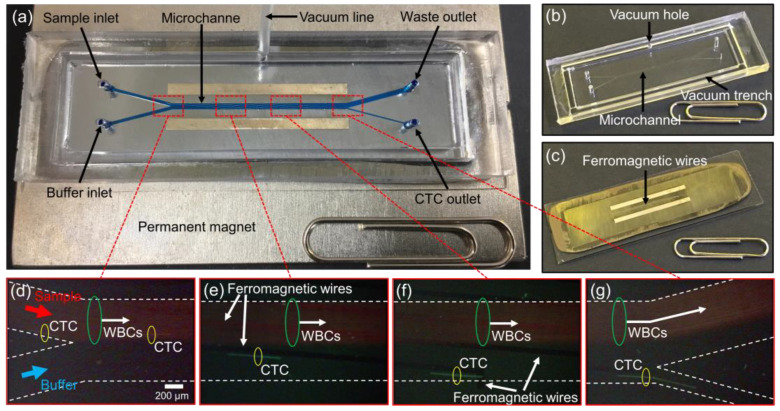
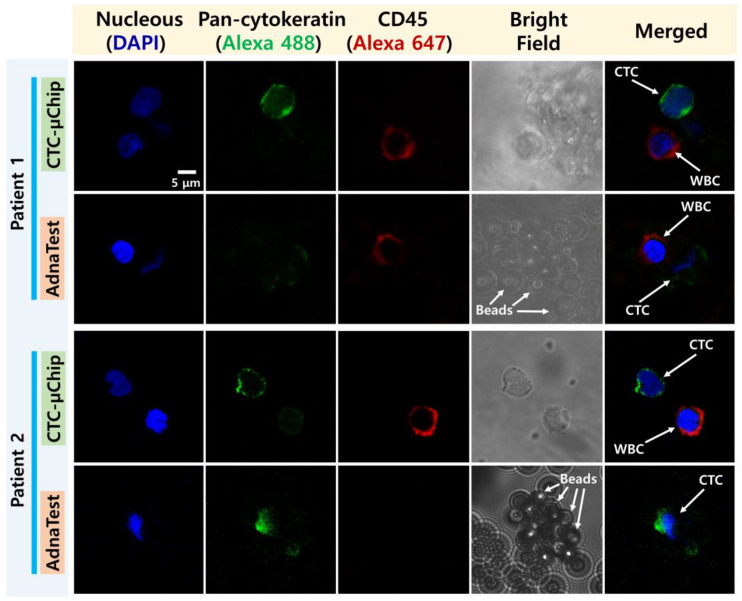
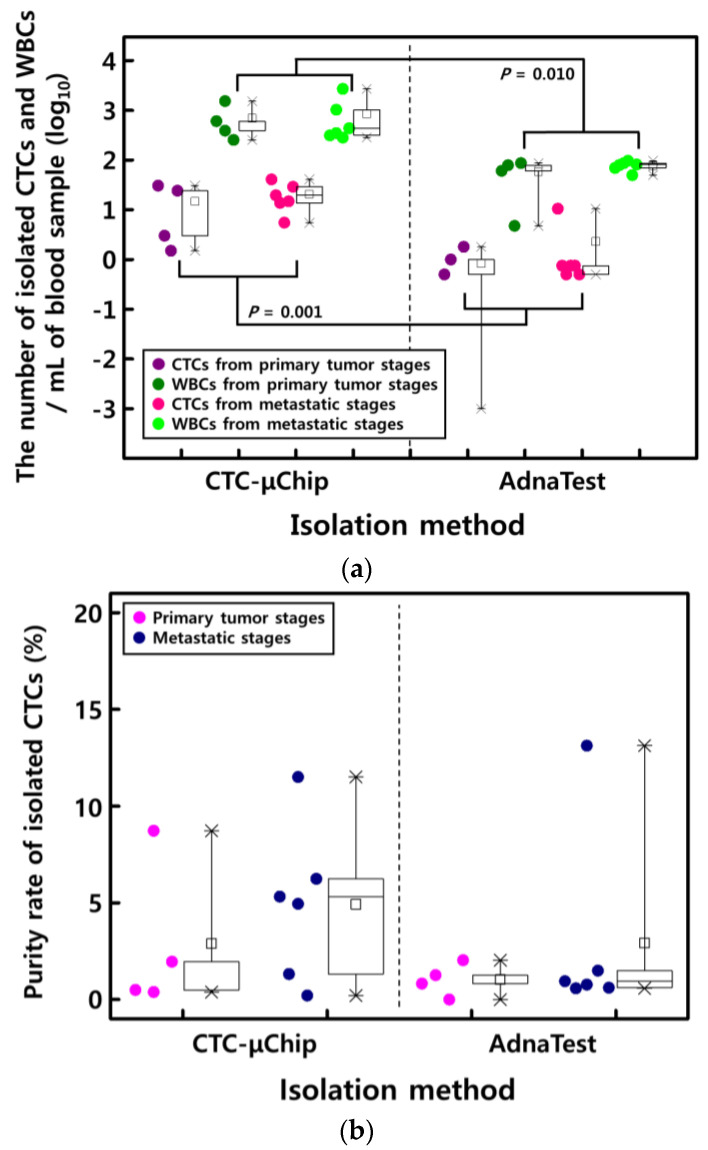
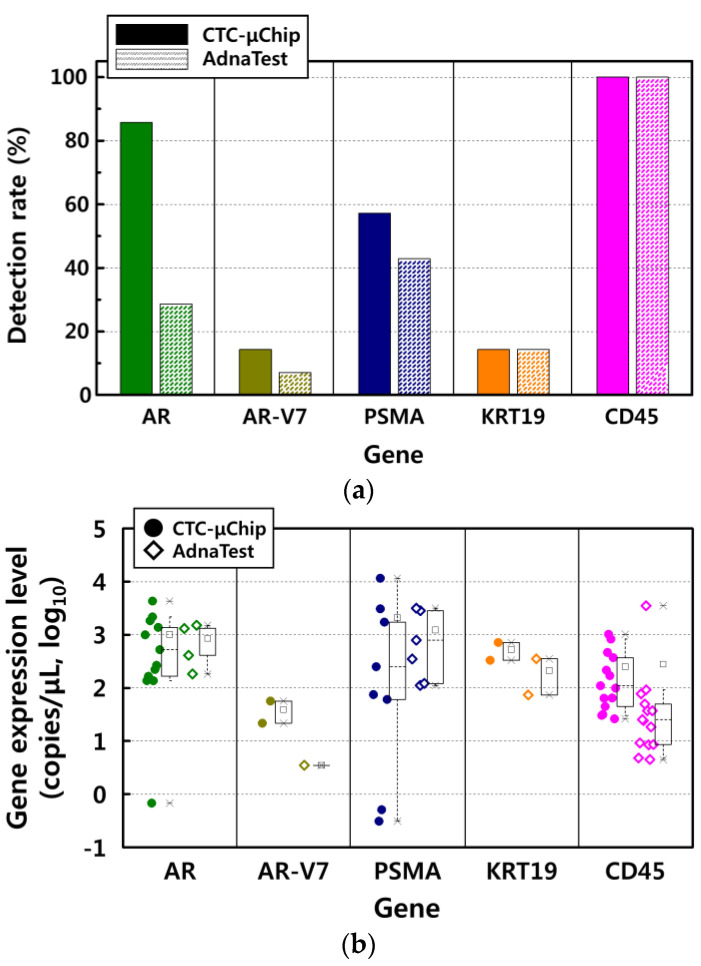
Circulating tumor cells (CTCs) are important biomarkers for the diagnosis, prognosis, and treatment of cancer. However, because of their extreme rarity, a more precise technique for isolating CTCs is required to gain deeper insight into the characteristics of cancer. This study compares the performance of a lateral magnetophoretic microseparator ("CTC-μChip"), as a representative microfluidic device, and AdnaTest ProstateCancer (Qiagen), as a commercially available specialized method, for isolating CTCs from the blood of patients with prostate cancer. The enumeration and genetic analysis results of CTCs isolated via the two methods were compared under identical conditions. In the CTC enumeration experiment, the number of CTCs isolated by the CTC-μChip averaged 17.67 CTCs/mL, compared to 1.56 CTCs/mL by the AdnaTest. The number of contaminating white blood cells (WBCs) and the CTC purity with the CTC-μChip averaged 772.22 WBCs/mL and 3.91%, respectively, whereas those with the AdnaTest averaged 67.34 WBCs/mL and 1.98%, respectively. Through genetic analysis, using a cancer-specific gene panel (AR (androgen receptor), AR-V7 (A\androgen receptor variant-7), PSMA (prostate specific membrane antigen), KRT19 (cytokeratin-19), CD45 (PTPRC, Protein tyrosine phosphatase, receptor type, C)) with reverse transcription droplet digital PCR, three genes (AR, AR-V7, and PSMA) were more highly expressed in cells isolated by the CTC-μChip, while KRT19 and CD45 were similarly detected using both methods. Consequently, this study showed that the CTC-μChip can be used to isolate CTCs more reliably than AdnaTest ProstateCancer, as a specialized method for gene analysis of prostate CTCs, as well as more sensitively obtain cancer-associated gene expressions.
循环肿瘤细胞(CTCs)是癌症诊断、预后和治疗的重要生物标志物。然而,由于其极其稀少,需要一种更精确的技术来分离CTCs,以便更深入地了解癌症的特征。本研究比较了作为代表性微流控设备的横向磁泳微分离器(“CTC-μ芯片”)和作为市售专用方法的AdnaTest ProstateCancer(Qiagen)从前列腺癌患者血液中分离CTCs的性能。在相同条件下比较了通过这两种方法分离的CTCs的计数和基因分析结果。在CTC计数实验中,CTC-μ芯片分离的CTCs数量平均为17.67个/毫升,而AdnaTest分离的为1.56个/毫升。CTC-μ芯片污染的白细胞(WBCs)数量和CTC纯度平均分别为772.22个/毫升和3.91%,而AdnaTest的分别为67.34个/毫升和1.98%。通过基因分析,使用癌症特异性基因panel(AR(雄激素受体)、AR-V7(雄激素受体变体-7)、PSMA(前列腺特异性膜抗原)、KRT19(细胞角蛋白-19)、CD45(PTPRC,蛋白酪氨酸磷酸酶,受体型,C))和逆转录液滴数字PCR,三种基因(AR、AR-V7和PSMA)在通过CTC-μ芯片分离的细胞中表达更高,而使用两种方法均能类似地检测到KRT19和CD45。因此,本研究表明,作为前列腺CTCs基因分析的专用方法,CTC-μ芯片比AdnaTest ProstateCancer能更可靠地分离CTCs,并且能更灵敏地获得癌症相关基因表达。