Wu Shibo, Chen Weizhuang, Liu Kaitai, Ren Feng, Zheng Dawei, Xu Feng, Wu Hongcheng
Second Clinical Medical College, Zhejiang Chinese Medical University, Hangzhou, China.
Department of Respiratory medicine, Lihuili Hospital, Ningbo Medical Centre, Ningbo, China.
J Int Med Res. 2020 Sep;48(9):300060520937163. doi: 10.1177/0300060520937163.
To study the effects of saikosaponin D (SSD) on proliferation and apoptosis in human non-small cell lung cancer cell lines, and to explore underlying mechanisms.
Following treatment with saikosaponin D, A549 and H1299 cells were assessed for anti-proliferation effects using cell cycle kit-8 assays, changes in nuclear morphology using 4',6-diamidino-2-phenylindole (DAPI) staining, and cell apoptosis using annexin V/propidium iodide double staining. Proliferation- and apoptosis-related proteins were detected by immunoblotting.
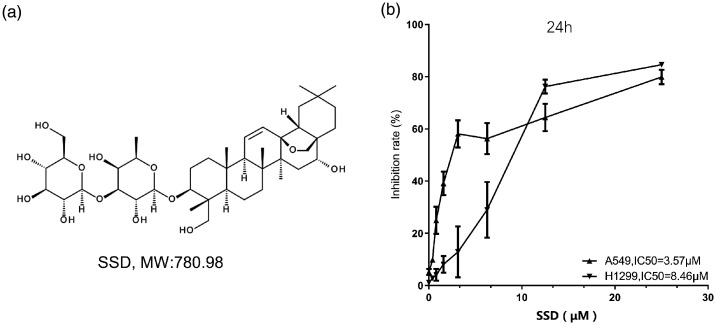
Saikosaponin D had dose-dependent inhibitory effects on A549 cells (IC, 3.57 µM) and H1299 cells (IC, 8.46 µM). DAPI staining revealed decreased cell numbers, and most H1299 cells became round after treatment with 20 µM saikosaponin D. As saikosaponin D concentration increased, the proportions of cells in G0/G1 phase, and cells undergoing apoptosis, increased. Levels of phosphorylated p44/42 and signal transducer and activator of transcription (STAT)3 were significantly downregulated in both cell lines, while total STAT3 levels were not significantly affected. The cleaved form of caspase 3 was significantly upregulated.
Saikosaponin D inhibits proliferation, inducing cell cycle arrest and apoptosis, in lung cancer cells in a dose-dependent manner, possibly through inhibition of STAT3 phosphorylation and activation of caspase 3.
研究柴胡皂苷D(SSD)对人非小细胞肺癌细胞系增殖和凋亡的影响,并探讨其潜在机制。
用柴胡皂苷D处理后,采用细胞周期试剂盒-8法评估A549和H1299细胞的抗增殖作用,用4',6-二脒基-2-苯基吲哚(DAPI)染色观察细胞核形态变化,用膜联蛋白V/碘化丙啶双染法检测细胞凋亡。通过免疫印迹法检测增殖和凋亡相关蛋白。
柴胡皂苷D对A549细胞(IC,3.57 μM)和H1299细胞(IC,8.46 μM)具有剂量依赖性抑制作用。DAPI染色显示细胞数量减少,用20 μM柴胡皂苷D处理后,大多数H1299细胞变圆。随着柴胡皂苷D浓度增加,G0/G1期细胞比例和凋亡细胞比例增加。两种细胞系中磷酸化p44/42和信号转导子及转录激活子(STAT)3水平均显著下调,而总STAT3水平未受显著影响。半胱天冬酶3的裂解形式显著上调。
柴胡皂苷D以剂量依赖性方式抑制肺癌细胞增殖,诱导细胞周期停滞和凋亡,可能是通过抑制STAT3磷酸化和激活半胱天冬酶3实现的。