Infectious Diseases and Genomic Medicine Group, J. Craig Venter Institute, Rockville, Maryland.
Department of Pathology, University of Pittsburgh School of Medicine, Pittsburgh, Pennsylvania.
Mol Cell Proteomics. 2020 Dec;19(12):2030-2047. doi: 10.1074/mcp.RA120.002235. Epub 2020 Sep 22.
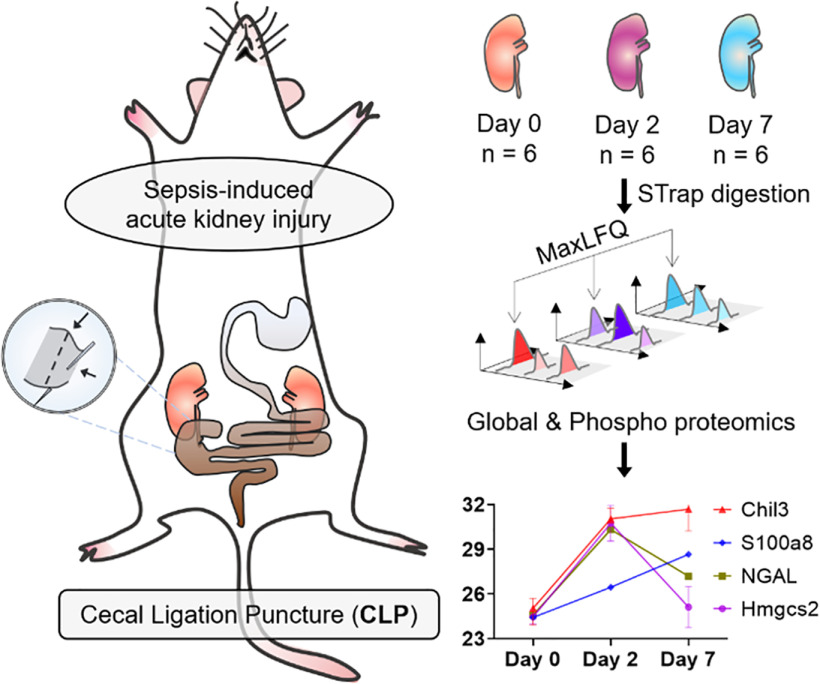
Sepsis-induced acute kidney injury (S-AKI) is the most common complication in hospitalized and critically ill patients, highlighted by a rapid decline of kidney function occurring a few hours or days after sepsis onset. Systemic inflammation elicited by microbial infections is believed to lead to kidney damage under immunocompromised conditions. However, although AKI has been recognized as a disease with long-term sequelae, partly because of the associated higher risk of chronic kidney disease (CKD), the understanding of kidney pathophysiology at the molecular level and the global view of dynamic regulations after S-AKI, including the transition to CKD, remains limited. Existing studies of S-AKI mainly focus on deriving sepsis biomarkers from body fluids. In the present study, we constructed a mid-severity septic murine model using cecal ligation and puncture (CLP), and examined the temporal changes to the kidney proteome and phosphoproteome at day 2 and day 7 after CLP surgery, corresponding to S-AKI and the transition to CKD, respectively, by employing an ultrafast and economical filter-based sample processing method combined with the label-free quantitation approach. Collectively, we identified 2,119 proteins and 2950 phosphosites through multi-proteomics analyses. Among them, we identified an array of highly promising candidate marker proteins indicative of disease onset and progression accompanied by immunoblot validations, and further denoted the pathways that are specifically responsive to S-AKI and its transition to CKD, which include regulation of cell metabolism regulation, oxidative stress, and energy consumption in the diseased kidneys. Our data can serve as an enriched resource for the identification of mechanisms and biomarkers for sepsis-induced kidney diseases.
脓毒症相关性急性肾损伤(S-AKI)是住院和危重症患者中最常见的并发症,其特征为在脓毒症发作数小时或数天后肾功能迅速下降。人们认为,微生物感染引起的全身炎症会导致免疫功能低下的情况下发生肾损伤。然而,尽管 AKI 已被认为是一种具有长期后遗症的疾病,部分原因是其与慢性肾脏病(CKD)相关的风险较高,但对 S-AKI 后肾脏病理生理学的分子水平理解和全局动态调控(包括向 CKD 的转变)仍然有限。现有的 S-AKI 研究主要集中在从体液中提取脓毒症生物标志物。在本研究中,我们使用盲肠结扎穿刺术(CLP)构建了一个中度严重脓毒症的小鼠模型,并通过采用超快且经济的基于滤膜的样品处理方法结合无标记定量方法,分别在 CLP 手术后第 2 天和第 7 天(分别对应 S-AKI 和向 CKD 的转变)检测肾脏蛋白质组和磷酸蛋白质组的时间变化。通过多蛋白质组学分析,我们共鉴定出 2119 种蛋白质和 2950 个磷酸化位点。其中,我们鉴定出了一系列很有前途的候选标志物蛋白,这些蛋白可以指示疾病的发生和进展,并通过免疫印迹验证,同时还进一步指出了对 S-AKI 及其向 CKD 转变有特异性反应的途径,包括细胞代谢调节、氧化应激和患病肾脏中的能量消耗。我们的数据可以作为鉴定脓毒症相关性肾脏疾病的机制和生物标志物的丰富资源。