Chen Jia, Zheng Quan-You, Wang Li-Ming, Luo Jia, Chen Ke-Hong, He Ya-Ni
Department of Nephrology, Daping Hospital, Army Medical University, Chongqing, 400042, China.
Department of Nephrology and Urology, The 958th Hospital, The First Affiliated Hospital, Army Medical University, Chongqing, 400020, China.
Heliyon. 2023 Jul 17;9(7):e18134. doi: 10.1016/j.heliyon.2023.e18134. eCollection 2023 Jul.
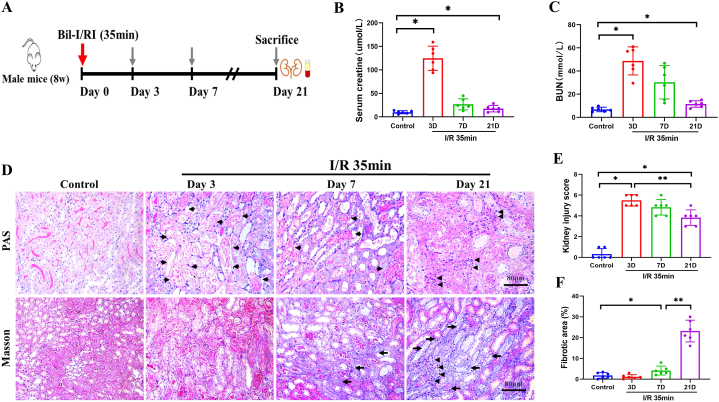
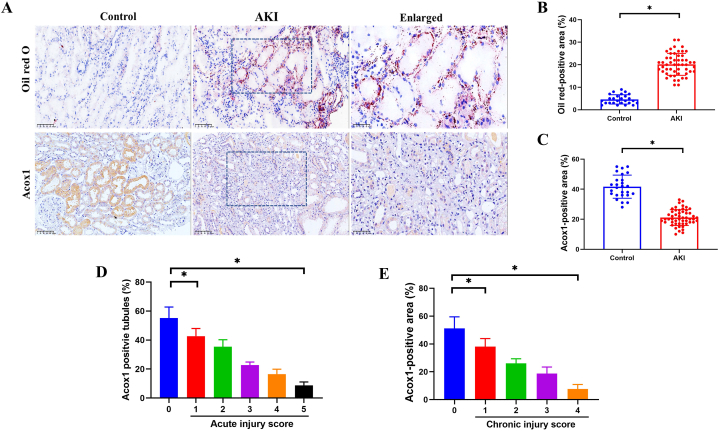
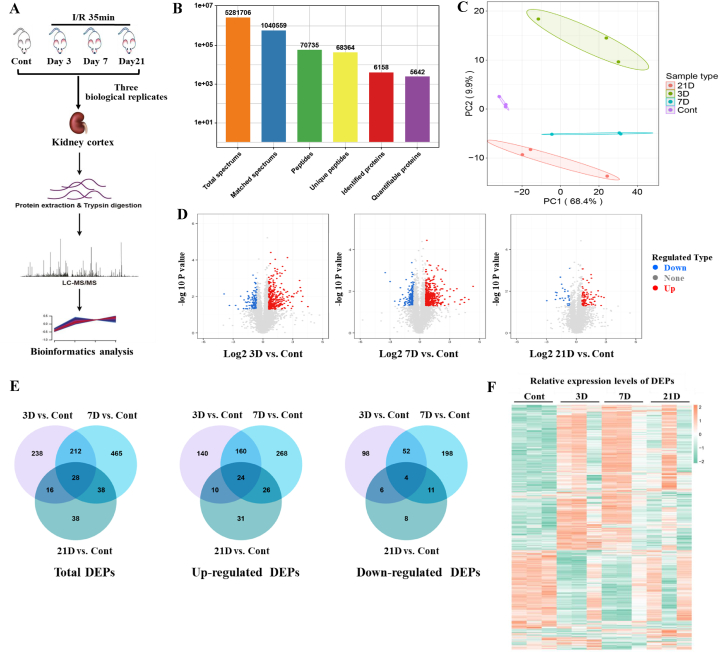
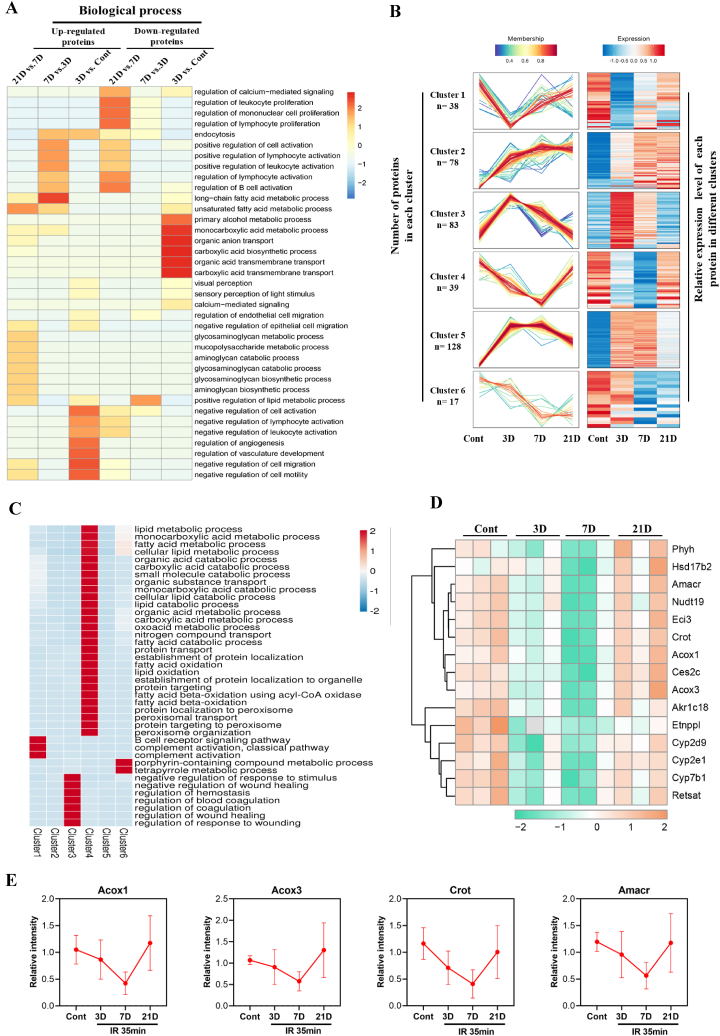
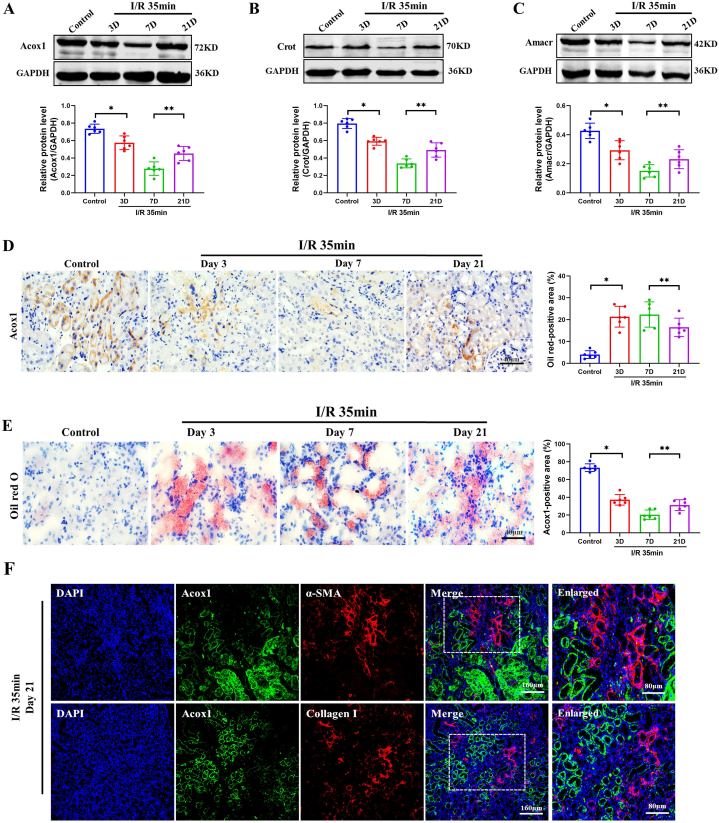
Acute kidney injury (AKI) is characterized by a rapid decrease in renal function with high mortality and risk of progression to chronic kidney disease (CKD). Ischemia and reperfusion injury (IRI) is one of the major causes of AKI. However, the cellular and molecular responses of the kidney to IRI are complex and not fully understood. Herein, we conducted unbiased proteomics and bioinformatics analyses in an IRI mouse model on days 3, 7, and 21, and validated the results using IRI, unilateral ureteral obstruction (UUO), and biopsies from patients with AKI or CKD. The results indicated an obvious temporal expression profile of differentially expressed proteins and highlighted impaired lipid metabolism during the progression of AKI to CKD. Acyl-coenzyme A oxidase 1 (Acox1), the first rate-limiting enzyme of peroxisomal fatty acid beta-oxidation, was then selected, and its disturbed expression in the two murine models validated the proteomic findings. Accordingly, Acox1 expression was significantly downregulated in renal biopsies from patients with AKI or CKD, and its expression was negatively correlated with kidney injury score. Furthermore, in contrast to the decreased Acox1 expression, lipid droplet accumulation was remarkably increased in these renal tissues, suggesting dysregulation of fatty acid oxidation. In conclusion, our results suggest that defective peroxisomal fatty acid oxidation might be a common pathological feature in the transition from AKI to CKD, and that Acox1 is a promising intervention target for kidney injury and repair.
急性肾损伤(AKI)的特征是肾功能迅速下降,死亡率高,且有进展为慢性肾脏病(CKD)的风险。缺血再灌注损伤(IRI)是AKI的主要原因之一。然而,肾脏对IRI的细胞和分子反应复杂,尚未完全明确。在此,我们在IRI小鼠模型的第3天、第7天和第21天进行了无偏蛋白质组学和生物信息学分析,并使用IRI、单侧输尿管梗阻(UUO)以及AKI或CKD患者的活检样本对结果进行了验证。结果显示差异表达蛋白呈现明显的时间表达谱,并突出了AKI进展为CKD过程中脂质代谢受损。随后选择了过氧化物酶体脂肪酸β氧化的首个限速酶酰基辅酶A氧化酶1(Acox1),其在两种小鼠模型中的表达紊乱验证了蛋白质组学研究结果。相应地,Acox1在AKI或CKD患者的肾活检组织中表达显著下调,且其表达与肾损伤评分呈负相关。此外,与Acox1表达降低相反,这些肾组织中的脂滴积累明显增加,提示脂肪酸氧化失调。总之,我们的结果表明,过氧化物酶体脂肪酸氧化缺陷可能是AKI向CKD转变过程中的一个常见病理特征,且Acox1是肾脏损伤和修复的一个有前景的干预靶点。