Shanxi Academy of Advanced Research and Innovation, Taiyuan, 030032, China.
CAS Key Laboratory of Pathogenic Microbiology and Immunology, Institute of Microbiology, Chinese Academy of Sciences (CAS), Beijing, 100101, China.
Nat Commun. 2020 Sep 22;11(1):4795. doi: 10.1038/s41467-020-18537-y.
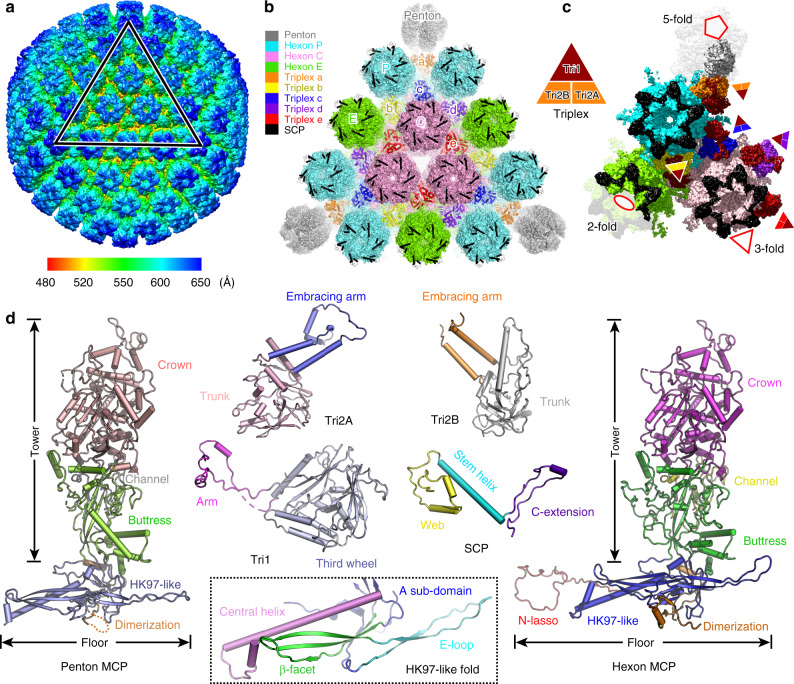
Varicella-zoster virus (VZV), a member of the Alphaherpesvirinae subfamily, causes severe diseases in humans of all ages. The viral capsids play critical roles in herpesvirus infection, making them potential antiviral targets. Here, we present the 3.7-Å-resolution structure of the VZV A-capsid and define the molecular determinants underpinning the assembly of this complicated viral machinery. Overall, the VZV capsid has a similar architecture to that of other known herpesviruses. The major capsid protein (MCP) assembles into pentons and hexons, forming extensive intra- and inter-capsomer interaction networks that are further secured by the small capsid protein (SCP) and the heterotriplex. The structure reveals a pocket beneath the floor of MCP that could potentially be targeted by antiviral inhibitors. In addition, we identified two alphaherpesvirus-specific structural features in SCP and Tri1 proteins. These observations highlight the divergence of different herpesviruses and provide an important basis for developing antiviral drugs.
水痘-带状疱疹病毒(VZV)属于α疱疹病毒亚科,可导致各年龄段人群发生严重疾病。病毒衣壳在疱疹病毒感染中发挥关键作用,使其成为潜在的抗病毒靶点。在此,我们呈现了 VZV A 衣壳的 3.7Å 分辨率结构,并定义了组装这种复杂病毒机制的分子决定因素。总体而言,VZV 衣壳的结构与其他已知疱疹病毒相似。主要衣壳蛋白(MCP)组装成五聚体和六聚体,形成广泛的衣壳间相互作用网络,进一步由小衣壳蛋白(SCP)和异三聚体稳定。该结构揭示了 MCP 底部下方的一个口袋,该口袋可能成为抗病毒抑制剂的作用靶点。此外,我们在 SCP 和 Tri1 蛋白中鉴定了两个α疱疹病毒特异性结构特征。这些观察结果突出了不同疱疹病毒的差异,并为开发抗病毒药物提供了重要基础。