Dai Haoran, Liu Fei, Qiu Xinping, Liu Wenbin, Dong Zhaocheng, Jia Yingmin, Feng Zhendong, Liu Zhiyuan, Zhao Qihan, Gao Yu, Zhang Zihan, Gao Chang, Sun Songge, Tian Xuefei, Liu Baoli
Department of Nephrology, Shunyi Hospital, Beijing Traditional Chinese Medicine Hospital, Station East 5, Shunyi District, Beijing 101300, China.
Beijing University of Chinese Medicine, No. 11, North Third Ring Road, Chaoyang District, Beijing 100029, China.
Evid Based Complement Alternat Med. 2020 Sep 3;2020:7809427. doi: 10.1155/2020/7809427. eCollection 2020.
Organ fibrosis is a common endpoint of a variety of diseases. Many studies have shown that the pathogenesis of diabetic kidney disease (DKD) is related to the excessive activation of the Wnt/-catenin signaling pathway on podocytes, so the treatment of DKD starts from this signaling pathway. At the same time, DKD, as a metabolic disease, has many connections related to podocyte autophagy.
We experimented the effects of Mahuang Fuzi and Shenzhuo decoction (MFSD) which is the combination of Mahuang Fuzi decoction and Shenzhuo decoction in traditional Chinese medicine compounds used "The Golden Chamber" in high glucose-induced podocytes, determined whether this effect was related to Wnt/-catenin signaling pathway, and further investigated the relationship between this effect and autophagy.
The mice podocytes were stimulated by using 30 mmol/L of high glucose and serum containing MFSD or Wnt/-catenin signaling pathway inhibitor DKK1 (100 ng/ml) was used to intervene podocytes before high glucose stimulation. Podocyte injury-related proteins, Wnt/-catenin signaling pathway-related proteins, and autophagy-related proteins were detected by using western blotting and immunofluorescence analysis.
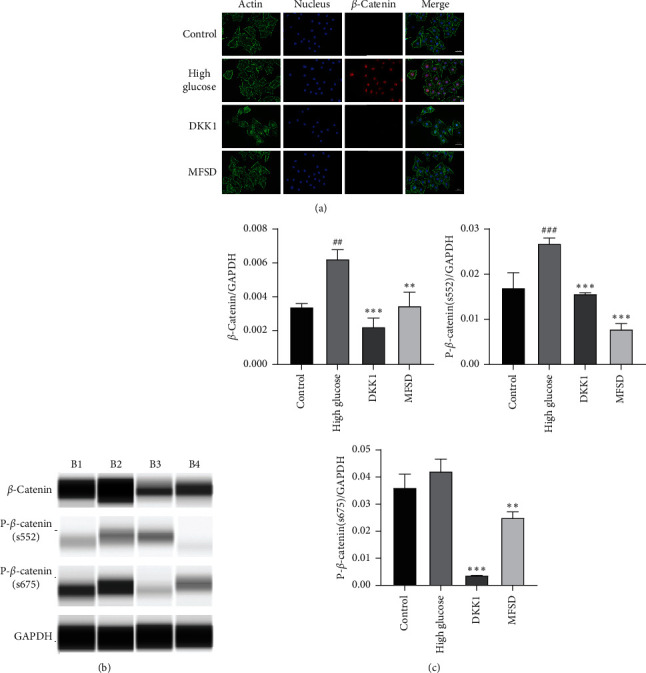
Our results showed that DKK1 and MFSD treatment significantly upregulated the protein expressions of nephrin, podocin, podocalyxin, and podoplanin in high glucose-induced podocytes and downregulated the -catenin protein expression. Furthermore, the protein expressions of beclin1, LC3B, and P62 were also significantly increased in high glucose-induced podocytes.
Our experiments confirmed that the destruction of podocytes in DKD is related to the excessive activation of Wnt/-catenin signaling pathway and the inhibition of autophagy after activation. MFSD treatment can inhibit the activation of Wnt/-catenin signaling pathway in podocytes stimulated by high glucose and helpful in reducing the podocyte injury. This protective mechanism can be related to the enhancement of podocyte autophagy by MFSD treatment.
器官纤维化是多种疾病的常见终点。许多研究表明,糖尿病肾病(DKD)的发病机制与足细胞上Wnt/β-连环蛋白信号通路的过度激活有关,因此DKD的治疗从此信号通路入手。同时,DKD作为一种代谢性疾病,与足细胞自噬有许多关联。
我们实验了中药复方中麻黄附子渗浊汤(MFSD)(由麻黄附子汤和渗浊汤组合而成,出自《金匮要略》)对高糖诱导的足细胞的影响,确定这种作用是否与Wnt/β-连环蛋白信号通路有关,并进一步研究这种作用与自噬之间的关系。
用30 mmol/L高糖刺激小鼠足细胞,在高糖刺激前用含MFSD的血清或Wnt/β-连环蛋白信号通路抑制剂DKK1(100 ng/ml)干预足细胞。采用蛋白质免疫印迹法和免疫荧光分析法检测足细胞损伤相关蛋白、Wnt/β-连环蛋白信号通路相关蛋白和自噬相关蛋白。
我们的结果表明,DKK1和MFSD处理显著上调了高糖诱导的足细胞中nephrin、podocin、podocalyxin和podoplanin的蛋白表达,并下调了β-连环蛋白的蛋白表达。此外,高糖诱导的足细胞中beclin1、LC3B和P62的蛋白表达也显著增加。
我们的实验证实,DKD中足细胞的破坏与Wnt/β-连环蛋白信号通路的过度激活以及激活后自噬的抑制有关。MFSD处理可抑制高糖刺激的足细胞中Wnt/β-连环蛋白信号通路的激活,有助于减轻足细胞损伤。这种保护机制可能与MFSD处理增强足细胞自噬有关。