Li Shan-Shan, Sun Qian, Hua Meng-Ru, Suo Ping, Chen Jia-Rong, Yu Xiao-Yong, Zhao Ying-Yong
Department of Nephrology, Shaanxi Traditional Chinese Medicine Hospital, Xi'an, China.
The First School of Clinical Medicine, Shaanxi University of Traditional Chinese Medicine, Xianyang, China.
Front Pharmacol. 2021 Aug 16;12:719880. doi: 10.3389/fphar.2021.719880. eCollection 2021.
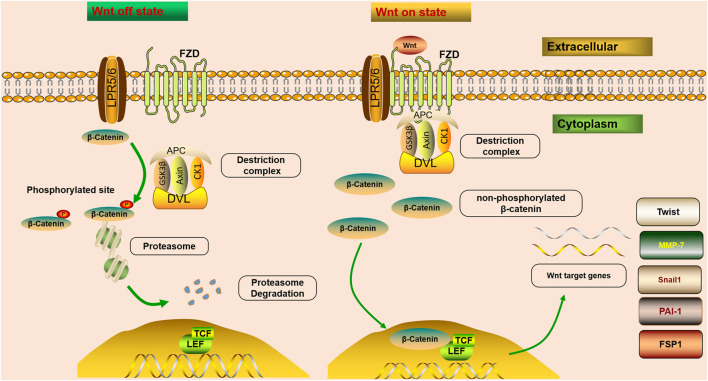
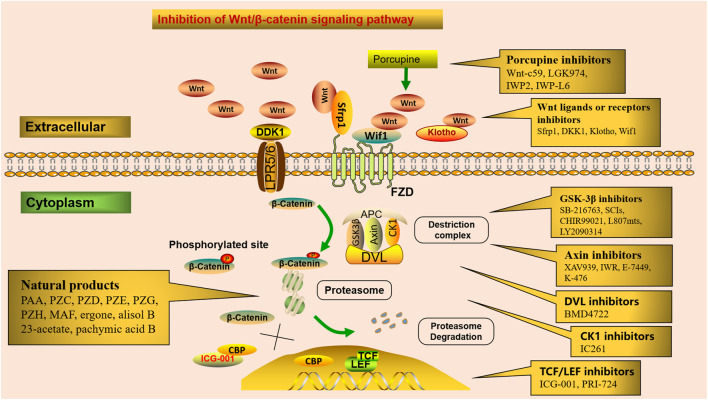
The Wnt/β-catenin signaling pathway plays important roles in embryonic development and tissue homeostasis. Wnt signaling is induced, and -catenin is activated, associated with the development and progression of renal fibrosis. Wnt/-catenin controls the expression of various downstream mediators such as snail1, twist, matrix metalloproteinase-7, plasminogen activator inhibitor-1, transient receptor potential canonical 6, and renin-angiotensin system components in epithelial cells, fibroblast, and macrophages. In addition, Wnt/-catenin is usually intertwined with other signaling pathways to promote renal interstitial fibrosis. Actually, given the crucial of Wnt/-catenin signaling in renal fibrogenesis, blocking this signaling may benefit renal interstitial fibrosis. There are several antagonists of Wnt signaling that negatively control Wnt activation, and these include soluble Fzd-related proteins, the family of Dickkopf 1 proteins, Klotho and Wnt inhibitory factor-1. Furthermore, numerous emerging small-molecule -catenin inhibitors cannot be ignored to prevent and treat renal fibrosis. Moreover, we reviewed the knowledge focusing on anti-fibrotic effects of natural products commonly used in kidney disease by inhibiting the Wnt/-catenin signaling pathway. Therefore, in this review, we summarize recent advances in the regulation, downstream targets, role, and mechanisms of Wnt/-catenin signaling in renal fibrosis pathogenesis. We also discuss the therapeutic potential of targeting this pathway to treat renal fibrosis; this may shed new insights into effective treatment strategies to prevent and treat renal fibrosis.
Wnt/β-连环蛋白信号通路在胚胎发育和组织稳态中发挥着重要作用。Wnt信号被诱导,β-连环蛋白被激活,这与肾纤维化的发生和发展相关。Wnt/β-连环蛋白控制上皮细胞、成纤维细胞和巨噬细胞中各种下游介质的表达,如蜗牛1、扭曲蛋白、基质金属蛋白酶-7、纤溶酶原激活物抑制剂-1、瞬时受体电位香草酸亚型6和肾素-血管紧张素系统成分。此外,Wnt/β-连环蛋白通常与其他信号通路相互交织以促进肾间质纤维化。实际上,鉴于Wnt/β-连环蛋白信号在肾纤维化发生中的关键作用,阻断该信号可能对肾间质纤维化有益。有几种Wnt信号拮抗剂可负向控制Wnt激活,包括可溶性类卷曲蛋白相关蛋白、Dickkopf 1蛋白家族、Klotho和Wnt抑制因子-1。此外,众多新兴的小分子β-连环蛋白抑制剂在预防和治疗肾纤维化方面也不容忽视。此外,我们回顾了通过抑制Wnt/β-连环蛋白信号通路来关注常用于肾脏疾病的天然产物抗纤维化作用的相关知识。因此,在本综述中,我们总结了Wnt/β-连环蛋白信号在肾纤维化发病机制中的调控、下游靶点、作用及机制的最新进展。我们还讨论了靶向该通路治疗肾纤维化的治疗潜力;这可能为预防和治疗肾纤维化的有效治疗策略提供新的见解。