Department of Otorhinolaryngology, Kuopio University Hospital, Puijonlaaksontie 2, PL 100, 70210, Kuopio, Finland.
School of Medicine, Institute of Clinical Medicine, University of Eastern Finland, Kuopio, Finland.
Eur Arch Otorhinolaryngol. 2021 Aug;278(8):2795-2806. doi: 10.1007/s00405-020-06360-6. Epub 2020 Sep 22.
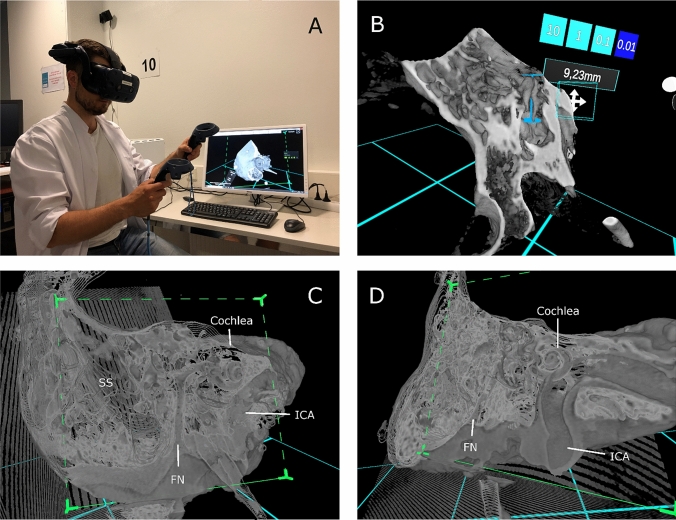
Consumer-grade virtual reality (VR) has recently enabled various medical applications, but more evidence supporting their validity is needed. We investigated the accuracy of simulated surgical planning in a VR environment (VR) with temporal bones and compared it to conventional cross-sectional image viewing in picture archiving and communication system (PACS) interface.
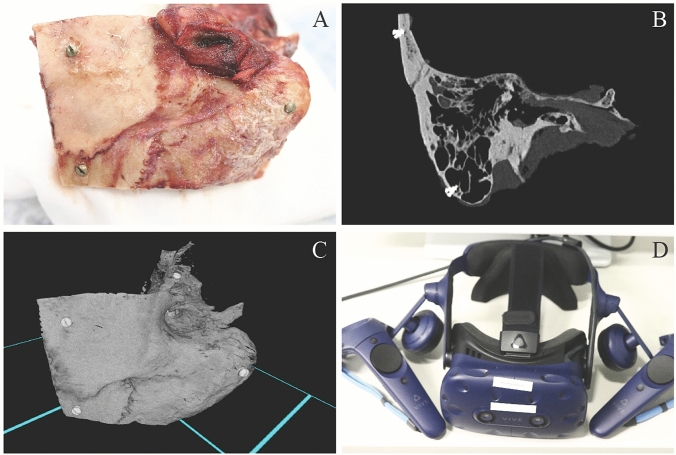
Five experienced otologic surgeons measured significant anatomic structures and fiducials on five fresh-frozen cadaveric temporal bones in VR and cross-sectional viewing. Primary image data were acquired by computed tomography. In total, 275 anatomical landmark measurements and 250 measurements of the distance between fiducials were obtained with both methods. Distance measurements between the fiducials were confirmed by physical measurement obtained by Vernier caliper. The experts evaluated the subjective validity of both methods on a 5-point Likert scale qualitative survey.
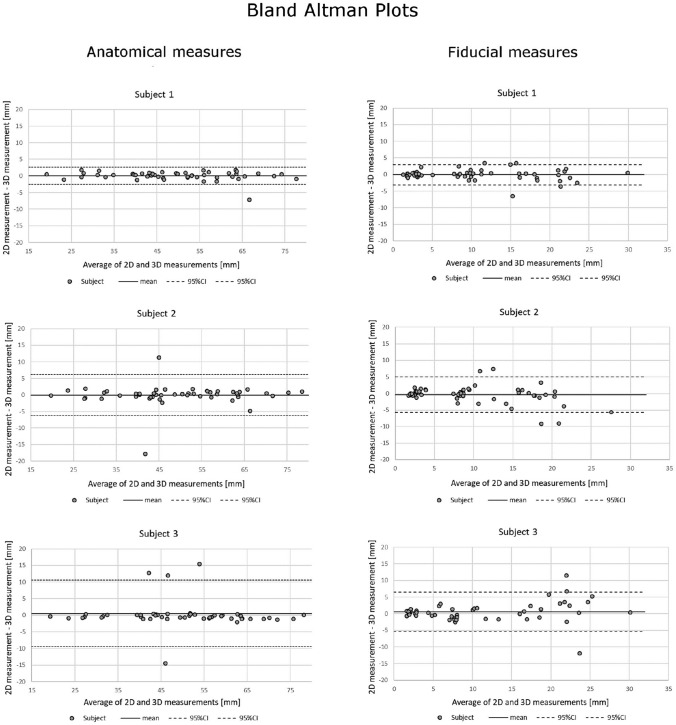
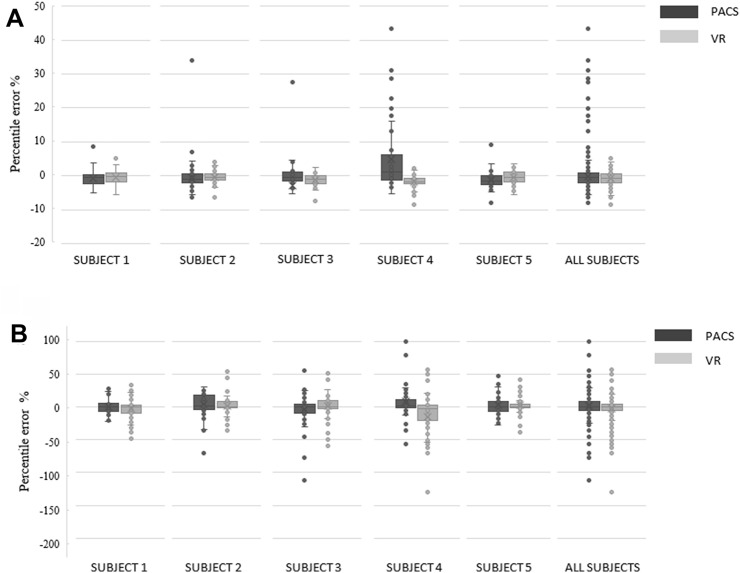
A strong correlation based on intraclass coefficient was found between the methods on both the anatomical (r > 0.900) and fiducial measurements (r > 0.916). Two-tailed paired t-test and Bland-Altman plots demonstrated high equivalences between the VR and cross-sectional viewing with mean differences of 1.9% (p = 0.396) and 0.472 mm (p = 0.065) for anatomical and fiducial measurements, respectively. Gross measurement errors due to the misidentification of fiducials occurred more frequently in the cross-sectional viewing. The mean face and content validity rating for VR were significantly better compared to cross-sectional viewing (total mean score 4.11 vs 3.39, p < 0.001).
Our study supports good accuracy and reliability of VR environment for simulated surgical planning in temporal bones compared to conventional cross-sectional visualization.
消费者级别的虚拟现实(VR)最近已经能够实现各种医学应用,但需要更多证据来支持其有效性。我们研究了在 VR 环境中模拟手术规划的准确性,并将其与传统的 PACS 界面中横断图像查看进行了比较。
五名经验丰富的耳科外科医生在 VR 和横断视图中对五个新鲜冷冻的尸头颞骨上的重要解剖结构和基准点进行了测量。主要图像数据由计算机断层扫描获得。两种方法共获得 275 个解剖标志测量值和 250 个基准点之间距离的测量值。通过游标卡尺进行的物理测量来确认基准点之间的距离测量值。专家们通过 5 分李克特量表对两种方法的主观有效性进行了评估。
两种方法在解剖结构(r>0.900)和基准点测量(r>0.916)上均显示出很强的相关性。双尾配对 t 检验和 Bland-Altman 图表明 VR 和横断视图之间具有高度的等效性,解剖和基准点测量的平均差异分别为 1.9%(p=0.396)和 0.472 毫米(p=0.065)。由于基准点的错误识别,横断视图中更频繁地出现 gross 测量误差。与横断视图相比,VR 的平均面部和内容有效性评分明显更好(总平均评分 4.11 与 3.39,p<0.001)。
与传统的横断可视化相比,我们的研究支持 VR 环境在颞骨模拟手术规划中具有良好的准确性和可靠性。