Doelare Sabrina A N, Smorenburg Stefan P M, van Schaik Theodorus G, Blankensteijn Jan D, Wisselink Willem, Nederhoed Johanna H, Lely Rutger J, Hoksbergen Arjan W J, Yeung Kak Khee
Department of Surgery, Amsterdam Cardiovascular Sciences, Amsterdam UMC, Vrije Universiteit, Amsterdam, the Netherlands.
Department of Radiology, Amsterdam Cardiovascular Sciences, Amsterdam UMC, Vrije Universiteit, Amsterdam, the Netherlands.
J Endovasc Ther. 2021 Feb;28(1):78-92. doi: 10.1177/1526602820960444. Epub 2020 Sep 23.
To determine if image fusion will reduce contrast volume, radiation dose, and fluoroscopy and procedure times in standard and complex (fenestrated/branched) endovascular aneurysm repair (EVAR).
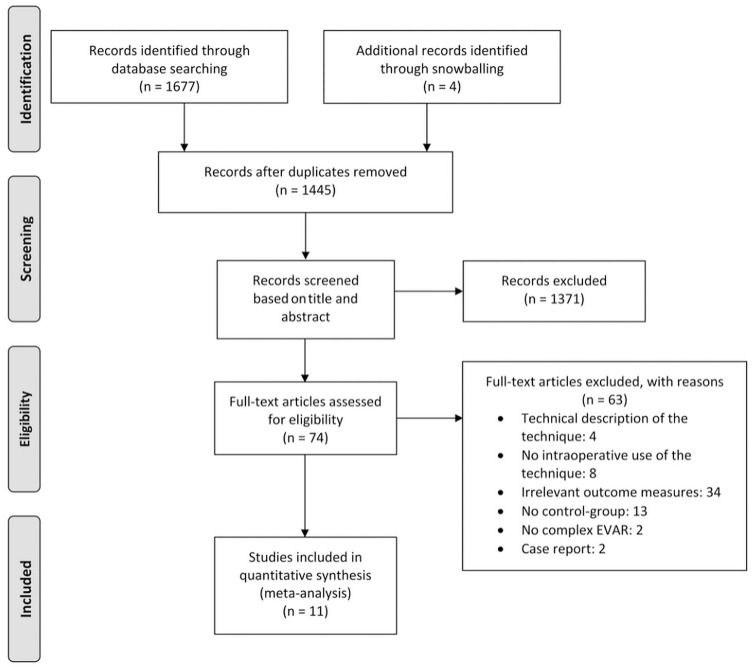
A search of the PubMed, Embase, and Cochrane databases was performed in December 2019 to identify articles describing results of standard and complex EVAR procedures using image fusion compared with a control group. Study selection, data extraction, and assessment of the methodological quality of the included publications were performed by 2 reviewers working independently. Primary outcomes of the pooled analysis were contrast volume, fluoroscopy time, radiation dose, and procedure time. Eleven articles were identified comprising 1547 patients. Data on 140 patients satisfying the study inclusion criteria were added from the authors' center. Mean differences (MDs) are presented with the 95% confidence interval (CI).
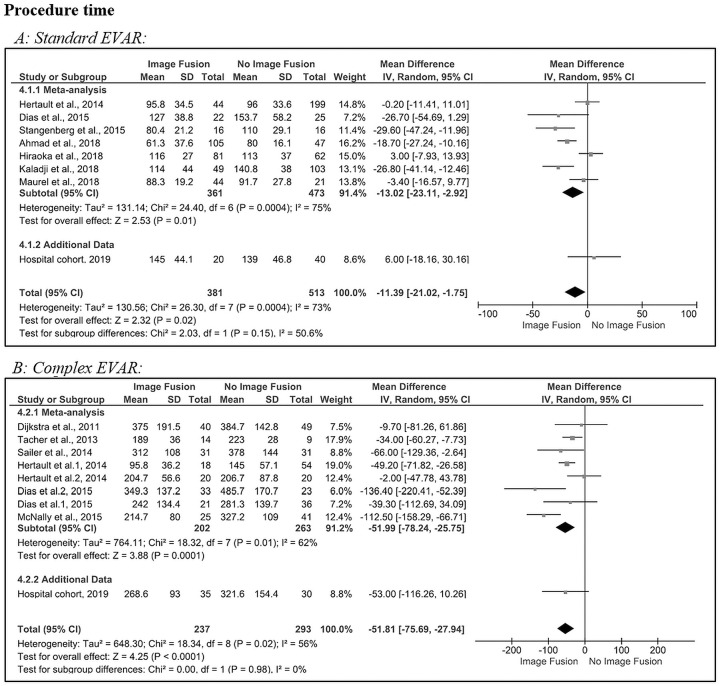
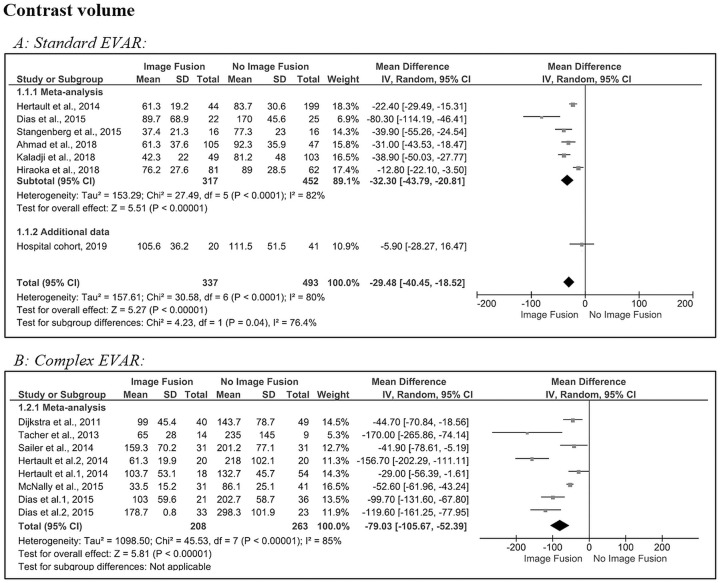
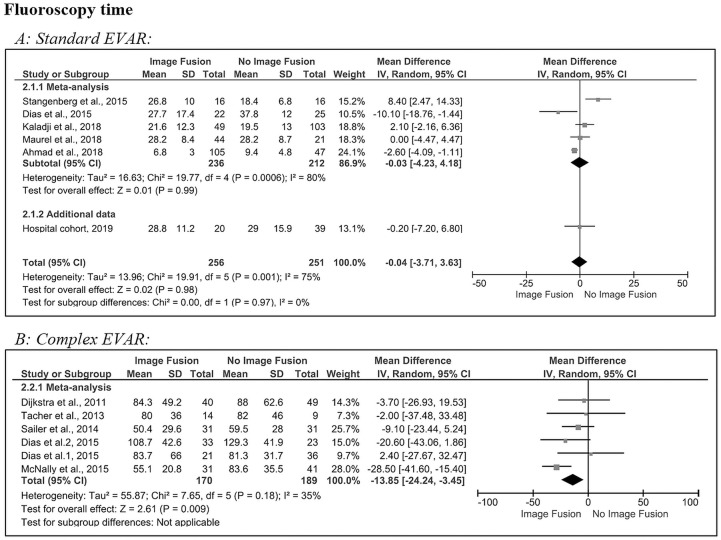
For standard EVAR, contrast volume and procedure time showed a significant reduction with an MD of -29 mL (95% CI -40.5 to -18.5, p<0.001) and -11 minutes (95% CI -21.0 to -1.8, p<0.01), respectively. For complex EVAR, significant reductions in favor of image fusion were found for contrast volume (MD -79 mL, 95% CI -105.7 to -52.4, p<0.001), fluoroscopy time (MD -14 minutes, 95% CI -24.2 to -3.5, p<0.001), and procedure time (MD -52 minutes, 95% CI -75.7 to -27.9, p<0.001).
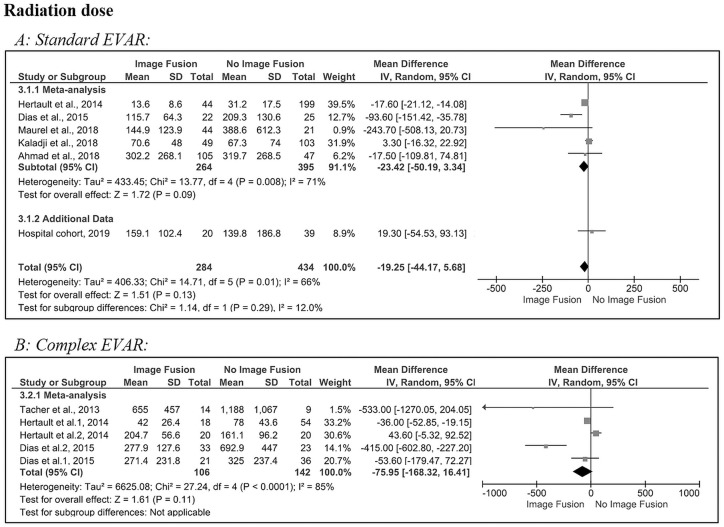
The results of this meta-analysis confirm that image fusion significantly reduces contrast volume, fluoroscopy time, and procedure time in complex EVAR but only contrast volume and procedure time for standard EVAR. Though a reduction was suggested, the radiation dose was not significantly affected by the use of fusion imaging in either standard or complex EVAR.
确定在标准及复杂(开窗/分支)血管内动脉瘤修复术(EVAR)中,图像融合是否会减少造影剂用量、辐射剂量、透视时间及手术时间。
2019年12月对PubMed、Embase和Cochrane数据库进行检索,以识别描述使用图像融合的标准及复杂EVAR手术结果并与对照组比较的文章。由两名独立工作的审阅者进行研究选择、数据提取及对纳入出版物的方法学质量评估。汇总分析的主要结局为造影剂用量、透视时间、辐射剂量及手术时间。共识别出11篇文章,包含1547例患者。从作者所在中心补充了140例符合研究纳入标准患者的数据。给出平均差值(MD)及95%置信区间(CI)。
对于标准EVAR,造影剂用量和手术时间显著减少,MD分别为-29 mL(95%CI -40.5至-18.5,p<0.001)和-11分钟(95%CI -21.0至-1.8,p<0.01)。对于复杂EVAR,造影剂用量(MD -79 mL,95%CI -105.7至-52.4,p<0.001)、透视时间(MD -14分钟,95%CI -24.2至-3.5,p<0.001)和手术时间(MD -52分钟,95%CI -75.7至-27.9,p<0.001)均显著减少且有利于图像融合。
该荟萃分析结果证实,图像融合在复杂EVAR中显著减少造影剂用量、透视时间和手术时间,但在标准EVAR中仅减少造影剂用量和手术时间。尽管提示辐射剂量有所降低,但在标准或复杂EVAR中,融合成像的使用对辐射剂量均无显著影响。