Department of Internal Medicine, Seoul National University College of Medicine, 103 Daehak-ro, Jongro-gu, Seoul,, 03080, Republic of Korea.
Center for Infection Control and Prevention, Seoul National University Hospital, Seoul, Republic of Korea.
Antimicrob Resist Infect Control. 2020 Sep 23;9(1):157. doi: 10.1186/s13756-020-00817-3.
After the Middle East respiratory syndrome coronavirus outbreak in Korea in 2015, the Government established a strategy for infection prevention to encourage infection control activities in hospitals. The new policy was announced in December 2015 and implemented in September 2016. The aim of this study is to evaluate how infection control activities improved within Korean hospitals after the change in government policy.
Three cross-sectional surveys using the WHO Hand Hygiene Self-Assessment Framework (HHSAF) were conducted in 2013, 2015, and 2017. Using a multivariable linear regression model, we analyzed the change in total HHSAF score according to survey year.
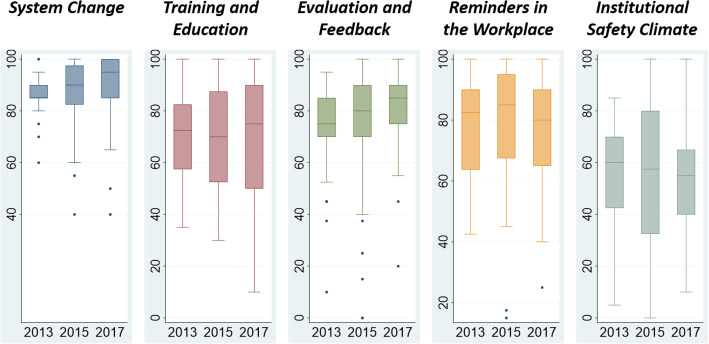
A total of 32 hospitals participated in the survey in 2013, 52 in 2015, and 101 in 2017. The number of inpatient beds per infection control professionals decreased from 324 in 2013 to 303 in 2015 and 179 in 2017. Most hospitals were at intermediate or advanced levels of progress (90.6% in 2013, 86.6% in 2015, and 94.1% in 2017). In the multivariable linear regression model, total HHSAF score was significantly associated with hospital teaching status (β coefficient of major teaching hospital, 52.6; 95% confidence interval [CI], 8.9 to 96.4; P = 0.018), beds size (β coefficient of 100 beds increase, 5.1; 95% CI, 0.3 to 9.8; P = 0.038), and survey time (β coefficient of 2017 survey, 45.1; 95% CI, 19.3 to 70.9; P = 0.001).
After the new national policy was implemented, the number of infection control professionals increased, and hand hygiene promotion activities were strengthened across Korean hospitals.
2015 年韩国中东呼吸综合征冠状病毒爆发后,政府制定了感染预防策略,以鼓励医院内的感染控制活动。新政策于 2015 年 12 月公布,并于 2016 年 9 月实施。本研究旨在评估政府政策变更后韩国医院内感染控制活动的改善情况。
使用世界卫生组织手部卫生自我评估框架(HHSAF)于 2013 年、2015 年和 2017 年进行了三次横断面调查。使用多变量线性回归模型,我们分析了根据调查年份的 HHSAF 总分变化。
共有 32 家医院参加了 2013 年的调查,52 家参加了 2015 年的调查,101 家参加了 2017 年的调查。感染控制专业人员每 324 张病床的数量从 2013 年的 303 张减少到 2015 年的 179 张。大多数医院处于中级或高级进展水平(2013 年为 90.6%,2015 年为 86.6%,2017 年为 94.1%)。在多变量线性回归模型中,HHSAF 总分与医院教学状况显著相关(主要教学医院的β系数为 52.6;95%置信区间[CI],8.9 至 96.4;P=0.018)、床位规模(床位增加 100 张的β系数为 5.1;95%CI,0.3 至 9.8;P=0.038)和调查时间(2017 年调查的β系数为 45.1;95%CI,19.3 至 70.9;P=0.001)。
新国家政策实施后,韩国医院的感染控制专业人员增加,手部卫生促进活动得到加强。