Department of Chemistry, University of Wisconsin-Madison, Madison, WI 53706.
Molecular and Cellular Pharmacology Training Program, University of Wisconsin-Madison, Madison, WI 53705.
Proc Natl Acad Sci U S A. 2020 Oct 6;117(40):24691-24700. doi: 10.1073/pnas.2006764117. Epub 2020 Sep 23.
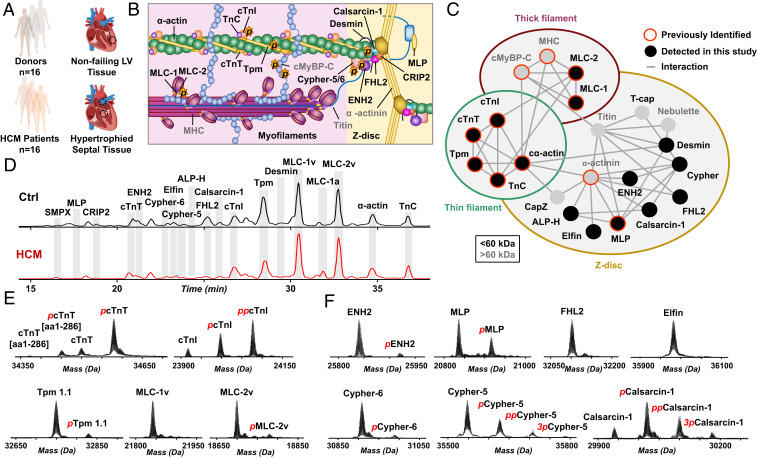
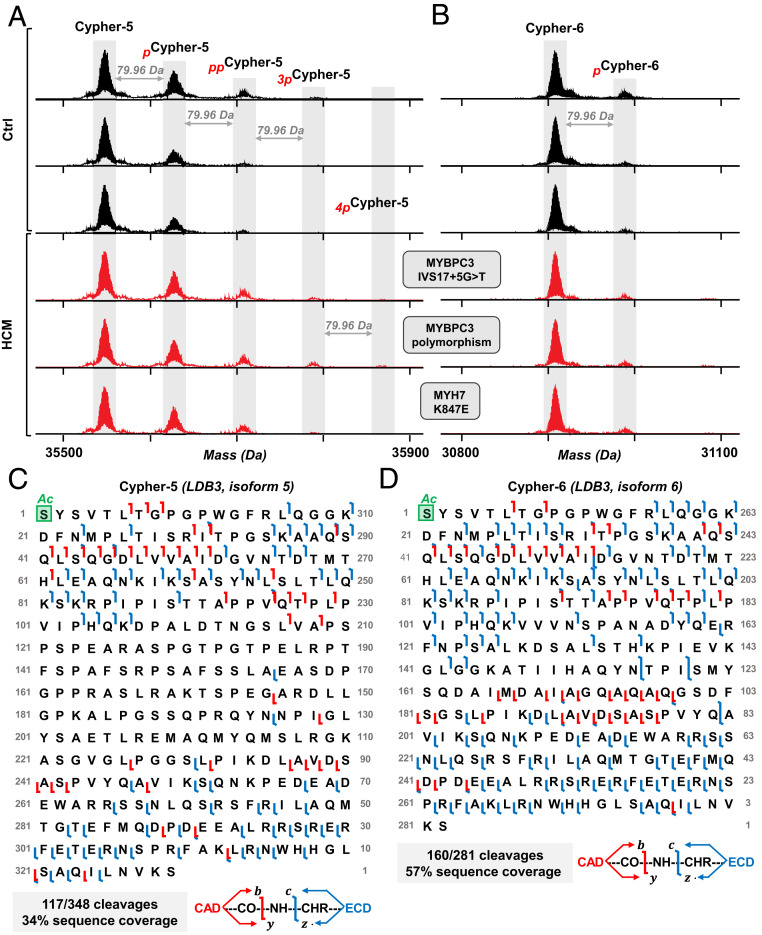
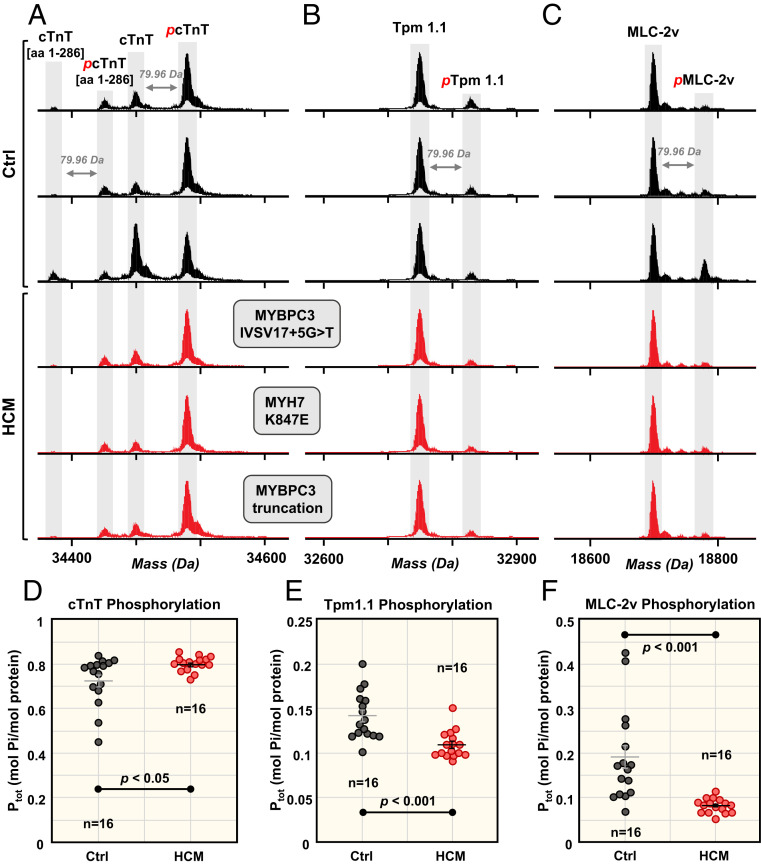
Hypertrophic cardiomyopathy (HCM) is the most common heritable heart disease. Although the genetic cause of HCM has been linked to mutations in genes encoding sarcomeric proteins, the ability to predict clinical outcomes based on specific mutations in HCM patients is limited. Moreover, how mutations in different sarcomeric proteins can result in highly similar clinical phenotypes remains unknown. Posttranslational modifications (PTMs) and alternative splicing regulate the function of sarcomeric proteins; hence, it is critical to study HCM at the level of proteoforms to gain insights into the mechanisms underlying HCM. Herein, we employed high-resolution mass spectrometry-based top-down proteomics to comprehensively characterize sarcomeric proteoforms in septal myectomy tissues from HCM patients exhibiting severe outflow track obstruction ( = 16) compared to nonfailing donor hearts ( = 16). We observed a complex landscape of sarcomeric proteoforms arising from combinatorial PTMs, alternative splicing, and genetic variation in HCM. A coordinated decrease of phosphorylation in important myofilament and Z-disk proteins with a linear correlation suggests PTM cross-talk in the sarcomere and dysregulation of protein kinase A pathways in HCM. Strikingly, we discovered that the sarcomeric proteoform alterations in the myocardium of HCM patients undergoing septal myectomy were remarkably consistent, regardless of the underlying HCM-causing mutations. This study suggests that the manifestation of severe HCM coalesces at the proteoform level despite distinct genotype, which underscores the importance of molecular characterization of HCM phenotype and presents an opportunity to identify broad-spectrum treatments to mitigate the most severe manifestations of this genetically heterogenous disease.
肥厚型心肌病(HCM)是最常见的遗传性心脏病。尽管 HCM 的遗传原因与编码肌节蛋白的基因突变有关,但根据 HCM 患者的特定突变来预测临床结果的能力是有限的。此外,不同肌节蛋白中的突变如何导致高度相似的临床表型仍然未知。翻译后修饰(PTMs)和选择性剪接调节肌节蛋白的功能;因此,在蛋白水平上研究 HCM 以深入了解 HCM 的机制至关重要。在这里,我们采用基于高分辨率质谱的自上而下的蛋白质组学方法,全面描述了来自 HCM 患者(表现出严重流出道阻塞的患者,n = 16)和非衰竭供体心脏(n = 16)的间隔心肌切除术组织中的肌节蛋白蛋白异构体。我们观察到 HCM 中肌节蛋白蛋白异构体的复杂组合 PTMs、选择性剪接和遗传变异景观。重要肌丝和 Z 盘蛋白磷酸化的协同减少与线性相关性表明肌节中的 PTM 串扰和蛋白激酶 A 途径在 HCM 中的失调。引人注目的是,我们发现接受间隔心肌切除术的 HCM 患者心肌中的肌节蛋白蛋白异构体改变非常一致,无论潜在的 HCM 致病突变如何。这项研究表明,尽管存在明显的基因型,但严重 HCM 的表现会在蛋白异构体水平上融合,这突显了对 HCM 表型进行分子特征描述的重要性,并为识别广谱治疗方法提供了机会,以减轻这种遗传异质性疾病的最严重表现。