
LOX 家族基因在肾透明细胞癌中的表达水平及预后价值的综合分析。
Comprehensive analysis on the expression levels and prognostic values of LOX family genes in kidney renal clear cell carcinoma.
机构信息
Cancer Biology Research Center (Key Laboratory of the Ministry of Education), Tongji Hospital, Tongji Medical College, Huazhong University of Science and Technology, Wuhan, China.
Department of Nuclear Medicine, Huashan Hospital, Fudan University, Shanghai, China.
出版信息
Cancer Med. 2020 Nov;9(22):8624-8638. doi: 10.1002/cam4.3472. Epub 2020 Sep 24.
BACKGROUNDS
Kidney renal clear cell carcinoma (KIRC) is a major pathological type of renal cell carcinoma (RCC), and the prognosis of advanced KIRC patients is often unsatisfactory. Some lysine oxidase (LOX) family genes have been proven to be upregulated in some malignancies and play pivotal roles in the carcinogenesis. However, their roles in KIRC remain unclear.
MATERIALS AND METHODS
Here, we used some online databases (eg, ONCOMINE, GEPIA, UALCAN, c-BioPortal, Human Protein Altas) to comprehensively explored the expression levels and the prognostic values of LOX family genes in KIRC using bioinformatic methods.
RESULTS
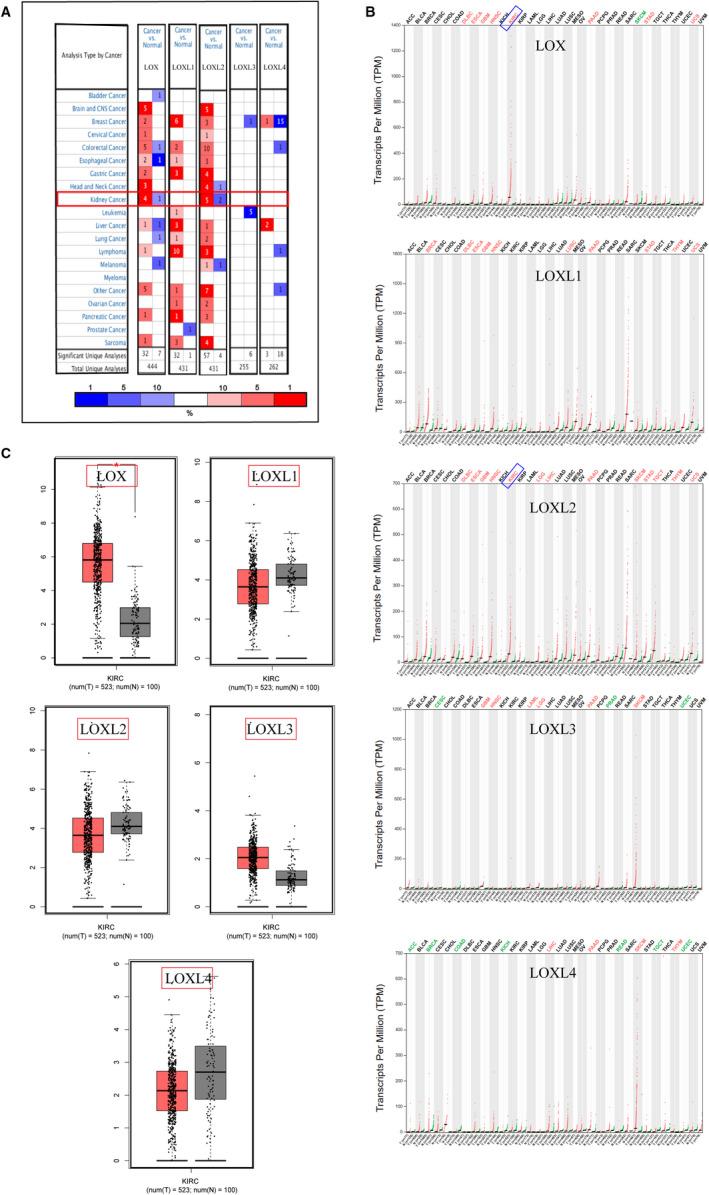
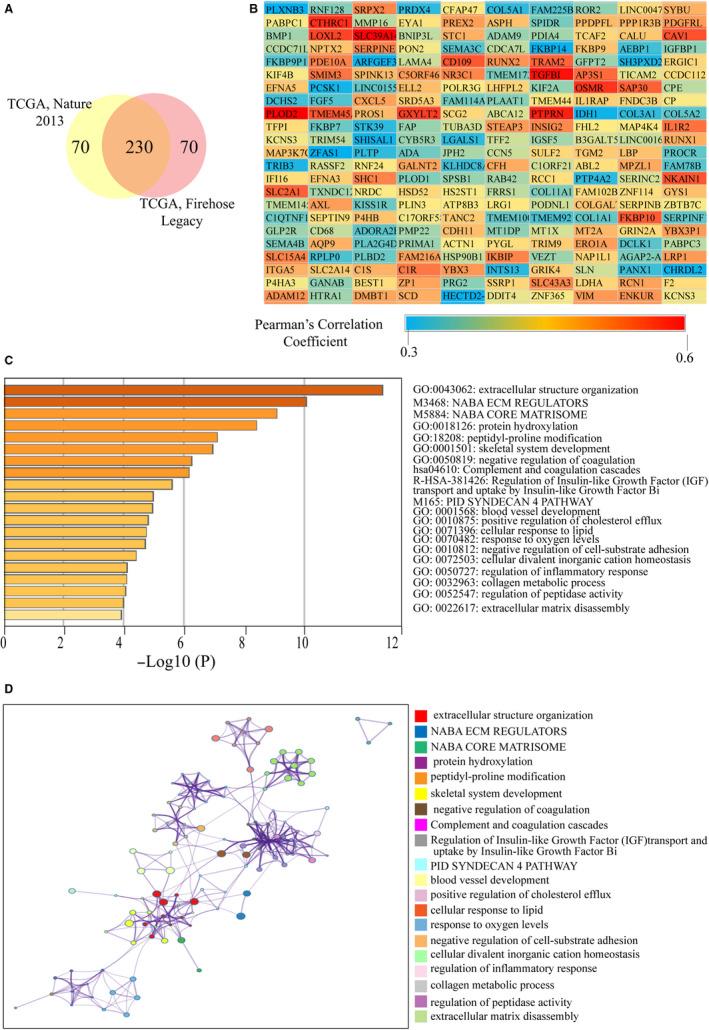
The results revealed that lysyl oxidase (LOX) and lysyl oxidase-like 2 (LOXL2) were significantly overexpressed in KIRC at the level of mRNA expression, protein expression, and RCC cell lines. Further analysis demonstrated that higher mRNA expression of LOX and LOXL2 were significantly correlated with poor survival, tumor grade, individual cancer stages, and nodal metastasis status. DNA copy number amplifications and mRNA upregulation, DNA deep deletion, and mRNA upregulation were the main genetic mutations of LOX and LOXL2, respectively. Prognostic analysis showed that the altered group had significantly poorer overall survival (OS) compared to the unaltered group (p = .0387). Co-expression analysis showed CP, PLOD2, and COL5A1 were significantly correlated with LOX, and COL1A2 was positively correlated with LOXL2. Further analysis confirmed that these co-expressed genes were significantly upregulated and predicted unfavorable prognosis in KIRC.
CONCLUSION
Multi-level analysis demonstrated that LOX and LOXL2 were significantly upregulated and predicted poor survival in KIRC, which may apply as promising biomarkers for diagnosis and therapy of KIRC in the future.
背景
肾透明细胞癌(KIRC)是肾细胞癌(RCC)的主要病理类型,晚期 KIRC 患者的预后往往不理想。一些赖氨酸氧化酶(LOX)家族基因已被证明在一些恶性肿瘤中上调,并在肿瘤发生中起关键作用。然而,它们在 KIRC 中的作用尚不清楚。
材料和方法
在这里,我们使用了一些在线数据库(例如 ONCOMINE、GEPIA、UALCAN、c-BioPortal、Human Protein Altas),使用生物信息学方法全面探讨了 LOX 家族基因在 KIRC 中的表达水平和预后价值。
结果
结果表明,赖氨酸氧化酶(LOX)和赖氨酸氧化酶样 2(LOXL2)在 KIRC 的 mRNA 表达、蛋白质表达和 RCC 细胞系中均显著过表达。进一步分析表明,LOX 和 LOXL2 的 mRNA 表达水平较高与生存率差、肿瘤分级、个体癌症分期和淋巴结转移状态显著相关。LOX 和 LOXL2 的主要基因突变分别为 DNA 拷贝数扩增和 mRNA 上调、DNA 深度缺失和 mRNA 上调。预后分析表明,改变组的总生存期(OS)明显比未改变组差(p=0.0387)。共表达分析表明 CP、PLOD2 和 COL5A1 与 LOX 显著相关,COL1A2 与 LOXL2 呈正相关。进一步分析证实,这些共表达基因在 KIRC 中显著上调并预测预后不良。
结论
多层次分析表明,LOX 和 LOXL2 在 KIRC 中显著上调并预测生存率差,这可能为 KIRC 的诊断和治疗提供有前途的生物标志物。





 Zotero 插件