Kenya Medical Research Institute (KEMRI) Center for Geographical Medicine Research-Coast, KEMRI-Wellcome Trust Research Programme, Kilifi P.O. Box 230-80108, Kenya.
Centre for Tropical Medicine and Global Health, Nuffield Department of Medicine, University of Oxford, Oxford OX3 7FZ, UK.
Int J Mol Sci. 2020 Sep 22;21(18):6976. doi: 10.3390/ijms21186976.
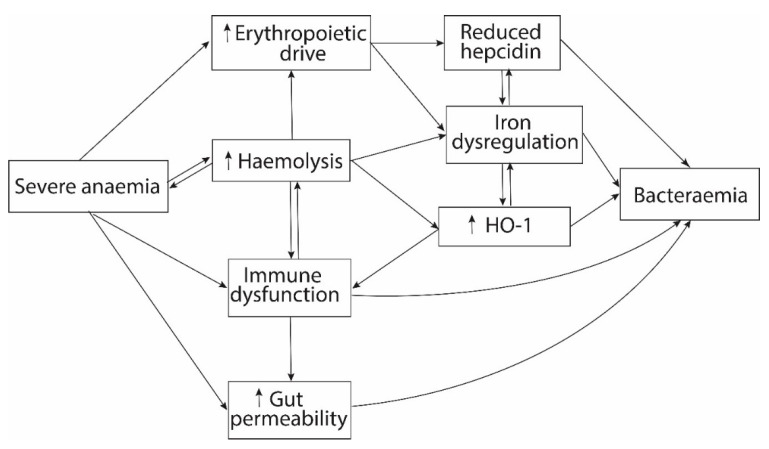
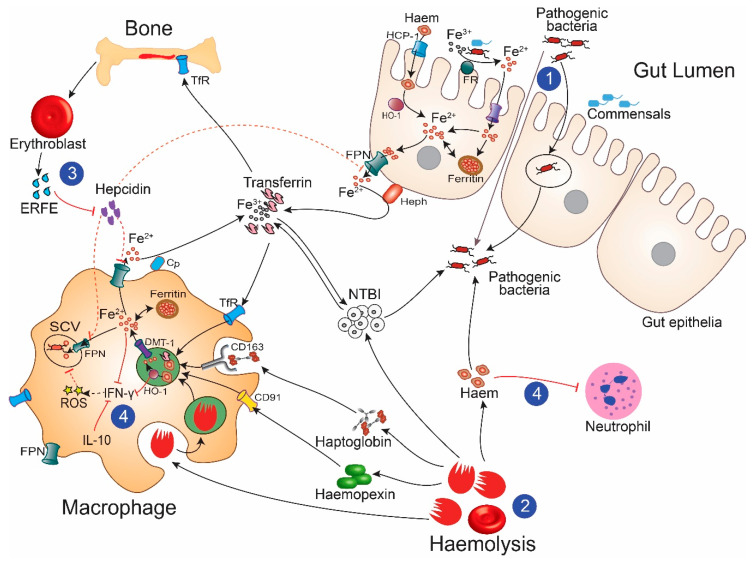
Severe anaemia and invasive bacterial infections are common causes of childhood sickness and death in sub-Saharan Africa. Accumulating evidence suggests that severely anaemic African children may have a higher risk of invasive bacterial infections. However, the mechanisms underlying this association remain poorly described. Severe anaemia is characterized by increased haemolysis, erythropoietic drive, gut permeability, and disruption of immune regulatory systems. These pathways are associated with dysregulation of iron homeostasis, including the downregulation of the hepatic hormone hepcidin. Increased haemolysis and low hepcidin levels potentially increase plasma, tissue and intracellular iron levels. Pathogenic bacteria require iron and/or haem to proliferate and have evolved numerous strategies to acquire labile and protein-bound iron/haem. In this review, we discuss how severe anaemia may mediate the risk of invasive bacterial infections through dysregulation of hepcidin and/or iron homeostasis, and potential studies that could be conducted to test this hypothesis.
严重贫血和侵袭性细菌感染是撒哈拉以南非洲儿童疾病和死亡的常见原因。越来越多的证据表明,严重贫血的非洲儿童可能有更高的侵袭性细菌感染风险。然而,这种关联的机制仍描述不足。严重贫血的特征是溶血增加、红细胞生成驱动、肠道通透性增加以及免疫调节系统受损。这些途径与铁稳态的失调有关,包括肝脏激素铁调素的下调。溶血增加和铁调素水平降低可能会增加血浆、组织和细胞内铁水平。病原体需要铁和/或血红素来增殖,并进化出许多策略来获取可利用的和蛋白结合的铁/血红素。在这篇综述中,我们讨论了严重贫血如何通过铁调素和/或铁稳态的失调来介导侵袭性细菌感染的风险,以及可以进行哪些潜在的研究来检验这一假设。