Centre for Molecular and Vascular Biology, Department of Cardiovascular Sciences, KU Leuven, Herestraat 49, Bus 911, 3000, Leuven, Belgium.
Department of Cardiology, CARIM School for Cardiovascular Diseases, Maastricht University, Universiteitssingel 50, 6229 ER, Maastricht, The Netherlands.
Sci Rep. 2020 Sep 24;10(1):15701. doi: 10.1038/s41598-020-72924-5.
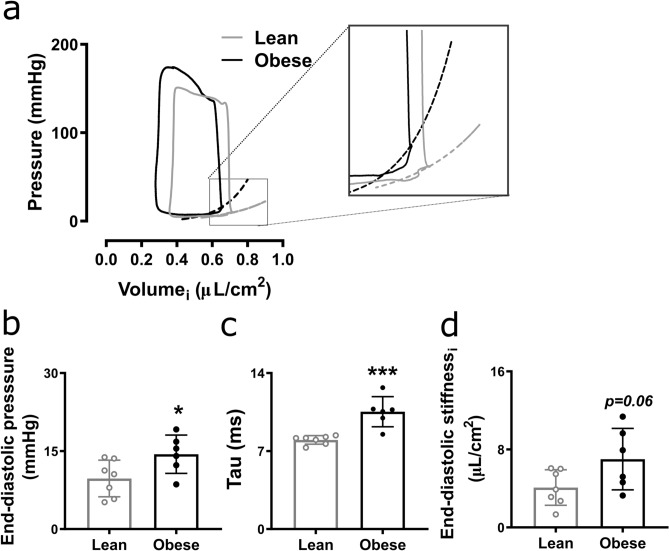
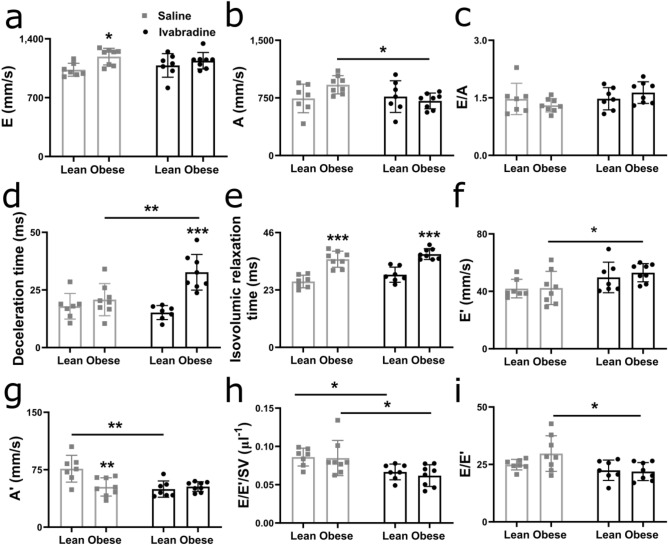
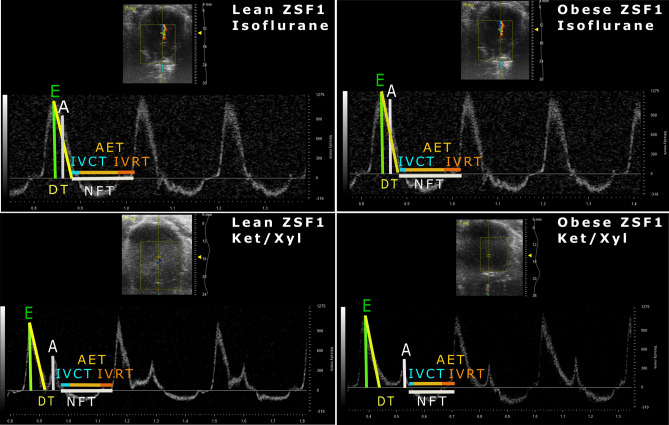
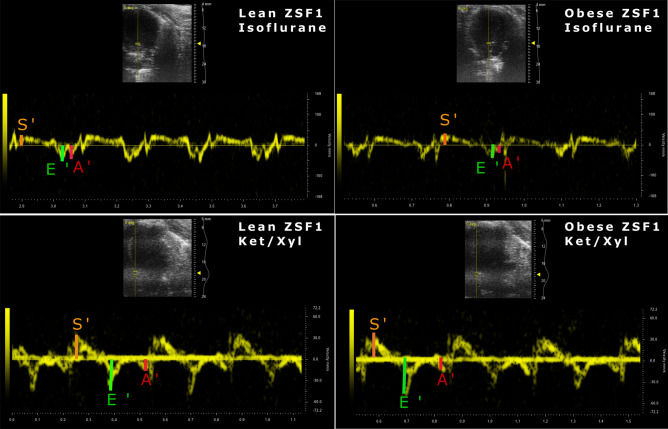
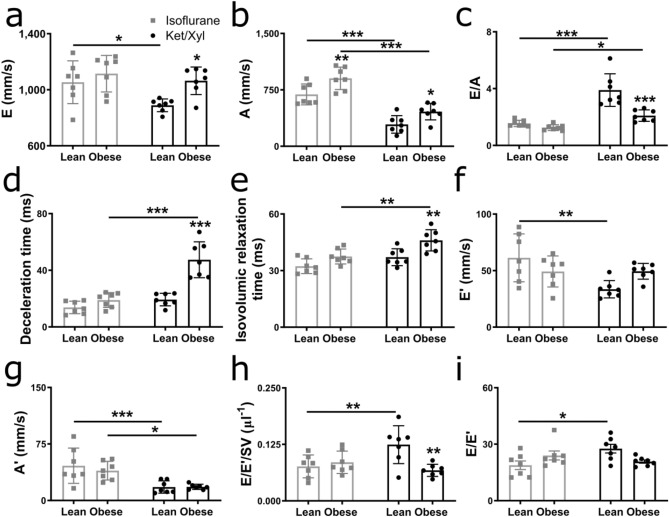
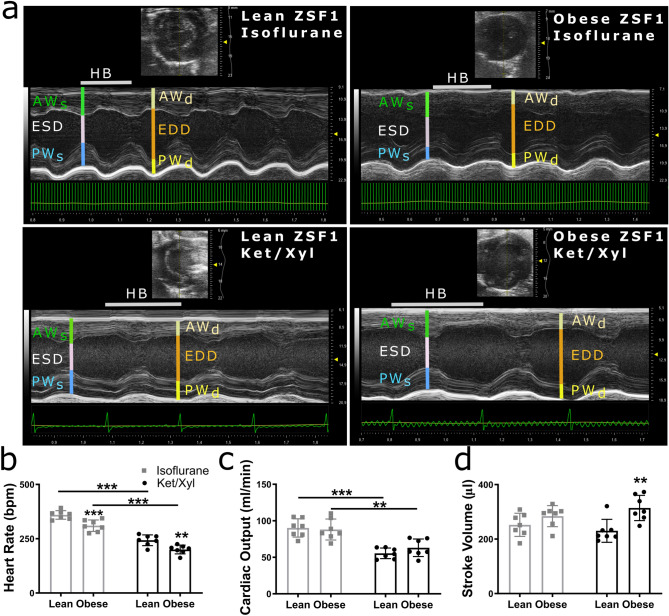
Heart failure with preserved ejection fraction (HFpEF) is currently untreated. Therapeutics development demands effective diagnosis of diastolic dysfunction in animal models mimicking human pathology, which requires appropriate anaesthetics. Here, we investigated which anaesthetic, ketamine/xylazine or isoflurane, could be used to reveal diastolic dysfunction in HFpEF-diseased obese ZSF1 rats by echocardiography. First, diastolic dysfunction was confirmed by pressure-volume loops in obese compared to lean control ZSF1 rats. In echocardiography, ketamine/xylazine, unlike isoflurane, was able to demonstrate impaired relaxation in obese ZSF1 rats, as reflected by impaired early (E) and late (A) filling peak velocities, decreased E/A ratio, and a prolonged deceleration and isovolumic relaxation time. Interestingly, ketamine/xylazine induced a wider separation of both tissue and pulsed wave Doppler-derived echocardiographic waves required for diastolic dysfunction diagnosis, potentially by reducing the heart rate (HR), while isoflurane resulted in merged waves. To assess whether HR-lowering alone explained the differences between the anaesthetics, echocardiography measurements under isoflurane with and without the HR-lowering drug ivabradine were compared. However, diastolic dysfunction could not be diagnosed in ivabradine-treated obese ZSF1 rats. In summary, ketamine/xylazine compared to isoflurane is the anaesthetic of choice to detect diastolic dysfunction by echocardiography in rodent HFpEF, which was only partly mediated by HR-lowering.
射血分数保留型心力衰竭(HFpEF)目前尚无有效治疗方法。治疗药物的研发需要在模拟人类病理的动物模型中对舒张功能障碍进行有效的诊断,这就需要合适的麻醉剂。在这里,我们研究了哪种麻醉剂(氯胺酮/甲苯噻嗪或异氟烷)可用于通过超声心动图来检测模拟人类病理的肥胖 ZSF1 大鼠的 HFpEF 舒张功能障碍。首先,与瘦型对照 ZSF1 大鼠相比,压力-容积环证实了肥胖大鼠存在舒张功能障碍。在超声心动图中,与异氟烷不同,氯胺酮/甲苯噻嗪能够显示肥胖 ZSF1 大鼠的舒张功能障碍,表现为早期(E)和晚期(A)充盈峰值速度受损、E/A 比值降低以及减速和等容舒张时间延长。有趣的是,氯胺酮/甲苯噻嗪诱导了组织多普勒和脉冲波多普勒衍生的超声心动图波之间更大的分离,这可能是通过降低心率(HR)来实现的,而异氟烷则导致了波的融合。为了评估 HR 降低是否单独解释了两种麻醉剂之间的差异,比较了异氟烷下和 HR 降低药物伊伐布雷定存在或不存在下的超声心动图测量值。然而,在伊伐布雷定治疗的肥胖 ZSF1 大鼠中,无法诊断舒张功能障碍。综上所述,与异氟烷相比,氯胺酮/甲苯噻嗪是通过超声心动图检测啮齿类 HFpEF 舒张功能障碍的首选麻醉剂,这主要是通过降低 HR 来实现的。