Chen Ray, Wong Hon Lun, Kindler Gareth S, MacLeod Fraser Iain, Benaud Nicole, Ferrari Belinda C, Burns Brendan P
School of Biotechnology and Biomolecular Sciences, University of New South Wales, Sydney, NSW, Australia.
Australian Centre for Astrobiology, University of New South Wales, Sydney, NSW, Australia.
Front Microbiol. 2020 Aug 21;11:1950. doi: 10.3389/fmicb.2020.01950. eCollection 2020.
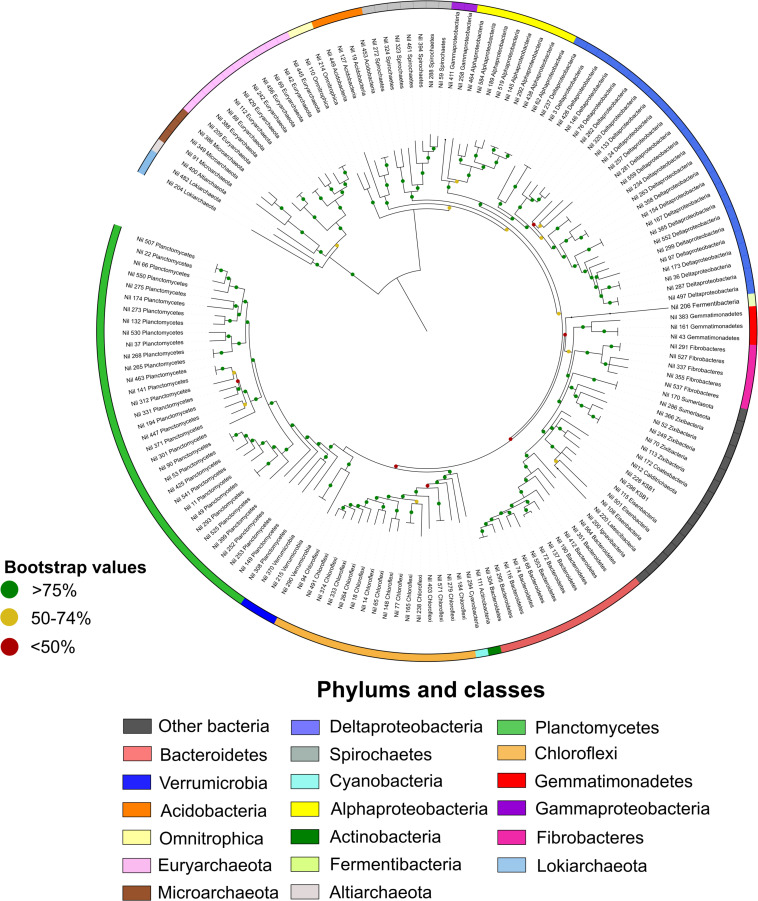
Microbial mats are geobiological multilayered ecosystems that have significant evolutionary value in understanding the evolution of early life on Earth. Shark Bay, Australia has some of the best examples of modern microbial mats thriving under harsh conditions of high temperatures, salinity, desiccation, and ultraviolet (UV) radiation. Microorganisms living in extreme ecosystems are thought to potentially encode for secondary metabolites as a survival strategy. Many secondary metabolites are natural products encoded by a grouping of genes known as biosynthetic gene clusters (BGCs). Natural products have diverse chemical structures and functions which provide competitive advantages for microorganisms and can also have biotechnology applications. In the present study, the diversity of BGC were described in detail for the first time from Shark Bay microbial mats. A total of 1477 BGCs were detected in metagenomic data over a 20 mm mat depth horizon, with the surface layer possessing over 200 BGCs and containing the highest relative abundance of BGCs of all mat layers. Terpene and bacteriocin BGCs were highly represented and their natural products are proposed to have important roles in ecosystem function in these mat systems. Interestingly, potentially novel BGCs were detected from Heimdallarchaeota and Lokiarchaeota, two evolutionarily significant archaeal phyla not previously known to possess BGCs. This study provides new insights into how secondary metabolites from BGCs may enable diverse microbial mat communities to adapt to extreme environments.
微生物席是具有重要进化价值的地质生物学多层生态系统,有助于理解地球早期生命的演化。澳大利亚的鲨鱼湾拥有一些现代微生物席的最佳范例,这些微生物席在高温、高盐、干燥和紫外线辐射等恶劣条件下蓬勃生长。生活在极端生态系统中的微生物被认为可能编码次生代谢产物作为一种生存策略。许多次生代谢产物是由一组被称为生物合成基因簇(BGCs)的基因编码的天然产物。天然产物具有多样的化学结构和功能,为微生物提供竞争优势,也具有生物技术应用价值。在本研究中,首次详细描述了鲨鱼湾微生物席中BGC的多样性。在20毫米厚的微生物席深度范围内的宏基因组数据中,共检测到1477个BGC,表层拥有200多个BGC,且其BGC相对丰度在所有微生物席层中最高。萜类和细菌素BGC的占比很高,其天然产物被认为在这些微生物席系统的生态系统功能中发挥重要作用。有趣的是,在海姆达尔古菌门和洛基古菌门中检测到了潜在的新型BGC,这两个在进化上具有重要意义的古菌门此前并不被认为拥有BGC。这项研究为来自BGC的次生代谢产物如何使不同的微生物席群落适应极端环境提供了新的见解。