Department of Hematology, Leiden University Medical Center, Leiden, Netherlands.
Center for Clinical Transfusion Research, Sanquin Research, Leiden, Netherlands.
Front Immunol. 2020 Aug 20;11:1804. doi: 10.3389/fimmu.2020.01804. eCollection 2020.
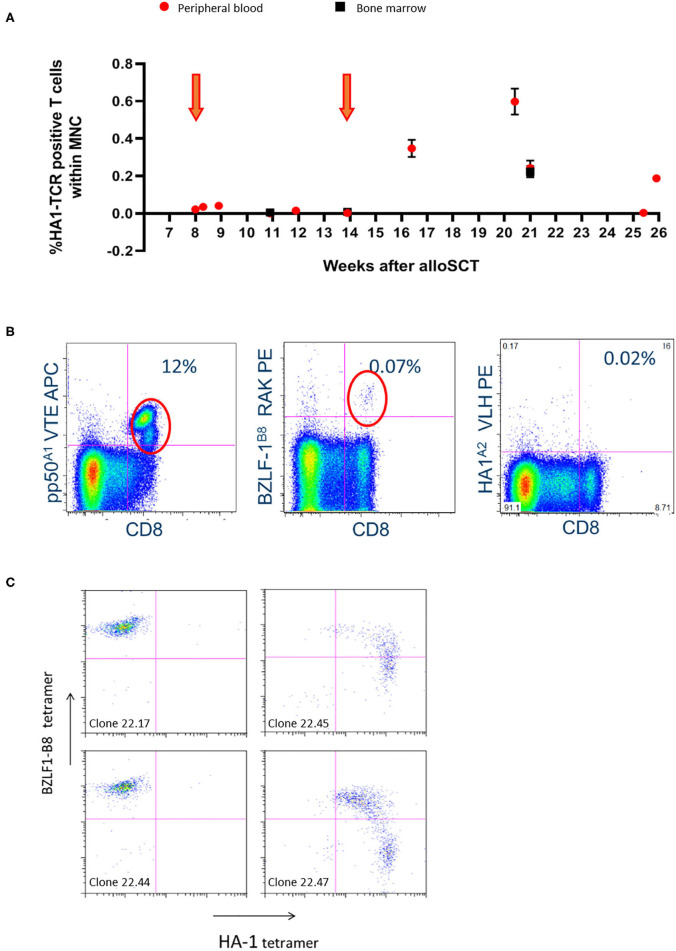
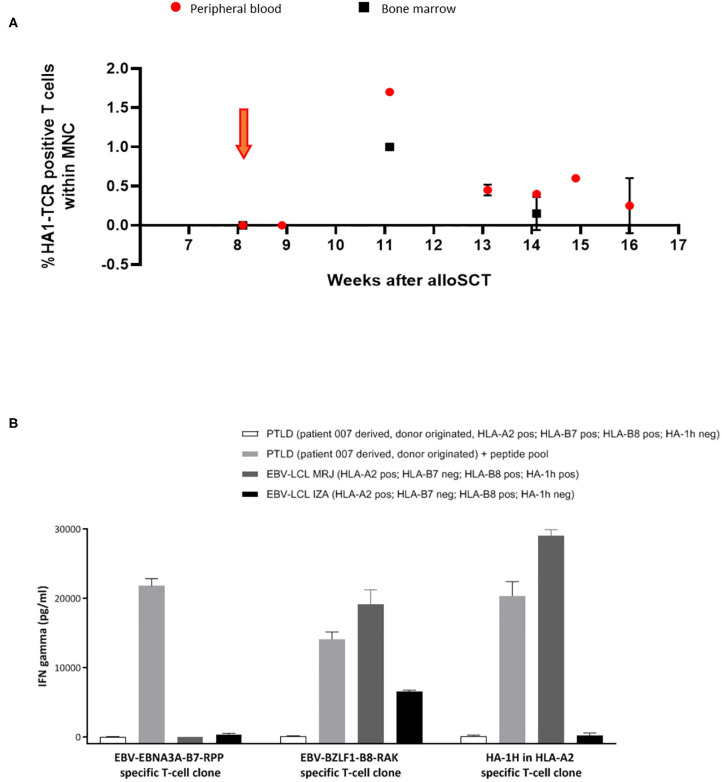
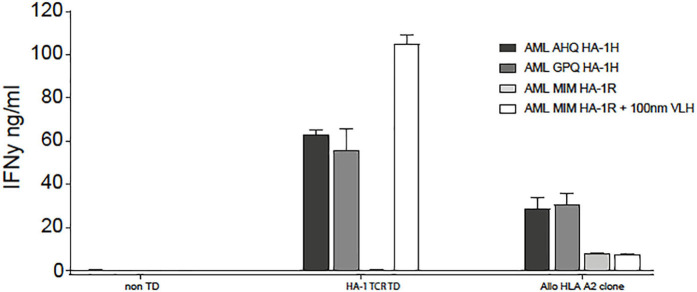
Graft-vs.-leukemia (GVL) reactivity after HLA-matched allogeneic stem cell transplantation (alloSCT) is mainly mediated by donor T cells recognizing minor histocompatibility antigens (MiHA). If MiHA are targeted that are exclusively expressed on hematopoietic cells of recipient origin, selective GVL reactivity without severe graft-vs.-host-disease (GVHD) may occur. In this phase I study we explored HA-1H TCR gene transfer into T cells harvested from the HA-1H negative stem-cell donor to treat HA-1H positive HLA-A02:01 positive patients with high-risk leukemia after alloSCT. HA-1H is a hematopoiesis-restricted MiHA presented in HLA-A02:01. Since we previously demonstrated that donor-derived virus-specific T-cell infusions did not result in GVHD, we used donor-derived EBV and/or CMV-specific T-cells to be redirected by HA-1H TCR. EBV and/or CMV-specific T-cells were purified, retrovirally transduced with HA-1H TCR, and expanded. Validation experiments illustrated dual recognition of viral antigens and HA-1H by HA-1H TCR-engineered virus-specific T-cells. Release criteria included products containing more than 60% antigen-specific T-cells. Patients with high risk leukemia following T-cell depleted alloSCT in complete or partial remission were eligible. HA-1H TCR T-cells were infused 8 and 14 weeks after alloSCT without additional pre-conditioning chemotherapy. For 4/9 included patients no appropriate products could be made. Their donors were all CMV-negative, thereby restricting the production process to EBV-specific T-cells. For 5 patients a total of 10 products could be made meeting the release criteria containing 3-280 × 10 virus and/or HA-1H TCR T-cells. No infusion-related toxicity, delayed toxicity or GVHD occurred. One patient with relapsed AML at time of infusions died due to rapidly progressing disease. Four patients were in remission at time of infusion. Two patients died of infections during follow-up, not likely related to the infusion. Two patients are alive and well without GVHD. In 2 patients persistence of HA-1H TCR T-cells could be illustrated correlating with viral reactivation, but no overt expansion of infused T-cells was observed. In conclusion, HA-1H TCR-redirected virus-specific T-cells could be made and safely infused in 5 patients with high-risk AML, but overall feasibility and efficacy was too low to warrant further clinical development using this strategy. New strategies will be explored using patient-derived donor T-cells isolated after transplantation transduced with HA-1H-specific TCR to be infused following immune conditioning.
移植物抗白血病(GVL)反应在 HLA 匹配的异基因干细胞移植(alloSCT)后主要由识别次要组织相容性抗原(MiHA)的供体 T 细胞介导。如果靶向的 MiHA 仅在受者来源的造血细胞上表达,则可能发生选择性 GVL 反应而无严重移植物抗宿主病(GVHD)。在这项 I 期研究中,我们探索了从 HA-1H 阴性干细胞供体中采集的 T 细胞中转移 HA-1H TCR 基因,以治疗 alloSCT 后 HLA-A02:01 阳性高危白血病患者中的 HA-1H 阳性患者。HA-1H 是一种造血受限的 MiHA,在 HLA-A02:01 中呈现。由于我们之前证明供体来源的病毒特异性 T 细胞输注不会导致 GVHD,因此我们使用供体来源的 EBV 和/或 CMV 特异性 T 细胞来重定向 HA-1H TCR。EBV 和/或 CMV 特异性 T 细胞被纯化,逆转录病毒转导 HA-1H TCR,并进行扩增。验证实验表明,HA-1H TCR 工程化病毒特异性 T 细胞可双重识别病毒抗原和 HA-1H。释放标准包括含有超过 60%抗原特异性 T 细胞的产品。在完全或部分缓解后接受 T 细胞耗尽的 alloSCT 的高危白血病患者符合条件。在 alloSCT 后 8 周和 14 周时输注 HA-1H TCR T 细胞,无需额外的预处理化疗。对于纳入的 9 名患者中的 4 名,无法制备出合适的产品。他们的供体均为 CMV 阴性,因此生产过程仅限于 EBV 特异性 T 细胞。对于 5 名患者,共制备了 10 种符合释放标准的产品,其中含有 3-280×10 的病毒和/或 HA-1H TCR T 细胞。没有发生与输注相关的毒性、迟发性毒性或 GVHD。一名在输注时患有复发 AML 的患者因疾病迅速进展而死亡。在输注时,4 名患者处于缓解期。在随访期间,2 名患者因感染死亡,这可能与输注无关。2 名患者情况良好,无 GVHD。在 2 名患者中,HA-1H TCR T 细胞的持续存在可与病毒再激活相关联,但未观察到输注 T 细胞的明显扩增。总之,我们可以制备并安全输注 5 名高危 AML 患者的 HA-1H TCR 重定向病毒特异性 T 细胞,但总体可行性和疗效太低,不支持使用该策略进一步进行临床开发。我们将探索使用移植后分离的源自患者的供体 T 细胞,在免疫调理后转导 HA-1H 特异性 TCR 进行输注的新策略。