Terradas-Monllor Marc, Ochandorena-Acha Mirari, Salinas-Chesa Julio, Ramírez Sergi, Beltran-Alacreu Hector
Faculty of Health Sciences and Welfare, University of Vic-Central University of Catalonia, Vic, Spain.
Research Group on Methodology, Methods, Models and Outcomes of Health and Social Sciences (M3O), Faculty of Health Sciences and Welfare, Center for Health and Social Care Research (CESS), University of Vic-Central University of Catalonia (UVIC-UCC), Vic, Spain.
PeerJ. 2020 Sep 9;8:e9903. doi: 10.7717/peerj.9903. eCollection 2020.
Knee arthroplasty (KA) is a typically successful surgical procedure commonly performed to alleviate painin participants with end-stage knee osteoarthritis. Despite its beneficial effects, a significant proportion of individuals with KA continue experiencing persistent pain and functional limitations. The purpose of this study was to assess the postoperative outcomes after KA in relation to postoperative pain catastrophizing.
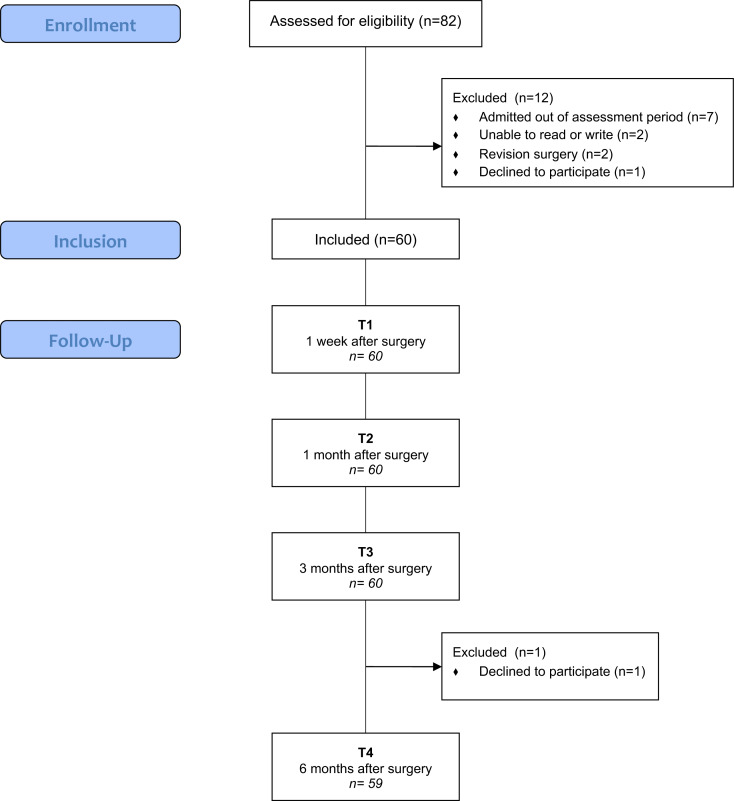
Participants were recruited at a domiciliary physiotherapy service, using a prospective, observational, hypothesis-generating cohort design. Participants were divided into two groups based on their Pain Catastrophizing Scale (PCS) total score (50th percentile), which resulted in high and low PCS groups. The primary outcome measure was the Western Ontario and McMaster Universities Osteoarthritis Index (WOMAC). In addition, quality of life, walking speed, physical performance, range of motion, and pain were measured. Outcome measures were collected at baseline (1 week postoperatively) and at follow-up (1, 3, and 6 months postoperatively).
A total of 60 participants (21 total KA and 39 unicompartmental KA) were recruited. Individuals with a higher degree of pain catastrophizing showed significantly higher WOMAC total scores at every follow-up, indicating poorer health functioning ( < 0.01). Similarly, the high PCS group showed higher WOMAC pain, stiffness and disability subscale scores ( < 0.05), poorer quality of life ( < 0.01), and poorer physical performance ( < 0.05) at every follow-up. In addition, the high PCS group achieved a slower walking speed at baseline and at 3 months follow-up ( < 0.05), and a higher degree of pain at rest, on walking and on knee flexion at every follow-up ( < 0.01, < 0.05 and < 0.05, respectively) except for walking pain at 3 months follow-up. No significant differences were observed between groups in range of motion, except for active knee extension at the 6-month follow-up ( < 0.05). Effect size was large at 1 month follow-up in WOMAC total score ( = 0.578) and pain intensity during knee flexion ( = 0.529). Longitudinal analyses revealed different improvement trends during the rehabilitation process between groups, with a lack of significant improvements in the high PCS group between the 3- and 6-month follow-up in WOMAC total score, WOMAC pain, WOMAC disability, quality of life, physical performance, active knee extension and resting pain ( > 0.05).
The results of the present study suggest that participants with high postoperative pain catastrophizing might have poorer outcomes during the rehabilitation process after KA. Future work should seek to clarify if this relationship is causal.
膝关节置换术(KA)是一种通常很成功的外科手术,常用于缓解终末期膝关节骨关节炎患者的疼痛。尽管其具有有益效果,但相当一部分接受KA手术的患者仍持续存在疼痛和功能受限问题。本研究的目的是评估KA术后与术后疼痛灾难化相关的结果。
采用前瞻性、观察性、假设生成队列设计,在居家物理治疗服务中招募参与者。根据疼痛灾难化量表(PCS)总分(第50百分位数)将参与者分为两组,形成高PCS组和低PCS组。主要结局指标是西安大略和麦克马斯特大学骨关节炎指数(WOMAC)。此外,还测量了生活质量、步行速度、身体功能、关节活动范围和疼痛。在基线(术后1周)和随访(术后1、3和6个月)时收集结局指标。
共招募了60名参与者(21例行全膝关节置换术,39例行单髁膝关节置换术)。疼痛灾难化程度较高的个体在每次随访时WOMAC总分显著更高,表明健康功能较差(P<0.01)。同样,高PCS组在每次随访时WOMAC疼痛、僵硬和残疾分量表得分更高(P<0.05),生活质量较差(P<0.01),身体功能较差(P<0.05)。此外,高PCS组在基线和3个月随访时步行速度较慢(P<0.05),在每次随访时静息痛、步行痛和膝关节屈曲痛程度更高(分别为P<0.01、P<0.05和P<0.05),3个月随访时步行痛除外。除6个月随访时主动膝关节伸展外,两组在关节活动范围方面未观察到显著差异(P<0.05)。在1个月随访时,WOMAC总分(效应量=0.578)和膝关节屈曲时疼痛强度(效应量=0.529)的效应量较大。纵向分析显示,两组在康复过程中的改善趋势不同,高PCS组在3至6个月随访期间WOMAC总分、WOMAC疼痛、WOMAC残疾、生活质量、身体功能、主动膝关节伸展和静息痛方面缺乏显著改善(P>0.05)。
本研究结果表明,术后疼痛灾难化程度高的参与者在KA术后康复过程中可能有较差的结果。未来的工作应致力于阐明这种关系是否为因果关系。