Mangalaparthi Kiran K, Patel Krishna, Khan Aafaque A, Manoharan Malini, Karunakaran Coral, Murugan Sakthivel, Gupta Ravi, Gupta Rohit, Khanna-Gupta Arati, Chaudhuri Amitabha, Kumar Prashant, Nair Bipin, Kumar Rekha V, Prasad T S Keshava, Chatterjee Aditi, Pandey Akhilesh, Gowda Harsha
Institute of Bioinformatics, International Technology Park, Bangalore, India.
Amrita School of Biotechnology, Amrita Vishwa Vidyapeetham, Kollam, India.
Front Oncol. 2020 Aug 20;10:1457. doi: 10.3389/fonc.2020.01457. eCollection 2020.
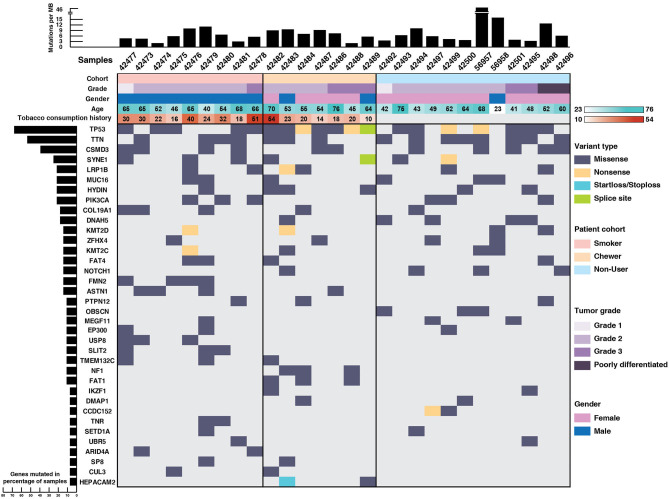
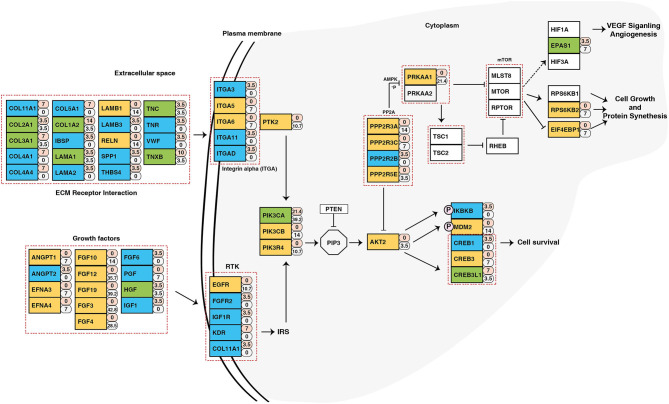
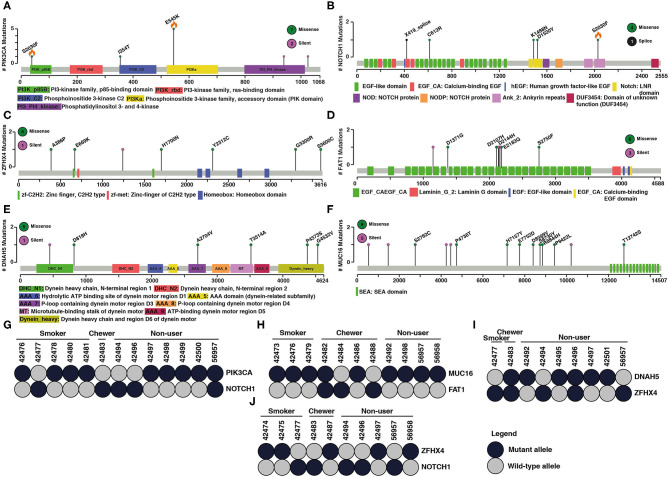
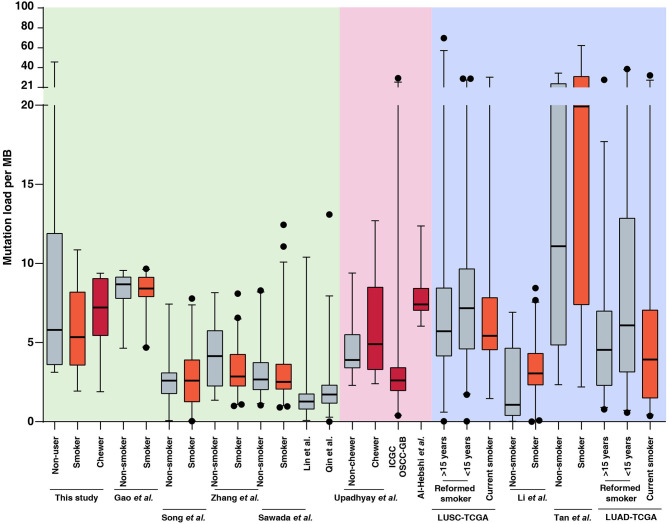
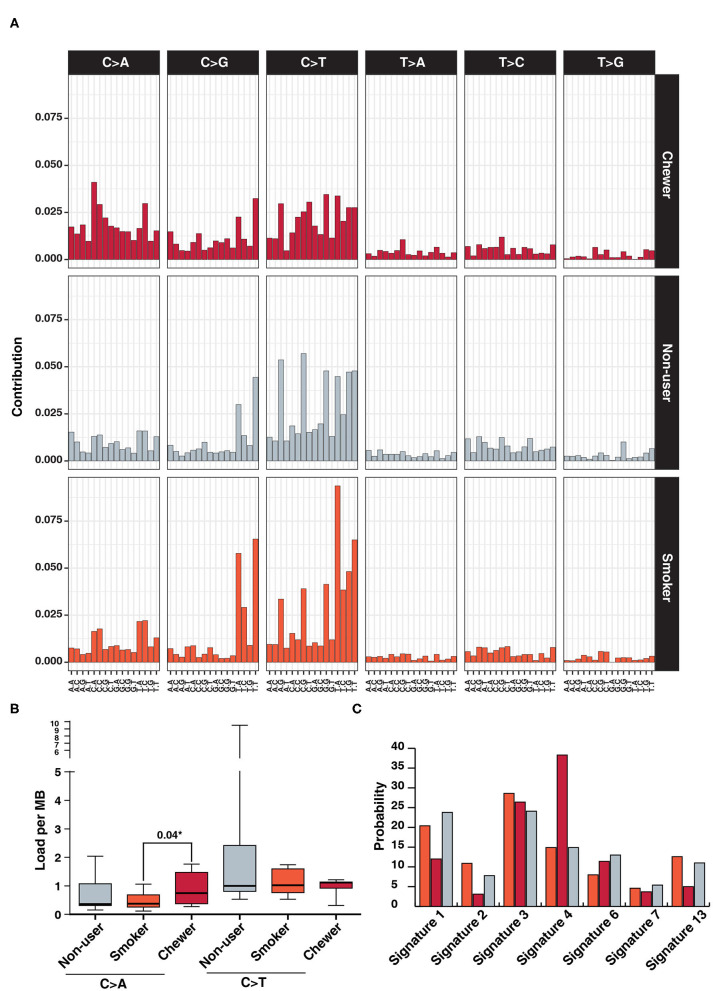
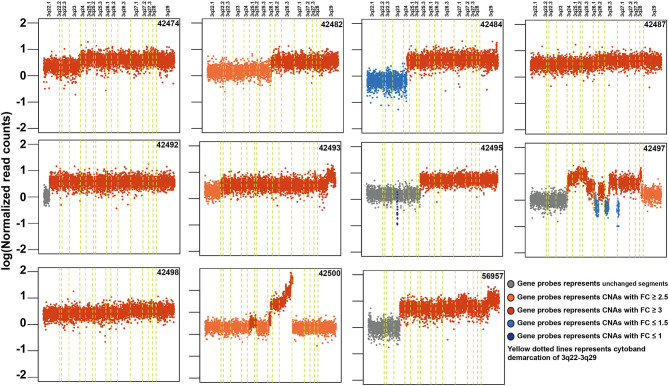
Esophageal squamous cell carcinoma (ESCC) is the most common histological subtype of esophageal cancer in India. Cigarette smoking and chewing tobacco are known risk factors associated with ESCC. However, genomic alterations associated with ESCC in India are not well-characterized. In this study, we carried out exome sequencing to characterize the mutational landscape of ESCC tumors from subjects with a varied history of tobacco usage. Whole exome sequence analysis of ESCC from an Indian cohort revealed several genes that were mutated or had copy number changes. ESCC from tobacco chewers had a higher frequency of C:G > A:T transversions and 2-fold enrichment for mutation signature 4 compared to smokers and non-users of tobacco. Genes, such as , and were found to be frequently mutated in Indian cohort. Mutually exclusive mutation patterns were observed in ---, and - gene pairs. Recurrent amplifications were observed in 3q22-3q29, 11q13.3-q13.4, 7q22.1-q31.1, and 8q24 regions. Approximately 53% of tumors had genomic alterations in making this pathway a promising candidate for targeted therapy. In conclusion, we observe enrichment of mutation signature 4 in ESCC tumors from patients with a history of tobacco chewing. This is likely due to direct exposure of esophagus to tobacco carcinogens when it is chewed and swallowed. Genomic alterations were frequently observed in PIK3CA-AKT pathway members independent of the history of tobacco usage. PIK3CA pathway can be potentially targeted in ESCC which currently has no effective targeted therapeutic options.
食管鳞状细胞癌(ESCC)是印度食管癌最常见的组织学亚型。吸烟和咀嚼烟草是已知的与ESCC相关的风险因素。然而,印度ESCC相关的基因组改变尚未得到充分表征。在本研究中,我们进行了外显子组测序,以表征来自有不同烟草使用史受试者的ESCC肿瘤的突变图谱。对一组印度ESCC患者进行全外显子组序列分析,发现了几个发生突变或有拷贝数变化的基因。与吸烟者和不使用烟草者相比,咀嚼烟草者的ESCC中C:G > A:T颠换频率更高,且突变特征4富集了2倍。在印度队列中发现,诸如 、 和 等基因经常发生突变。在 ---、 和 - 基因对中观察到互斥突变模式。在3q22 - 3q29、11q13.3 - q13.4、7q22.1 - q31.1和8q24区域观察到反复扩增。约53%的肿瘤在 中有基因组改变,这使得该通路成为靶向治疗的一个有前景的候选靶点。总之,我们观察到有咀嚼烟草史患者的ESCC肿瘤中突变特征4富集。这可能是由于食管在咀嚼和吞咽烟草时直接接触烟草致癌物所致。无论烟草使用史如何,在PIK3CA - AKT通路成员中经常观察到基因组改变。PIK3CA通路可能是ESCC潜在的靶向治疗靶点,目前ESCC尚无有效的靶向治疗选择。