Nagl Laurenz, Horvath Lena, Pircher Andreas, Wolf Dominik
Department of Internal Medicine V (Haematology and Oncology), Medical University of Innsbruck, Innsbruck, Austria.
Tyrolean Cancer Research Institute (TKFI), Innsbruck, Austria.
Front Cell Dev Biol. 2020 Aug 19;8:766. doi: 10.3389/fcell.2020.00766. eCollection 2020.
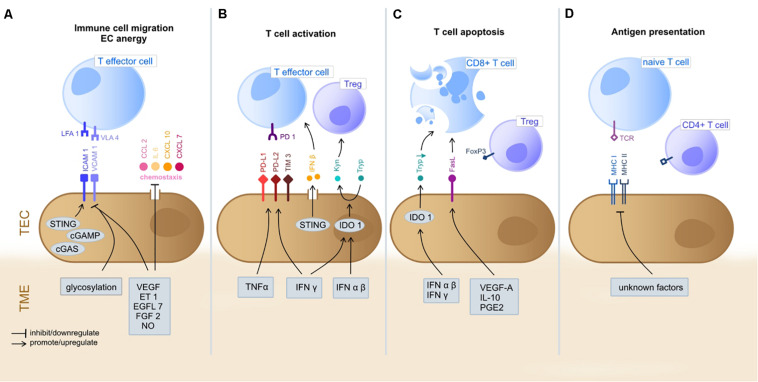
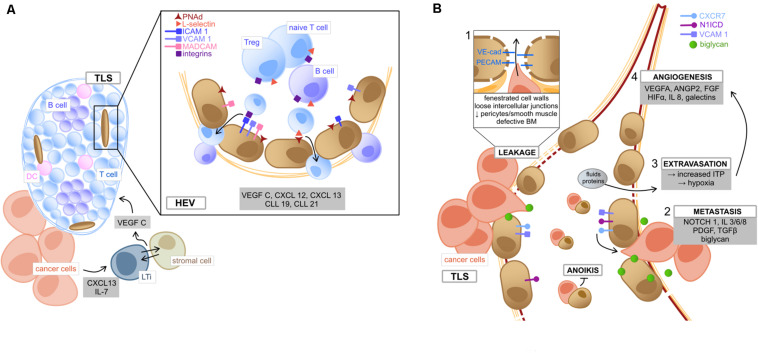
The tumor microenvironment (TME) plays a central role in cancer development and progression. It represents a complex network of cancer cell (sub-)clones and a variety of stromal cell types. Recently, new technology platforms shed light on the cellular composition of the TME at very high resolution and identified a complex landscape of multi-lineage immune cells (e.g., T and B lymphocytes, myeloid cells, and dendritic cells), cancer associated fibroblasts (CAF) and tumor endothelial cells (TECs). A growing body of evidence suggests that metabolically, genetically and on their transcriptomic profile TECs exhibit unique phenotypic and functional characteristics when compared to normal endothelial cells (NECs). Furthermore, the functional role of TECs is multifaceted as they are not only relevant for promoting tumor angiogenesis but have also evolved as key mediators of immune regulation in the TME. Regulatory mechanisms are complex and profoundly impact peripheral immune cell trafficking into the tumor compartment by acting as major gatekeepers of cellular transmigration. Moreover, TECs are associated with T cell priming, activation and proliferation by acting as antigen-presenting cells themselves. TECs are also essential for the formation of tertiary lymphoid structures (TLS) within the tumor, which have recently been associated with treatment response to checkpoint antibody therapy. Further essential characteristics of TECs compared to NECs are their high proliferative potential as well as greatly altered gene expression profile (e.g., upregulation of pro-angiogenic, extracellular matrix remodeling, and stemness genes), which results in enhanced secretion of immunomodulatory cytokines and altered cell-surface receptors [e.g., major histocompatibility complex (MHC) and immune checkpoints]. The TEC phenotype may be rooted in an aggressive tumor micro-milieu based on cellular stress hypoxia and reactive oxygen species (ROS). TECs might modulate TME immunogenicity thereby fostering cancer-associated immune suppression. This review aims to elucidate the currently emergent pathophysiological aspects of TECs with a particular focus on their potential role as regulators of immune cell function in the TME. It is a main future challenge to deeply characterize the phenotypic and functional profile of TECs to illuminate their complex role within the TME. The ultimate goal is the identification of TEC-specific drug targets to improve cancer (immuno-)therapy.
肿瘤微环境(TME)在癌症的发生和发展中起着核心作用。它代表了一个由癌细胞(亚)克隆和多种基质细胞类型组成的复杂网络。最近,新技术平台以非常高的分辨率揭示了TME的细胞组成,并确定了多谱系免疫细胞(如T和B淋巴细胞、髓样细胞和树突状细胞)、癌症相关成纤维细胞(CAF)和肿瘤内皮细胞(TEC)的复杂格局。越来越多的证据表明,与正常内皮细胞(NEC)相比,TEC在代谢、基因和转录组特征方面表现出独特的表型和功能特征。此外,TEC的功能是多方面的,它们不仅与促进肿瘤血管生成有关,而且已成为TME中免疫调节的关键介质。调节机制很复杂,通过作为细胞迁移的主要守门人,深刻影响外周免疫细胞向肿瘤区域的运输。此外,TEC本身作为抗原呈递细胞,与T细胞的启动、激活和增殖有关。TEC对于肿瘤内三级淋巴结构(TLS)的形成也至关重要,最近已发现其与检查点抗体治疗的反应有关。与NEC相比,TEC的其他重要特征包括其高增殖潜力以及显著改变的基因表达谱(如促血管生成、细胞外基质重塑和干性基因的上调),这导致免疫调节细胞因子的分泌增加和细胞表面受体的改变[如主要组织相容性复合体(MHC)和免疫检查点]。TEC表型可能源于基于细胞应激、缺氧和活性氧(ROS)的侵袭性肿瘤微环境。TEC可能调节TME的免疫原性,从而促进癌症相关的免疫抑制。本综述旨在阐明TEC目前新出现的病理生理方面,特别关注其作为TME中免疫细胞功能调节因子的潜在作用。深入表征TEC的表型和功能特征以阐明其在TME中的复杂作用是未来的一个主要挑战。最终目标是确定TEC特异性药物靶点,以改善癌症(免疫)治疗。