Department of General Practice, Erasmus MC University Medical Center Rotterdam, The Netherlands.
Department of Radiology & Nuclear Medicine, Erasmus MC University Medical Center Rotterdam, The Netherlands.
Rheumatology (Oxford). 2021 Mar 2;60(3):1392-1399. doi: 10.1093/rheumatology/keaa522.
To assess the association between meniscal volume, its change over time and the development of knee OA after 30 months in overweight/obese women.
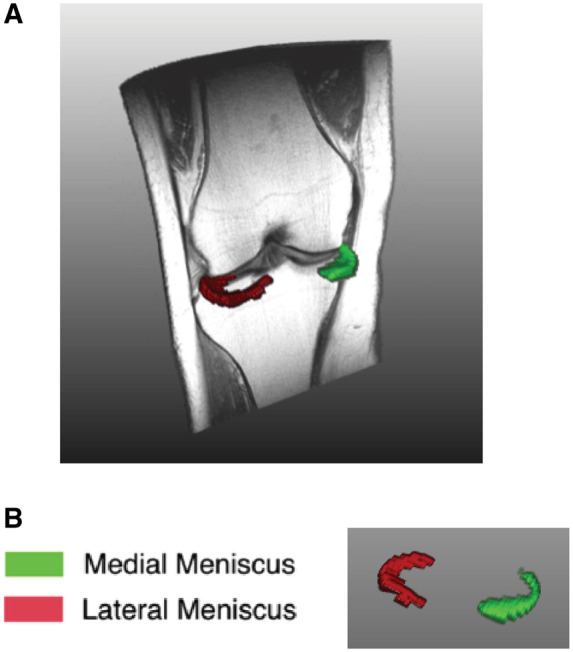
Data from the PRevention of knee Osteoarthritis in Overweight Females study were used. This cohort included 407 women with a BMI ≥ 27 kg/m2, free of OA-related symptoms. The primary outcome measure was incident OA after 30 months, defined by one out of the following criteria: medial or lateral joint space narrowing (JSN) ≥ 1.0 mm, incident radiographic OA [Kellgren and Lawrence (K&L) ≥ 2], or incident clinical OA. The secondary outcomes were either of these items separately. Menisci at both baseline and follow-up were automatically segmented to obtain meniscal volume and delta-volumes. Generalized estimating equations were used to evaluate associations between the volume measures and the outcomes.
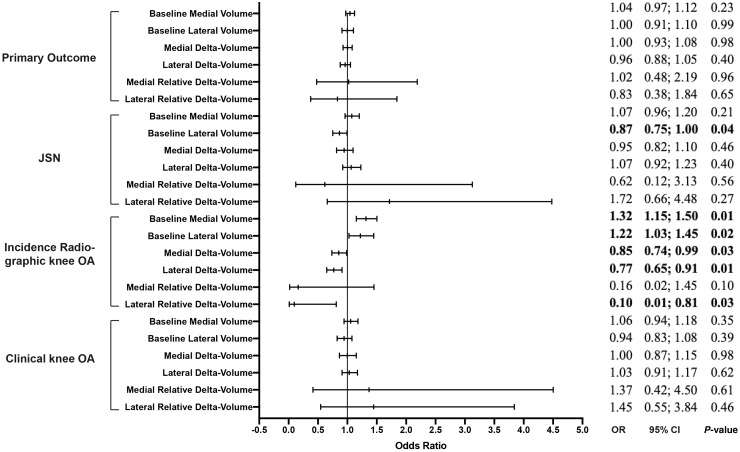
Medial and lateral baseline and delta-volumes were not significantly associated to the primary outcome. Lateral meniscal baseline volume was significantly associated to lateral JSN [odds ratio (OR) = 0.87; 95% CI: 0.75, 0.99], while other measures were not. Medial and lateral baseline volume were positively associated to K&L incidence (OR = 1.32 and 1.22; 95% CI: 1.15, 1.50 and 1.03, 1.45, respectively), while medial and lateral delta-volume were negatively associated to K&L incidence (OR = 0.998 and 0.997; 95% CI: 0.997, 1.000 and 0.996, 0.999, respectively). None of the meniscal measures were significantly associated to incident clinical OA.
Larger baseline meniscal volume and the decrease of meniscal volume over time were associated to the development of structural OA after 30 months in overweight and obese women.
评估半月板体积及其随时间的变化与超重/肥胖女性 30 个月后患膝骨关节炎(OA)的发展之间的关联。
使用预防超重女性膝关节 OA 研究的数据。该队列包括 407 名 BMI≥27kg/m2 且无 OA 相关症状的女性。主要结局指标为 30 个月后出现的新发 OA,定义为以下标准之一:内侧或外侧关节间隙狭窄(JSN)≥1.0mm、新发放射学 OA [Kellgren 和 Lawrence(K&L)分级≥2]或新发临床 OA。次要结局指标为单独的这些项目中的任何一个。在基线和随访时自动对半月板进行分割,以获得半月板体积和体积差值。使用广义估计方程评估体积测量值与结局之间的关联。
内侧和外侧基线及差值体积与主要结局无显著相关性。外侧半月板基线体积与外侧 JSN 显著相关(比值比[OR] = 0.87;95%置信区间[CI]:0.75,0.99),而其他测量值则无相关性。内侧和外侧基线体积与 K&L 发生率呈正相关(OR=1.32 和 1.22;95%CI:1.15,1.50 和 1.03,1.45),而内侧和外侧差值体积与 K&L 发生率呈负相关(OR=0.998 和 0.997;95%CI:0.997,1.000 和 0.996,0.999)。半月板的任何测量值均与新发临床 OA 无显著相关性。
在超重和肥胖女性中,基线半月板体积较大和半月板体积随时间的减少与 30 个月后结构 OA 的发展相关。