Curtis Lauren M, Ostojic Alen, Venzon David J, Holtzman Noa G, Pirsl Filip, Kuzmina Zoya J, Baird Kristin, Rose Jeremy J, Cowen Edward W, Mays Jacqueline W, Mitchell Sandra A, Parsons-Wandell Laura, Joe Galen O, Comis Leora E, Berger Ann, Pusic Iskra, Peer Cody J, Figg William D, Cao Liang, Gale Robert Peter, Hakim Frances T, Pavletic Steven Z
Immune Deficiency Cellular Therapy Program, Center for Cancer Research, National Cancer Institute, National Institutes of Health, Bethesda, MD.
Sibley Memorial Hospital, Sidney Kimmel Cancer Center, Johns Hopkins Medicine, Washington, DC.
Blood. 2021 Feb 18;137(7):896-907. doi: 10.1182/blood.2020006892.
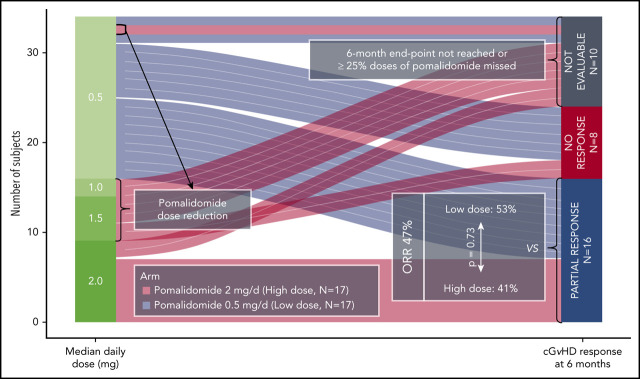
Steroid-refractory chronic graft-versus-host disease (cGVHD) is a therapeutic challenge. Sclerotic skin manifestations are especially difficult to treat. We conducted a randomized phase 2 clinical trial (#NCT01688466) to determine the safety, efficacy, and preferred dose of pomalidomide in persons with moderate to severe cGVHD unresponsive to corticosteroids and/or subsequent lines of therapy. Thirty-four subjects were randomized to receive pomalidomide 0.5 mg per day orally (n = 17; low-dose cohort) or 2 mg per day at a starting dose of 0.5 mg per day increasing to 2 mg per day over 6 weeks (n = 17; high-dose cohort). The primary endpoint was overall response rate (ORR) at 6 months according to the 2005 National Institutes of Health cGVHD Response Criteria. Thirty-two patients had severe sclerotic skin and received a median of 5 (range, 2-10) previous systemic therapies. ORR was 47% (95% confidence interval, 30-65) in the intention-to-treat analyses. All were partial responses, with no difference in ORR between the cohorts. ORR was 67% (45%-84%) in the 24 evaluable subjects at 6 months. Nine had improvement in National Institutes of Health joint/fascia scores (P = .018). Median change from the baseline in body surface area involvement of skin cGVHD was -7.5% (-10% to 35%; P = .002). The most frequent adverse events were lymphopenia, infection, and fatigue. Eight subjects in the high-dose cohort had dose decreases because of adverse events. There was 1 death in the low-dose cohort from bacterial pneumonia. Our data indicate antifibrotic effects of pomalidomide and possible association with increases in concentrations of blood regulatory T-cell and interleukin-2. Pomalidomide 0.5 mg per day is a safe and effective therapy for advanced corticosteroid-refractory cGVHD.
类固醇难治性慢性移植物抗宿主病(cGVHD)是一项治疗挑战。硬化性皮肤表现尤其难以治疗。我们开展了一项随机2期临床试验(#NCT01688466),以确定泊马度胺在对皮质类固醇和/或后续治疗方案无反应的中度至重度cGVHD患者中的安全性、疗效和最佳剂量。34名受试者被随机分组,分别口服每日0.5毫克泊马度胺(n = 17;低剂量组)或起始剂量为每日0.5毫克、6周内增至每日2毫克(n = 17;高剂量组)。主要终点是根据2005年美国国立卫生研究院cGVHD反应标准得出的6个月时的总缓解率(ORR)。32例患者有严重的硬化性皮肤,既往接受全身治疗的中位数为5次(范围2 - 10次)。意向性分析中ORR为47%(95%置信区间,30 - 65)。所有均为部分缓解,两组间ORR无差异。6个月时,24例可评估受试者的ORR为67%(45% - 84%)。9例患者的美国国立卫生研究院关节/筋膜评分有所改善(P = 0.018)。皮肤cGVHD累及体表面积较基线的中位数变化为 - 7.5%(-10%至35%;P = 0.002)。最常见的不良事件是淋巴细胞减少、感染和疲劳。高剂量组有8名受试者因不良事件而降低剂量。低剂量组有1例因细菌性肺炎死亡。我们的数据表明泊马度胺具有抗纤维化作用,且可能与血液调节性T细胞和白细胞介素 - 2浓度升高有关。每日0.5毫克泊马度胺是晚期皮质类固醇难治性cGVHD的一种安全有效的治疗方法。