Mazorra-Alonso Mónica, Martín-Vivaldi Manuel, Peralta-Sánchez Juan Manuel, Soler Juan José
Departamento de Ecología Funcional y Evolutiva, Estación Experimental de Zonas Áridas del Consejo Superior de Investigaciones Científicas, 04120 Almería, Spain.
Unidad Asociada Consejo Superior de Investigaciones Científicas: Coevolución: Cucos, Hospedadores y Bacterias Simbiontes, Universidad de Granada, 18071 Granada, Spain.
Biology (Basel). 2020 Sep 23;9(10):306. doi: 10.3390/biology9100306.
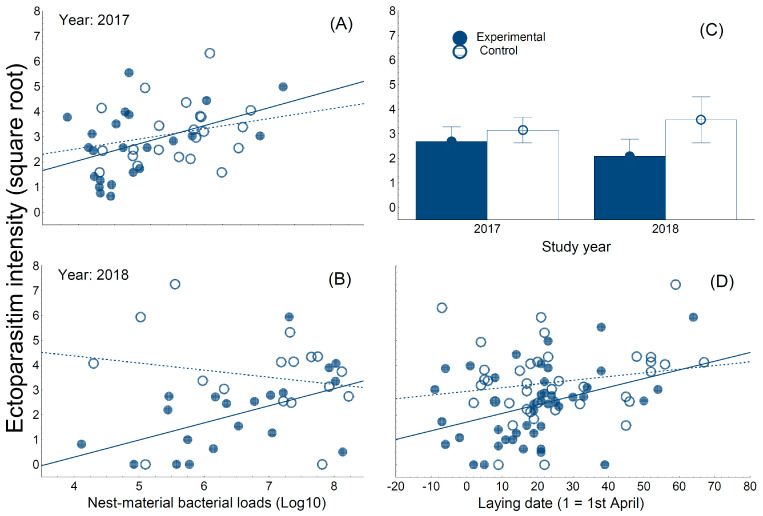
Nest bacterial environment influences avian reproduction directly because it might include pathogenic- or antibiotic-producing bacteria or indirectly because predators or ectoparasites can use volatile compounds from nest bacterial metabolism to detect nests of their avian hosts. Hoopoes () do not build nests. They rather reuse holes or nest-boxes that contain remains of nest-materials from previous breeding seasons. Interestingly, it has been recently described that the nest's bacterial environment partly affects the uropygial gland microbiota of hoopoe females and eggshells. Blood-sucking ectoparasites use chemical cues to find host nests, so we experimentally tested the hypothetical effects of microorganisms inhabiting nest-material remains before reproduction regarding the intensity of ectoparasitism suffered by 8-day-old nestling hoopoes. In accordance with the hypothesis, nestlings hatched in nest-boxes with autoclaved nest-material remains from the previous reproductive seasons suffered less from ectoparasites than those hatched in the control nest-boxes with nonautoclaved nest-material. Moreover, we found a positive association between the bacterial density of nest-material during the nestling phase and ectoparasitism intensity that was only apparent in nest-boxes with autoclaved nest-material. However, contrary to our expectations, nest bacterial load was positively associated with fledgling success. These results suggest a link between the community of microorganisms of nest-material remains and the intensity of ectoparasitism, and, on the other hand, that the nest bacterial environment during reproduction is related to fledging success. Here, we discuss possible mechanisms explaining the experimental and correlative results, including the possibility that the experimental autoclaving of nest material affected the microbiota of females and nestlings' secretion and/or nest volatiles that attracted ectoparasites, therefore indirectly affecting both the nest bacterial environment at the nestling stage and fledging success.
巢内细菌环境可能直接影响鸟类繁殖,因为其中可能包含致病或产生抗生素的细菌;也可能间接影响,因为捕食者或体外寄生虫可以利用巢内细菌代谢产生的挥发性化合物来探测鸟类宿主的巢穴。戴胜不筑巢。它们更喜欢重复使用包含上一繁殖季节巢材残余物的洞穴或巢箱。有趣的是,最近有研究表明,巢内细菌环境会部分影响戴胜雌鸟的尾脂腺微生物群和蛋壳。吸血体外寄生虫利用化学信号来寻找宿主巢穴,因此我们通过实验测试了繁殖前栖息在巢材残余物中的微生物对8日龄戴胜雏鸟体外寄生虫感染强度的假设影响。与假设一致,在装有经过高压灭菌的上一繁殖季节巢材残余物的巢箱中孵化的雏鸟,比在装有未经过高压灭菌巢材的对照巢箱中孵化的雏鸟,遭受的体外寄生虫感染更少。此外,我们发现雏鸟期巢材的细菌密度与体外寄生虫感染强度呈正相关,这种相关性仅在装有经过高压灭菌巢材的巢箱中明显。然而,与我们的预期相反,巢内细菌负荷与雏鸟出飞成功率呈正相关。这些结果表明,巢材残余物中的微生物群落与体外寄生虫感染强度之间存在联系,另一方面,繁殖期间的巢内细菌环境与雏鸟出飞成功率有关。在此,我们讨论了解释实验和相关结果的可能机制,包括巢材实验性高压灭菌可能影响雌鸟和雏鸟分泌物的微生物群以及吸引体外寄生虫的巢内挥发性物质,从而间接影响雏鸟阶段的巢内细菌环境和出飞成功率的可能性。