Institute for Clinical and Molecular Virology, Friedrich-Alexander University (FAU) Erlangen-Nürnberg, 91054, Erlangen, Germany.
Department of Biostatistics, UCLA School of Public Health, Los Angeles, CA, 90095-1772, USA.
Virus Res. 2020 Nov;289:198170. doi: 10.1016/j.virusres.2020.198170. Epub 2020 Sep 24.
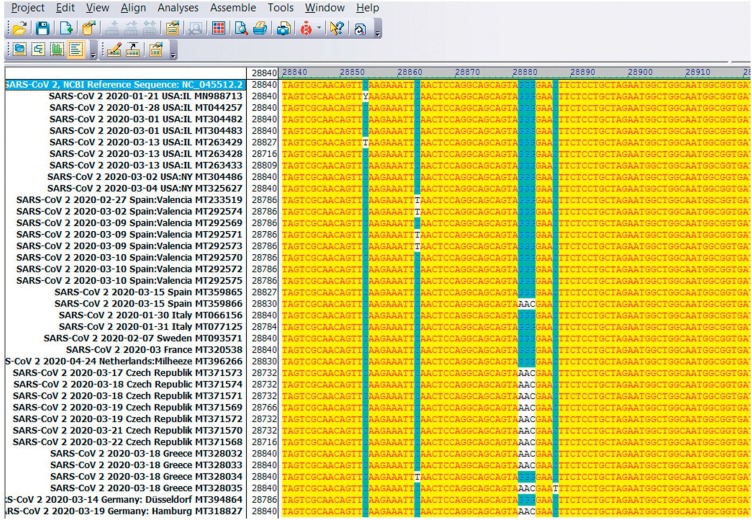
Severe Acute Respiratory Syndrome Coronavirus-2 (SARS-CoV-2) was first identified in Wuhan, China late in 2019. Nine months later (Sept. 23, 2020), the virus has infected > 31.6 million people around the world and caused > 971.000 (3.07 %) fatalities in 220 countries and territories. Research on the genetics of the SARS-CoV-2 genome, its mutants and their penetrance can aid future defense strategies. By analyzing sequence data deposited between December 2019 and end of May 2020, we have compared nucleotide sequences of 570 SARS-CoV-2 genomes from China, Europe, the US, and India to the sequence of the Wuhan isolate. During worldwide spreading among human populations, at least 10 distinct hotspot mutations had been selected and found in up to > 80 % of viral genomes. Many of these mutations led to amino acid exchanges in replication-relevant viral proteins. Mutations in the SARS-CoV-2 genome would also impinge upon the secondary structure of the viral RNA molecule and its repertoire of interactions with essential cellular and viral proteins. The increasing frequency of SARS-CoV-2 mutation hotspots might select for dangerous viral pathogens. Alternatively, in a 29.900 nucleotide-genome, there might be a limit to the number of mutable and selectable sites which, when exhausted, could prove disadvantageous to viral survival. The speed, at which novel SARS-CoV-2 mutants are selected and dispersed around the world, could pose problems for the development of vaccines and therapeutics.
严重急性呼吸综合征冠状病毒 2(SARS-CoV-2)于 2019 年末在中国武汉首次被发现。9 个月后(2020 年 9 月 23 日),该病毒已在全球感染超过 3160 万人,并在 220 个国家和地区造成超过 97.1 万人(3.07%)死亡。对 SARS-CoV-2 基因组的遗传学、其突变体及其穿透性的研究可以帮助制定未来的防御策略。通过分析 2019 年 12 月至 2020 年 5 月底期间存储的序列数据,我们比较了来自中国、欧洲、美国和印度的 570 个 SARS-CoV-2 基因组的核苷酸序列与武汉分离株的序列。在全球人群中传播期间,至少选择了 10 个不同的热点突变,并在高达>80%的病毒基因组中发现了这些突变。这些突变中的许多导致了复制相关病毒蛋白中的氨基酸替换。SARS-CoV-2 基因组中的突变也会影响病毒 RNA 分子的二级结构及其与必需的细胞和病毒蛋白相互作用的范围。SARS-CoV-2 突变热点的频率增加可能会选择出危险的病毒病原体。或者,在 29900 个核苷酸的基因组中,可能存在可突变和可选择的位点数量的限制,当这些位点耗尽时,可能对病毒的生存不利。新型 SARS-CoV-2 突变体在全球范围内选择和传播的速度可能会给疫苗和治疗药物的开发带来问题。