Division of Gastroenterology and Hepatology, Key Laboratory of Gastroenterology and Hepatology, Ministry of Health, Renji Hospital, School of Medicine, Shanghai Jiao Tong University; Shanghai Institute of Digestive Disease;145 Middle Shandong Road, Shanghai 200001, China.
Department of Gastrointestinal Surgery, Shanghai Tenth People's Hospital, School of Medicine, Tongji University, Shanghai, China.
EBioMedicine. 2020 Oct;60:102979. doi: 10.1016/j.ebiom.2020.102979. Epub 2020 Sep 24.
Log odds of positive lymph nodes (LODDS) classification showed superiority over 8 edition N staging in predicting survival of small bowel adenocarcinoma (SBA) patients. The aim of this study was to develop and validate the Tumor, LODDS, and Metastasis (TLM) staging of SBA.
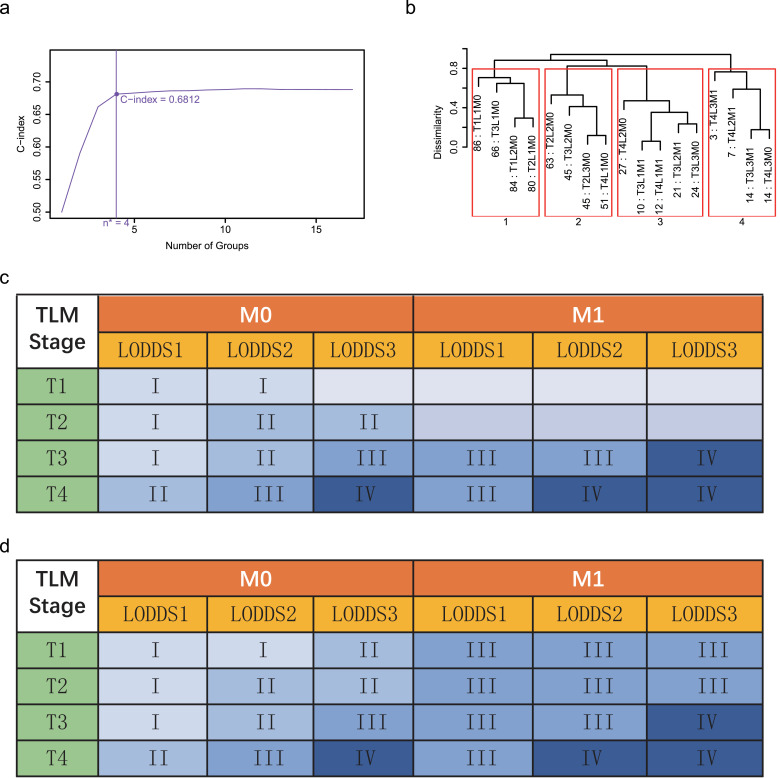
Totally 1789 SBA patients from the Surveillance, Epidemiology, and End Results (SEER) database between 1988-2010, 437 patients from SEER database between 2011-2013 and 166 patients from multicenters were categorized into development, validation and test cohort, respectively. The TLM staging was developed in the development cohort using Ensemble Algorithm for Clustering Cancer Data (EACCD) method. C-index was used to assess the performance of the TLM staging in predicting cancer-specific survival (CSS) and was compared with the traditional 8 edition TNM staging.
Four-category TLM staging designed for the development cohort showed higher discriminatory power than TNM staging in predicting CSS in the development cohort (0.682 vs. 0.650, P < 0.001), validation cohort (0.682 vs. 0.654, P = 0.022), and test cohort (0.659 vs. 0.611, P = 0.023), respectively. TLM staging continued to show its higher predictive efficacy than the 8 TNM in TNM stage II/III patients or in patients with lymph node yield less than 8.
TLM staging showed a better prognostic performance than the 8 TNM staging especially TNM stage II/III or patients with lymph node yield less than 8 and therefore, could serve to complement the TNM staging in patients with SBA.
A full list of funding bodies that contributed to this study can be found in the Acknowledgements section.
对数阳性淋巴结(LODDS)分类在预测小肠腺癌(SBA)患者生存方面优于第 8 版 N 分期。本研究旨在建立和验证 SBA 的肿瘤、LODDS 和转移(TLM)分期。
本研究共纳入 1988 年至 2010 年间 SEER 数据库中的 1789 例 SBA 患者、2011 年至 2013 年间 SEER 数据库中的 437 例患者以及来自多中心的 166 例患者,分别归入开发、验证和测试队列。在开发队列中,使用 Ensemble Algorithm for Clustering Cancer Data (EACCD) 方法对 TLM 分期进行开发。使用 C 指数评估 TLM 分期在预测癌症特异性生存(CSS)方面的性能,并与传统的第 8 版 TNM 分期进行比较。
为开发队列设计的四分类 TLM 分期在预测 CSS 方面显示出比 TNM 分期更高的区分能力,在开发队列(0.682 比 0.650,P<0.001)、验证队列(0.682 比 0.654,P=0.022)和测试队列(0.659 比 0.611,P=0.023)中均如此。TLM 分期在 TNM 分期 II/III 期或淋巴结检出数少于 8 的患者中,仍显示出比第 8 版 TNM 更高的预测疗效。
TLM 分期在预测预后方面优于第 8 版 TNM 分期,特别是在 TNM 分期 II/III 期或淋巴结检出数少于 8 的患者中,因此,可作为 SBA 患者的 TNM 分期的补充。
本研究的资金来源可在致谢部分找到完整清单。