
脑膜瘤治疗免疫疗法的基础。
Basis for Immunotherapy for Treatment of Meningiomas.
作者信息
Garzon-Muvdi Tomas, Bailey Destiny D, Pernik Mark N, Pan Edward
机构信息
Department of Neurosurgery, UT Southwestern Medical Center, Dallas, TX, United States.
Department of Neurology, UT Southwestern Medical Center, Dallas, TX, United States.
出版信息
Front Neurol. 2020 Aug 28;11:945. doi: 10.3389/fneur.2020.00945. eCollection 2020.
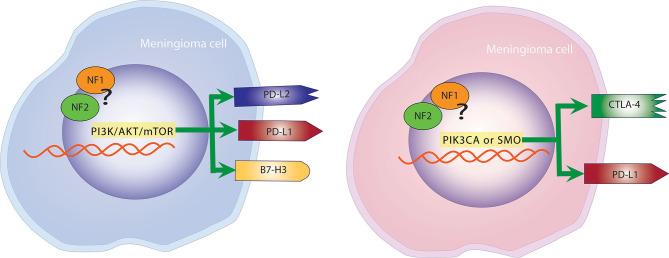
Meningiomas are common tumors that account for approximately one third of CNS tumors diagnosed every year. They are classified by the World Health Organization in grades I-III. Higher grades have an increased rate of growth, invasiveness, rate of recurrence, and worse outcomes than lower grades. Most meningiomas are grade I, while ~18% of meningiomas are grade II and III in hospital-based series. Meningiomas are typically "benign" tumors that are treated with surgery and radiation. However, when they recur or are unresectable, treatment options are very limited, especially since they are chemotherapy-resistant. Recent advances in the treatment of cancers with immunotherapy have focused on checkpoint blockade as well as other types of immunotherapy. There is emerging evidence supporting the use of immunotherapy as a potentially effective treatment strategy for meningioma patients. The immune microenvironment of meningiomas is a complex interplay of genetic alterations, immunomodulatory protein expression, and tumor-immune cell interactions. Meningiomas are known to be infiltrated by immune cells including microglia, macrophages, B-cells, and T-cells. Several mechanisms contribute to decreased an ti-tumor immune response, allowing tumor growth and evasion of the immune system. We discuss the most current knowledge on the immune micro-environment of meningiomas, preclinical findings of immunotherapy in meningiomas, meningioma immunotherapy clinical trials, and also offer insight into future prospects for immunotherapies in meningiomas.
脑膜瘤是常见肿瘤,约占每年诊断出的中枢神经系统肿瘤的三分之一。世界卫生组织将其分为I - III级。较高级别的脑膜瘤相比较低级别,生长速度更快、侵袭性更强、复发率更高且预后更差。大多数脑膜瘤为I级,而在基于医院的系列研究中,约18%的脑膜瘤为II级和III级。脑膜瘤通常是“良性”肿瘤,通过手术和放疗进行治疗。然而,当它们复发或无法切除时,治疗选择非常有限,尤其是因为它们对化疗耐药。癌症免疫治疗的最新进展集中在检查点阻断以及其他类型的免疫治疗上。越来越多的证据支持将免疫治疗作为脑膜瘤患者潜在的有效治疗策略。脑膜瘤的免疫微环境是基因改变、免疫调节蛋白表达和肿瘤 - 免疫细胞相互作用的复杂相互作用。已知脑膜瘤会被包括小胶质细胞、巨噬细胞、B细胞和T细胞在内的免疫细胞浸润。多种机制导致抗肿瘤免疫反应降低,从而使肿瘤生长并逃避免疫系统。我们讨论了关于脑膜瘤免疫微环境的最新知识、脑膜瘤免疫治疗的临床前研究结果、脑膜瘤免疫治疗临床试验,并对脑膜瘤免疫治疗的未来前景提供了见解。
 Zotero 插件