Liu Ning, Song Si-Ying, Jiang Jia-Bao, Wang Ting-Jian, Yan Chang-Xiang
Department of Neurosurgery, Sanbo Brain Hospital.
Department of Neurology, Xuanwu Hospital, Capital Medical University.
Medicine (Baltimore). 2020 Feb;99(9):e18644. doi: 10.1097/MD.0000000000018644.
Ki-67 is a typical immunohistochemical marker for cell proliferation. Higher expression of Ki-67 is correlated with poor clinical outcomes in several cancers. However, the prognostic value of Ki-67 on the prognosis of meningiomas is still controversial. The purpose of this meta-analysis was to evaluate the prognostic value of Ki-67 in meningiomas.
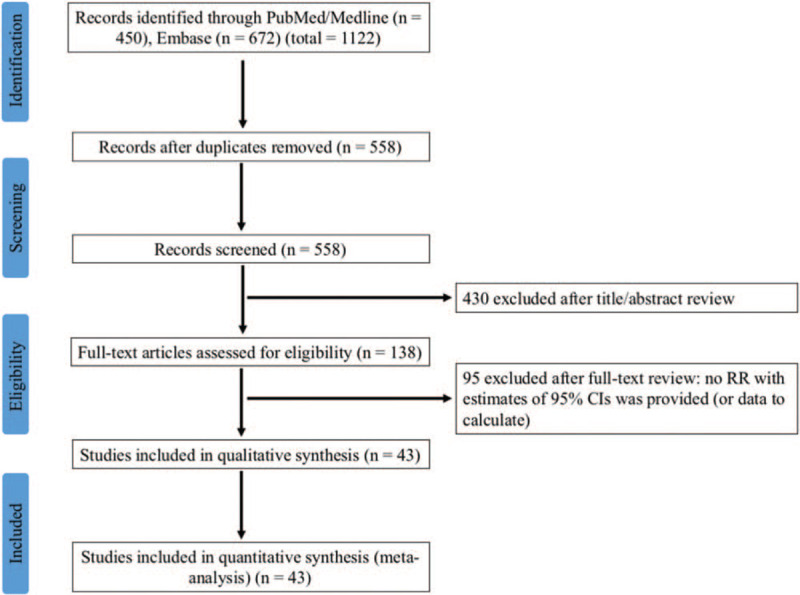
We searched Medline and EMBASE from inception to December 31, 2018, to identify relevant articles. Using a fixed or random effects model, pooled hazard ratios (HRs) for overall survival (OS) and disease/progression/recurrence-free survival (D/P/RFS) were estimated.
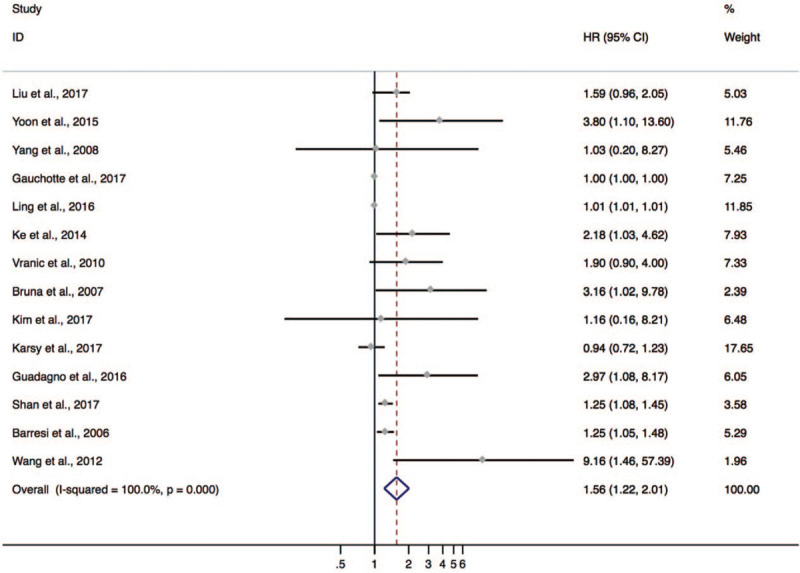
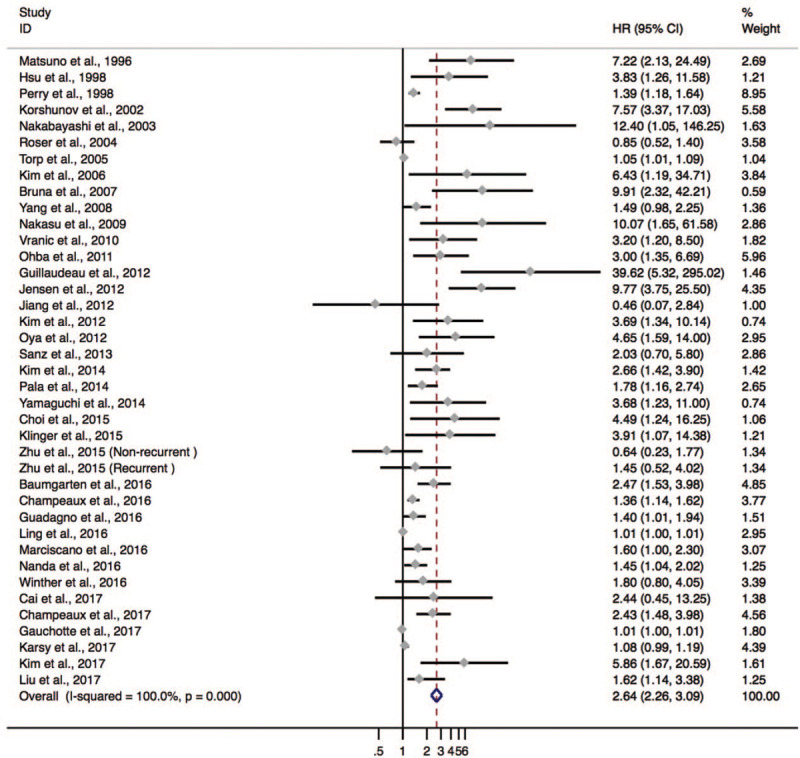
A total of 43 studies, comprising 5012 patients, were included in this analysis. Higher Ki-67 expression levels were significantly associated with worse OS (HR = 1.565; 95% CI: 1.217-2.013) and D/P/RFS (HR = 2.644; 95% CI: 2.264-3.087) in meningiomas. Subgroup analysis revealed that all the included factors (ethnicity, tumor grade, HR sources, definition of cutoffs, cutoff values) for heterogeneity investigation can affect the pooled results. Among them, the definitions of cutoffs and cutoff values factor are the two main contributors toward heterogeneity. Multivariable meta-regression analysis also showed that methodologies used for cutoff value definition contributed to the high inner-study heterogeneity.
Higher Ki-67 expression levels negatively influenced survival in meningiomas. A higher cutoff value (>4%) is more appropriate for prognosis prediction. It is highly recommended that Ki-67 expression profile could be assessed in meningiomas treatment for predicting survival. And patients with elevated expression of Ki-67 need to have close follow-ups.
Ki-67是一种典型的细胞增殖免疫组化标志物。在几种癌症中,Ki-67的高表达与不良临床结局相关。然而,Ki-67对脑膜瘤预后的预测价值仍存在争议。本荟萃分析的目的是评估Ki-67在脑膜瘤中的预后价值。
我们检索了从创刊至2018年12月31日的Medline和EMBASE,以识别相关文章。使用固定或随机效应模型,估计总生存期(OS)和无疾病/进展/复发生存期(D/P/RFS)的合并风险比(HRs)。
本分析共纳入43项研究,包括5012例患者。在脑膜瘤中,较高的Ki-67表达水平与较差的OS(HR = 1.565;95%CI:1.217 - 2.013)和D/P/RFS(HR = 2.644;95%CI:2.264 - 3.087)显著相关。亚组分析显示,用于异质性研究的所有纳入因素(种族、肿瘤分级、HR来源、截断值定义、截断值)均可影响合并结果。其中,截断值定义和截断值因素是异质性的两个主要贡献因素。多变量meta回归分析还表明,用于截断值定义的方法导致了较高的研究内异质性。
较高的Ki-67表达水平对脑膜瘤的生存有负面影响。较高的截断值(>4%)更适合预后预测。强烈建议在脑膜瘤治疗中评估Ki-67表达谱以预测生存。并且Ki-67表达升高的患者需要密切随访。