Dutta Sourav, Das Nilanjana, Mukherjee Piyali
School of Biotechnology, Presidency University, Kolkata, India.
Front Microbiol. 2020 Aug 31;11:1990. doi: 10.3389/fmicb.2020.01990. eCollection 2020.
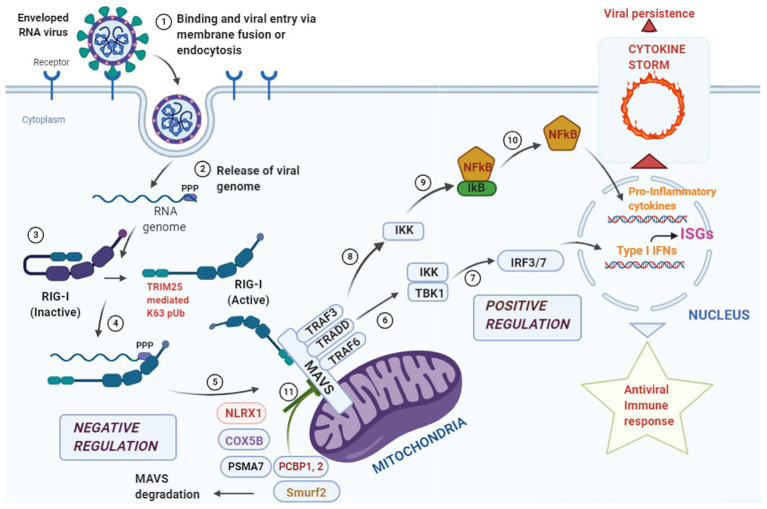
As the world faces the challenge of the COVID-19 pandemic, it has become an urgent need of the hour to understand how our immune system sense and respond to RNA viruses that are often life-threatening. While most vaccine strategies for these viruses are developed around a programmed antibody response, relatively less attention is paid to our innate immune defenses that can determine the outcome of a viral infection the production of antiviral cytokines like Type I Interferons. However, it is becoming increasingly evident that the "cytokine storm" induced by aberrant activation of the innate immune response against a viral pathogen may sometimes offer replicative advantage to the virus thus promoting disease pathogenesis. Thus, it is important to fine tune the responses of the innate immune network that can be achieved a deeper insight into the candidate molecules involved. Several pattern recognition receptors (PRRs) like the Toll like receptors (TLRs), NOD-like receptors (NLRs), and the retinoic acid inducible gene-I (RIG-I) like receptors (RLRs) recognize cytosolic RNA viruses and mount an antiviral immune response. RLRs recognize invasive viral RNA produced during infection and mediate the induction of Type I Interferons the mitochondrial antiviral signaling (MAVS) molecule. It is an intriguing fact that the mitochondrion, one of the cell's most vital organelle, has evolved to be a central hub in this antiviral defense. However, cytokine responses and interferon signaling MAVS signalosome at the mitochondria must be tightly regulated to prevent overactivation of the immune responses. This review focuses on our current understanding of the innate immune sensing of the host mitochondria by the RLR-MAVS signalosome and its specificity against some of the emerging/re-emerging RNA viruses like Ebola, Zika, Influenza A virus (IAV), and severe acute respiratory syndrome-coronavirus (SARS-CoV) that may expand our understanding for novel pharmaceutical development.
随着世界面临新冠疫情的挑战,当下迫切需要了解我们的免疫系统如何感知并应对那些往往危及生命的RNA病毒。虽然针对这些病毒的大多数疫苗策略都是围绕程序性抗体反应开发的,但相对较少关注我们的先天免疫防御,而这种防御能够决定病毒感染的结果——即抗病毒细胞因子如I型干扰素的产生。然而,越来越明显的是,针对病毒病原体的先天免疫反应异常激活所引发的“细胞因子风暴”,有时可能会为病毒提供复制优势,从而促进疾病发病机制。因此,微调先天免疫网络的反应很重要,而这可以通过更深入了解其中涉及的候选分子来实现。几种模式识别受体(PRR),如Toll样受体(TLR)、NOD样受体(NLR)和视黄酸诱导基因I(RIG-I)样受体(RLR),能够识别胞质RNA病毒并引发抗病毒免疫反应。RLR识别感染期间产生的侵入性病毒RNA,并介导I型干扰素的诱导——通过线粒体抗病毒信号(MAVS)分子。一个有趣的事实是,线粒体作为细胞最重要的细胞器之一,已进化成为这种抗病毒防御的核心枢纽。然而,细胞因子反应和干扰素信号——线粒体处的MAVS信号小体必须受到严格调控,以防止免疫反应过度激活。本综述重点关注我们目前对RLR-MAVS信号小体对宿主线粒体的先天免疫感知的理解,以及它对一些新出现/重新出现的RNA病毒(如埃博拉病毒、寨卡病毒、甲型流感病毒(IAV)和严重急性呼吸综合征冠状病毒(SARS-CoV))的特异性,这可能会拓展我们对新型药物开发的理解。