Department of Pulmonology, Biomedical Research in Endstage and Obstructive Lung Disease Hannover (BREATH), Member of the German Center for Lung Research (DZL), Hannover Medical School, Hanover, Germany.
Institute for Transfusion Medicine and Transplant Engineering, Hannover Medical School, Hanover, Germany.
Front Immunol. 2020 Aug 27;11:1964. doi: 10.3389/fimmu.2020.01964. eCollection 2020.
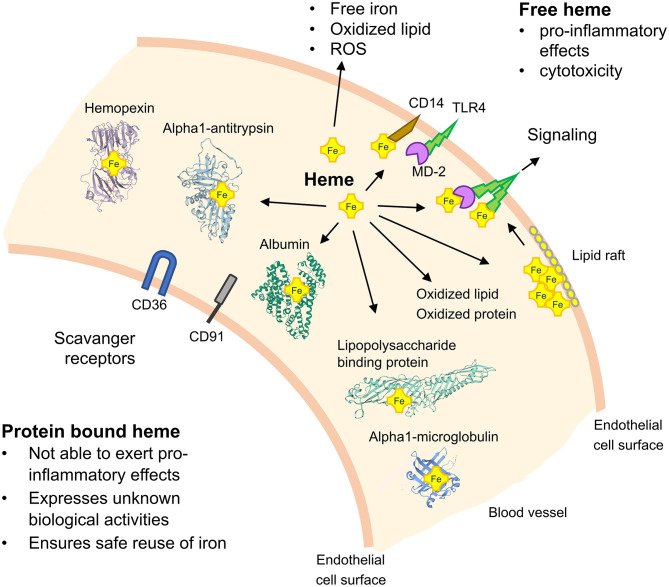
Toll-like receptors (TLRs), also known as pattern recognition receptors, respond to exogenous pathogens and to intrinsic danger signals released from damaged cells and tissues. The tetrapyrrole heme has been suggested to be an agonist for TLR4, the receptor for the pro-inflammatory bacterial component lipopolysaccharide (LPS), synonymous with endotoxin. Heme is a double-edged sword with contradictory functions. On the one hand, it has vital cellular functions as the prosthetic group of hemoproteins including hemoglobin, myoglobin, and cytochromes. On the other hand, if released from destabilized hemoproteins, non-protein bound or "free" heme can have pro-oxidant and pro-inflammatory effects, the mechanisms of which are not fully understood. In this review, the complex interactions between heme and TLR4 are discussed with a particular focus on the role of heme-binding serum proteins in handling extracellular heme and its impact on TLR4 signaling. Moreover, the role of heme as a direct and indirect trigger of TLR4 activation and species-specific differences in the regulation of heme-dependent TLR4 signaling are highlighted.
Toll 样受体 (TLRs),也称为模式识别受体,可对外源病原体和受损细胞和组织释放的内在危险信号作出反应。四吡咯血红素被认为是 TLR4 的激动剂,TLR4 是促炎细菌成分脂多糖 (LPS) 的受体,与内毒素同义。血红素是一把双刃剑,具有矛盾的功能。一方面,它作为包括血红蛋白、肌红蛋白和细胞色素在内的血红素蛋白的辅基,具有重要的细胞功能。另一方面,如果从不稳定的血红素蛋白中释放出来,非蛋白结合或“游离”的血红素可能具有促氧化剂和促炎作用,其机制尚不完全清楚。在这篇综述中,讨论了血红素与 TLR4 之间的复杂相互作用,特别关注血红素结合血清蛋白在处理细胞外血红素及其对 TLR4 信号转导的影响中的作用。此外,还强调了血红素作为 TLR4 激活的直接和间接触发物以及血红素依赖性 TLR4 信号转导的物种特异性差异的作用。