Liu Quan, Yu Xuxu, Yang Minjie, Li Xiangke, Zhai Xuejia, Lian Yujin, Chen Zhong, Fan Qingxia, Song Lijie, Li Wencai
Department of Emergency, The Fifth Affiliated Hospital of Zhengzhou University, Zhengzhou, 450052 China.
Department of Oncology, The First Affiliated Hospital of Zhengzhou University, Zhengzhou, 450052 China.
Infect Agent Cancer. 2020 Sep 22;15:55. doi: 10.1186/s13027-020-00321-8. eCollection 2020.
Hepatocellular carcinoma (HCC) is one of the cancers of highest incidence and mortality worldwide. The proliferation and invasion of tumor cells are the main reason for poor prognosis after HCC surgery. Long non-coding RNA (lncRNA) has been shown to play a key role in the progression of HCC. LncRNA-CR594175 is one of the highly expressed lncRNAs in HCC tumors and their metastatic tumors that we have obtained by the High-throughput screening method.
To elucidate the role of lncRNA-CR594175 in regulating the proliferation and invasion of human hepatoma cell line, HepG2, we operated through lncRNA-CR594175 silencing to inhibit the progression of HCC, either through in vitro or in vivo experiments.
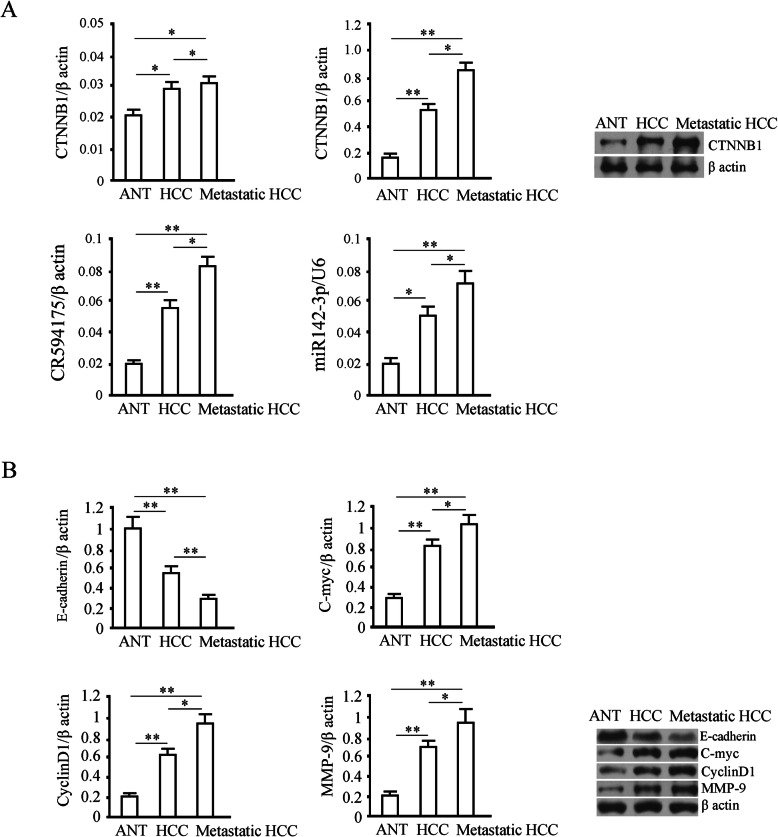
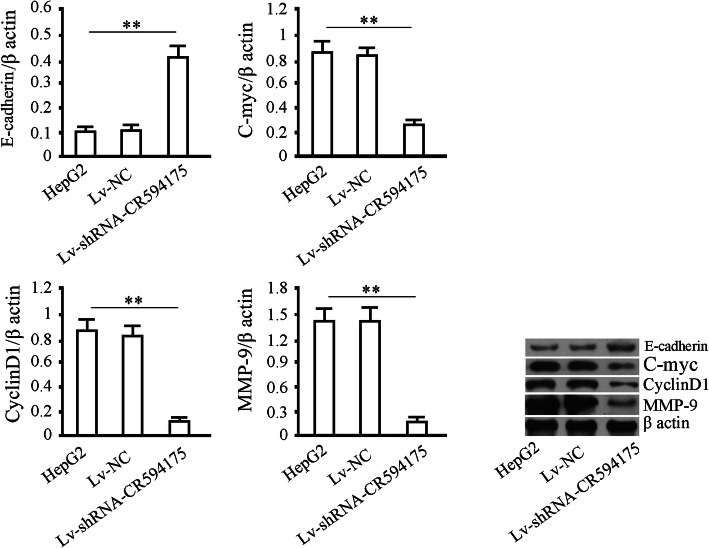
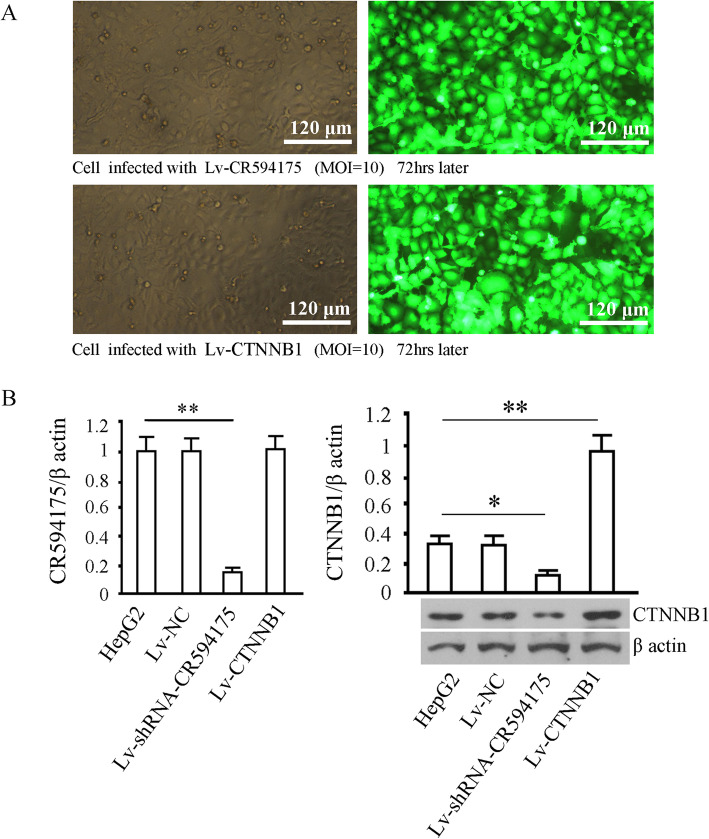
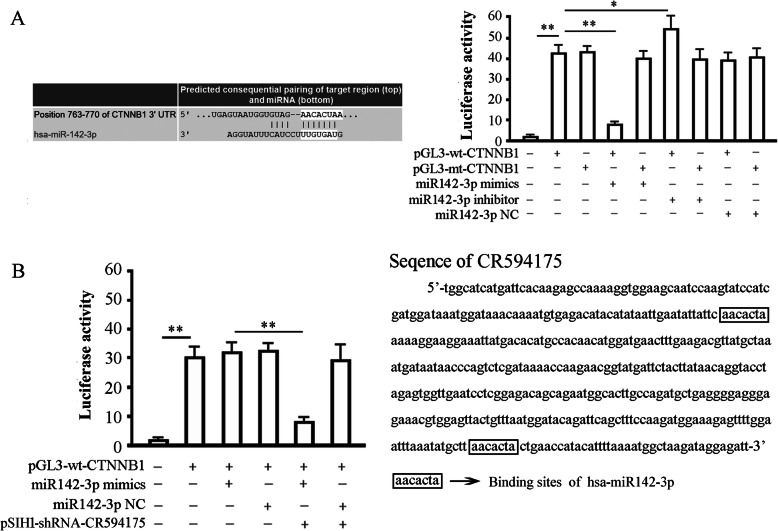
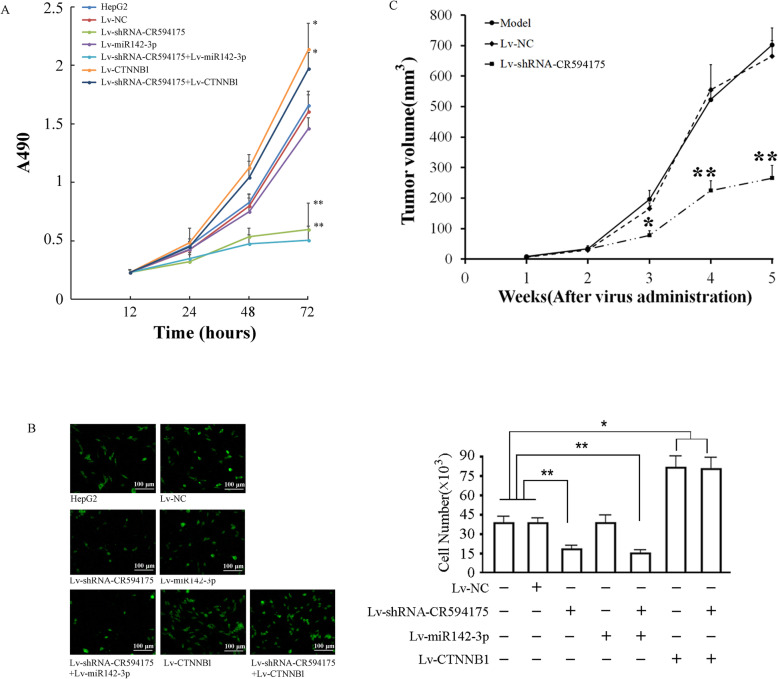
We found that lncRNA-CR594175 was lower in adjacent non-cancerous tissues than in primary HCC, and was lower in primary HCC than in its metastasis. Silencing of lncRNA-CR594175 inhibited the proliferation and invasion of HepG2 cells and growth of subcutaneous tumors. The results revealed that lncRNA-CR594175, as a RNA sponge, broke the negative regulation of hsa-miR-142-3p on Catenin, beta-1 (CTNNB1), and once lncRNA-CR594175 was silenced, the hsa-miR142-3p regained its negative regulation on CTNNB1 which can promote HCC progression by activating the wnt pathway.
Our present study demonstrated for the first time that lncRNA-CR594175 silencing suppressed proliferation and invasion of HCC cells in vivo and in vitro by restoring the negative regulation of hsa-miR-142-3p on CTNNB1, laying a solid theoretical base for using lncRNA-CR594175 as genetic target therapy for HCC and offering a reasonable explanation for inactivation of miRNA in different tumors or in the tumor at different stages.
肝细胞癌(HCC)是全球发病率和死亡率最高的癌症之一。肿瘤细胞的增殖和侵袭是肝癌手术后预后不良的主要原因。长链非编码RNA(lncRNA)已被证明在肝癌进展中起关键作用。LncRNA-CR594175是我们通过高通量筛选方法获得的肝癌肿瘤及其转移瘤中高表达的lncRNAs之一。
为阐明lncRNA-CR594175在调节人肝癌细胞系HepG2增殖和侵袭中的作用,我们通过lncRNA-CR594175沉默进行操作,以抑制肝癌的进展,包括体外和体内实验。
我们发现lncRNA-CR594175在癌旁非癌组织中低于原发性肝癌,在原发性肝癌中低于其转移灶。lncRNA-CR594175的沉默抑制了HepG2细胞的增殖和侵袭以及皮下肿瘤的生长。结果显示,lncRNA-CR594175作为一种RNA海绵,打破了hsa-miR-142-3p对β-连环蛋白1(CTNNB1)的负调控,一旦lncRNA-CR594175沉默,hsa-miR142-3p就恢复了对CTNNB1的负调控,而CTNNB1可通过激活Wnt通路促进肝癌进展。
我们目前的研究首次证明,lncRNA-CR594175沉默通过恢复hsa-miR-142-3p对CTNNB1的负调控,在体内和体外抑制了肝癌细胞的增殖和侵袭,为将lncRNA-CR594175用作肝癌的基因靶向治疗奠定了坚实的理论基础,并为不同肿瘤或肿瘤不同阶段miRNA的失活提供了合理的解释。