
吡非尼酮联合卡铂化疗治疗特发性肺纤维化合并非小细胞肺癌患者的安全性和有效性:一项回顾性队列研究。
Safety and effectiveness of pirfenidone combined with carboplatin-based chemotherapy in patients with idiopathic pulmonary fibrosis and non-small cell lung cancer: A retrospective cohort study.
机构信息
Department of Thoracic Oncology, National Hospital Organization Osaka Toneyama Medical Center, Toyonaka, Japan.
出版信息
Thorac Cancer. 2020 Nov;11(11):3317-3325. doi: 10.1111/1759-7714.13675. Epub 2020 Sep 28.
BACKGROUND
Pirfenidone is an antifibrotic agent that is potentially effective for the treatment of idiopathic pulmonary fibrosis (IPF). However, no study has reported on its prophylactic value against chemotherapy-associated acute IPF exacerbations when combined with chemotherapy for non-small cell lung cancer (NSCLC). The present study assessed the safety and effectiveness of pirfenidone combined with carboplatin-based chemotherapy or immune checkpoint inhibitors (ICIs) in patients with IPF and NSCLC.
METHODS
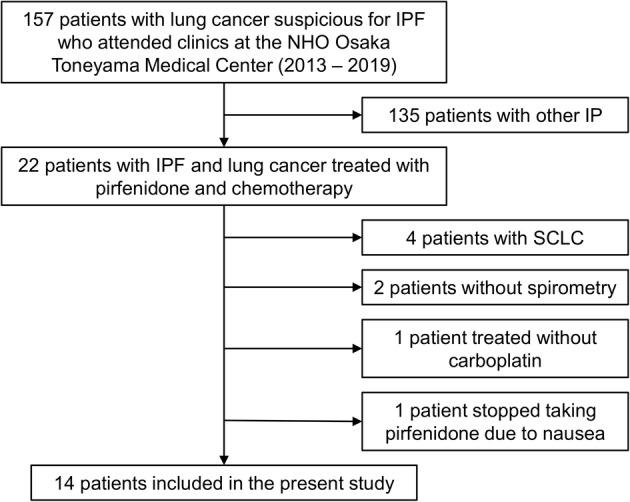
A total of 14 patients with IPF and NSCLC who received treatment from 2013 to 2019 were included. Patients were treated with pirfenidone combined with carboplatin and nanoparticle albumin-bound paclitaxel or S-1 as first-line chemotherapy. After confirming disease progression, patients received cytotoxic agents or ICIs, including nivolumab and pembrolizumab. Pirfenidone was continued regardless of chemotherapy changes. Overall survival (OS) and progression-free survival (PFS) for lung cancer and IPF were calculated. Moreover, the cumulative incidence of acute exacerbation of IPF (AE-IPF) within one year was evaluated.
RESULTS
Median PFS for lung cancer was 110 days (95% confidence interval [CI]: 57-199 days), while the median OS was 362 days (95% CI: 220-526 days). Moreover, PFS for IPF was 447 days (95% CI: 286-indeterminate days), and the cumulative incidence of AE-IPF within one year was 18%. Notably, none of the patients developed AE-IPF associated with first-line chemotherapy. Among the included patients, four received ICIs, none of whom developed ICI-associated AE-IPF.
CONCLUSIONS
The present study found that pirfenidone combined with carboplatin-based regimens or ICIs might be safe first-line chemotherapy for patients with IPF and NSCLC.
KEY POINTS
SIGNIFICANT FINDINGS OF THE STUDY: No patients with IPF and NSCLC who received pirfenidone in combination with first-line carboplatin-based chemotherapy or late-line ICIs developed acute IPF exacerbations. What this study adds Pirfenidone might have a prophylactic effect against chemotherapy-associated AE-IPF.
背景
吡非尼酮是一种抗纤维化药物,对特发性肺纤维化(IPF)的治疗具有潜在疗效。然而,目前尚无研究报道吡非尼酮与化疗联合治疗非小细胞肺癌(NSCLC)时对化疗相关急性 IPF 加重的预防价值。本研究评估了吡非尼酮联合卡铂为基础的化疗或免疫检查点抑制剂(ICI)治疗合并 IPF 和 NSCLC 的患者的安全性和有效性。
方法
纳入了 2013 年至 2019 年接受治疗的 14 例合并 IPF 和 NSCLC 的患者。患者接受吡非尼酮联合卡铂和纳米白蛋白结合紫杉醇或 S-1 作为一线化疗。在确认疾病进展后,患者接受细胞毒性药物或 ICI(包括纳武单抗和帕博利珠单抗)治疗。无论化疗方案如何变化,均继续使用吡非尼酮。计算肺癌和 IPF 的总生存期(OS)和无进展生存期(PFS)。此外,评估了一年内 IPF 急性加重(AE-IPF)的累积发生率。
结果
肺癌的中位 PFS 为 110 天(95%置信区间 [CI]:57-199 天),中位 OS 为 362 天(95%CI:220-526 天)。此外,IPF 的中位 PFS 为 447 天(95%CI:286-不确定天数),一年内 AE-IPF 的累积发生率为 18%。值得注意的是,一线化疗均未发生与 AE-IPF 相关的事件。纳入的患者中有 4 例接受了 ICI 治疗,均未发生与 ICI 相关的 AE-IPF。
结论
本研究发现,吡非尼酮联合卡铂为基础的方案或 ICI 可能是合并 IPF 和 NSCLC 患者安全的一线化疗方案。
关键点
本研究的重要发现:未接受一线卡铂为基础化疗联合吡非尼酮或接受二线 ICI 治疗的合并 IPF 和 NSCLC 的患者均未发生急性 IPF 加重。本研究的意义:吡非尼酮可能对化疗相关 AE-IPF 具有预防作用。


 Zotero 插件