Assié Jean-Baptiste, Chouaïd Christos, Nunes Hilario, Reynaud Dorothée, Gaudin Anne-Françoise, Grumberg Valentine, Jolivel Ronan, Jouaneton Baptiste, Cotté François-Emery, Duchemann Boris
Functional Genomics of Solid Tumors Laboratory, Centre de Recherche des Cordeliers, INSERM, Sorbonne Université, Université de Paris, Paris, France.
Centre Hospitalier Intercommunal Créteil, Créteil, France.
Ther Adv Med Oncol. 2023 Jan 31;15:17588359231152847. doi: 10.1177/17588359231152847. eCollection 2023.
Up to 10% of patients with advanced non-small cell lung cancer (aNSCLC) have pre-existing interstitial lung disease (ILD). These patients are usually excluded from immunotherapy clinical trials. Consequently, knowledge on outcomes following nivolumab treatment in these patients remains limited. The primary objective of this study was to evaluate survival outcome following nivolumab treatment in ILD patients with pre-treated aNSCLC in the real-world setting.
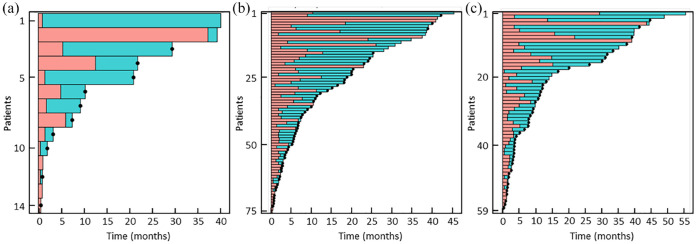
The study included all patients with aNSCLC recorded in the French hospital database, starting nivolumab in 2015-2016. Patients were stratified by pre-existing ILD and three subgroups were studied [auto-immune or granulomatous (AI/G) ILD, other known causes ILD and idiopathic ILD]. Time to discontinuation of nivolumab treatment [time to treatment duration (TTD)] and overall survival (OS) were estimated using Kaplan-Meier survival analysis.
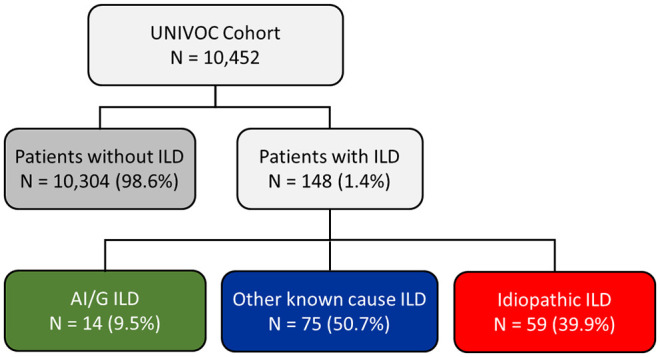
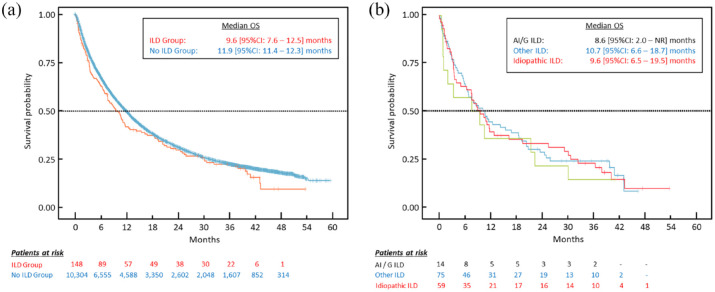
Of 10,452 aNSCLC patients initiating nivolumab, 148 (1.4%) had pre-existing ILD. Mean age at nivolumab initiation was 64.6 ± 9.4 years in ILD and 63.8 ± 9.6 years in non-ILD. Compared to non-ILD, patients in the ILD group were more frequently men ( < 0.05) and had more comorbidities ( < 0.001). There was no significant difference between ILD and non-ILD groups for median TTD (2.5 2.8 months; = 0.6) or median OS (9.6 11.9 months; = 0.1). Median OS in AI/G ILD ( = 14), other known causes ILD ( = 75), and idiopathic ILD ( = 59) were 8.6, 10.7, and 9.6 months, respectively.
In this large cohort of aNSCLC patients with ILD, outcomes are similar to those obtained in the non-ILD population. Immunotherapy could be beneficial for these patients.
高达10%的晚期非小细胞肺癌(aNSCLC)患者存在既往间质性肺疾病(ILD)。这些患者通常被排除在免疫治疗临床试验之外。因此,关于纳武利尤单抗治疗这些患者的疗效的知识仍然有限。本研究的主要目的是在真实世界环境中评估纳武利尤单抗治疗既往接受过治疗的aNSCLC合并ILD患者的生存结局。
本研究纳入了法国医院数据库中2015 - 2016年开始使用纳武利尤单抗的所有aNSCLC患者。患者根据是否存在既往ILD进行分层,并研究了三个亚组[自身免疫性或肉芽肿性(AI/G)ILD、其他已知病因的ILD和特发性ILD]。使用Kaplan-Meier生存分析估计纳武利尤单抗治疗停药时间[治疗持续时间(TTD)]和总生存期(OS)。
在10452例开始使用纳武利尤单抗的aNSCLC患者中,148例(1.4%)存在既往ILD。开始使用纳武利尤单抗时,ILD患者的平均年龄为64.6±9.4岁,非ILD患者为63.8±9.6岁。与非ILD患者相比,ILD组患者男性更常见(<0.05)且合并症更多(<0.001)。ILD组和非ILD组的中位TTD(2.5对2.8个月;P = 0.6)或中位OS(9.6对11.9个月;P = 0.1)无显著差异。AI/G ILD组(n = 14)、其他已知病因的ILD组(n = 75)和特发性ILD组(n = 59)的中位OS分别为8.6、10.7和9.6个月。
在这个大型aNSCLC合并ILD患者队列中,结局与非ILD人群相似。免疫治疗可能对这些患者有益。