Key Laboratory of Marine Drugs, Chinese Ministry of Education, School of Medicine and Pharmacy, Ocean University of China, Qingdao, China; Laboratory for Marine Drugs and Bioproducts, Pilot National Laboratory for Marine Science and Technology, Qingdao, China.
Key Laboratory of Marine Drugs, Chinese Ministry of Education, School of Medicine and Pharmacy, Ocean University of China, Qingdao, China; Laboratory for Marine Drugs and Bioproducts, Pilot National Laboratory for Marine Science and Technology, Qingdao, China.
J Biol Chem. 2020 Dec 4;295(49):16826-16839. doi: 10.1074/jbc.RA120.015282. Epub 2020 Sep 28.
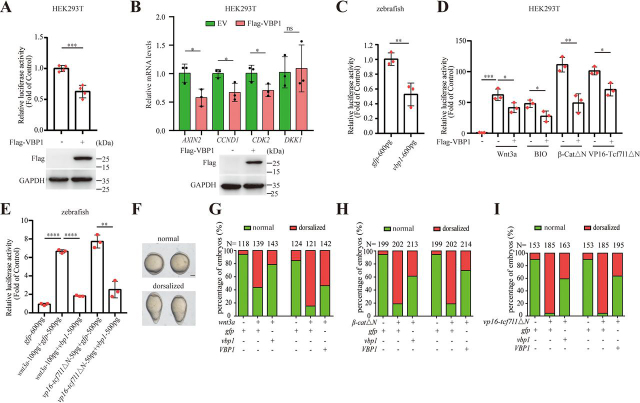
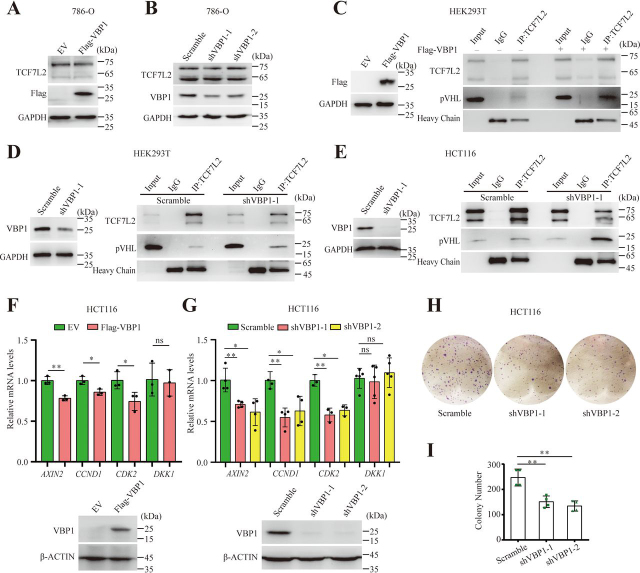
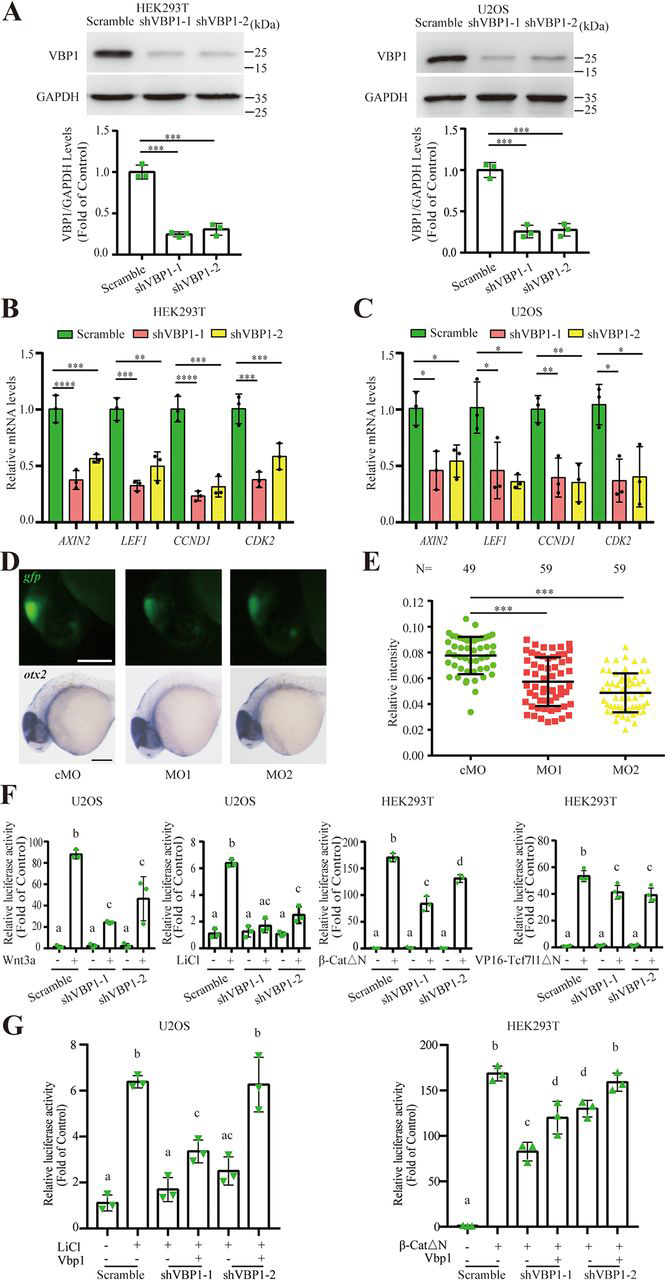
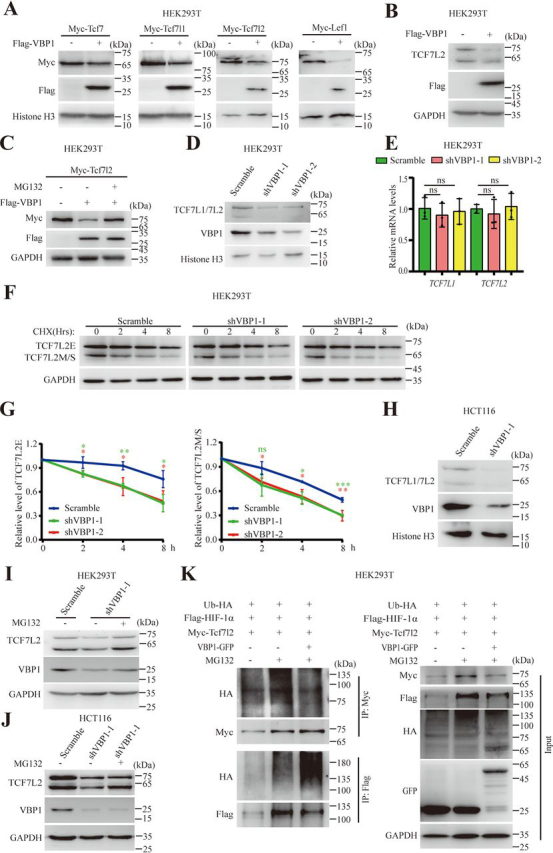
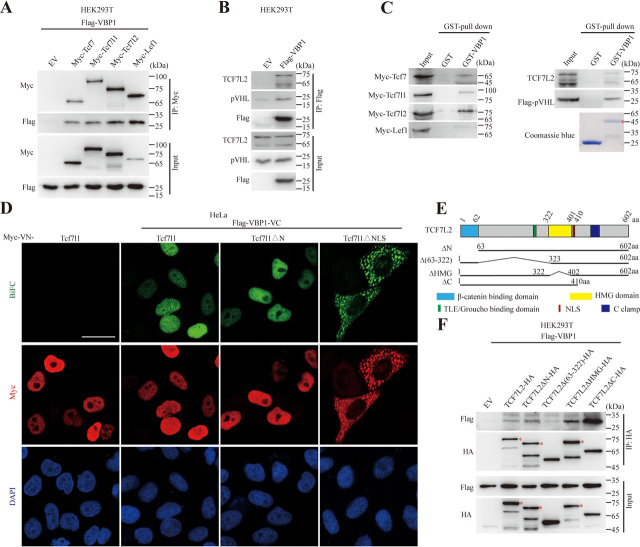
The Wnt/β-catenin pathway is one of the major pathways that regulates embryonic development, adult homeostasis, and stem cell self-renewal. In this pathway, transcription factors T-cell factor and lymphoid enhancer factor (TCF/LEF) serve as a key switch to repress or activate Wnt target gene transcription by recruiting repressor molecules or interacting with the β-catenin effector, respectively. It has become evident that the protein stability of the TCF/LEF family members may play a critical role in controlling the activity of the Wnt/β-catenin signaling pathway. However, factors that regulate the stability of TCF/LEFs remain largely unknown. Here, we report that pVHL binding protein 1 (VBP1) regulates the Wnt/β-catenin signaling pathway by controlling the stability of TCF/LEFs. Surprisingly, we found that either overexpression or knockdown of VBP1 decreased Wnt/β-catenin signaling activity in both cultured cells and zebrafish embryos. Mechanistically, VBP1 directly binds to all four TCF/LEF family members and von Hippel-Lindau tumor-suppressor protein (pVHL). Either overexpression or knockdown of VBP1 increases the association between TCF/LEFs and pVHL and then decreases the protein levels of TCF/LEFs via proteasomal degradation. Together, our results provide mechanistic insights into the roles of VBP1 in controlling TCF/LEFs protein stability and regulating Wnt/β-catenin signaling pathway activity.
Wnt/β-连环蛋白通路是调节胚胎发育、成体稳态和干细胞自我更新的主要通路之一。在该通路上,转录因子 T 细胞因子和淋巴增强因子(TCF/LEF)分别通过招募抑制分子或与β-连环蛋白效应物相互作用,作为抑制或激活 Wnt 靶基因转录的关键开关。显然,TCF/LEF 家族成员的蛋白质稳定性可能在控制 Wnt/β-连环蛋白信号通路的活性方面起着至关重要的作用。然而,调节 TCF/LEFs 稳定性的因素在很大程度上仍然未知。在这里,我们报告 pVHL 结合蛋白 1(VBP1)通过控制 TCF/LEFs 的稳定性来调节 Wnt/β-连环蛋白信号通路。令人惊讶的是,我们发现 VBP1 的过表达或敲低均降低了培养细胞和斑马鱼胚胎中的 Wnt/β-连环蛋白信号活性。在机制上,VBP1 直接与所有四个 TCF/LEF 家族成员和 von Hippel-Lindau 肿瘤抑制蛋白(pVHL)结合。VBP1 的过表达或敲低均增加了 TCF/LEFs 与 pVHL 的结合,并通过蛋白酶体降解降低 TCF/LEFs 的蛋白水平。总之,我们的结果为 VBP1 控制 TCF/LEFs 蛋白稳定性和调节 Wnt/β-连环蛋白信号通路活性的作用提供了机制上的见解。