Yoon Ji Young, Park Joo Hyun, Lee Kwang Jin, Kim Hyong Suk, Rhee Sung-Min, Oh Joo Han
Department of Orthopaedic Surgery, National Police Hospital, Seoul, Korea.
Department of Orthopaedic Surgery, Bundang Jesaeng Genenral Hospital, Seongnam, Korea.
Korean J Pain. 2020 Oct 1;33(4):344-351. doi: 10.3344/kjp.2020.33.4.344.
The effects of far-infrared radiation (FIR) on the treatment of rotator cuff diseases remains unknown. We evaluated the safety and efficacy of FIR after arthroscopic rotator cuff repair with regard to postoperative pain and healing.
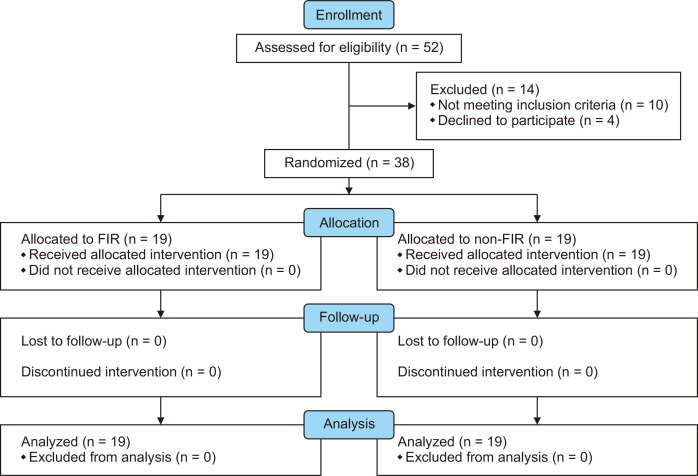
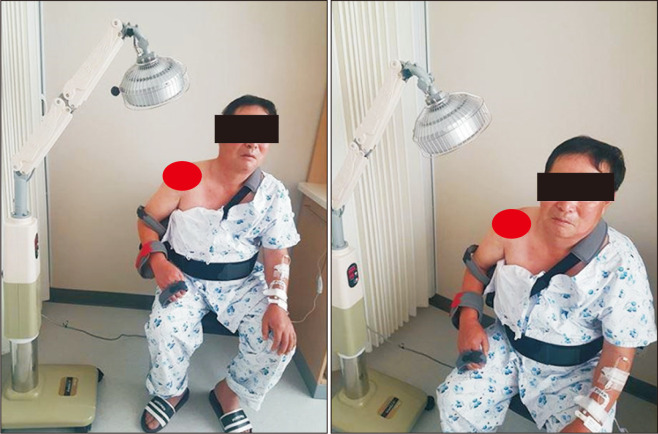
This prospective randomized comparative study included 38 patients who underwent arthroscopic rotator cuff repair due to a medium-sized tear. Patients were randomly divided into the FIR or control group (n = 19 per group). In the FIR group, FIR with an FIR radiator started 1 week postoperatively for 30 minutes per session twice daily. It lasted until abduction brace weaning at 5 weeks postoperatively. We assessed pain using a pain visual analogue scale (pVAS) and measured the range of motion (ROM) of the shoulder at 5 weeks, and 3 and 6 months, postoperatively. The anatomical outcome was evaluated using magnetic resonance imaging at 6 months postoperatively.
At 5 weeks postoperatively, the average pVAS score was lower in the FIR group than in the control group (1.5 ± 0.8 2.7 ± 1.7; = 0.019). At 3 months postoperatively, the average forward flexion was higher in the FIR group (151.6° ± 15.3° 132.9° ± 27.8°; = 0.045), but there was no significant difference at 6 months postoperatively. There was no significant difference in healing failure between the groups ( = 0.999).
FIR after arthroscopic rotator cuff repair could be an effective and safe procedure to reduce postoperative pain, thereby facilitating rehabilitation and better ROM in the early postoperative period.
远红外辐射(FIR)对肩袖疾病治疗的影响尚不清楚。我们评估了关节镜下肩袖修复术后FIR在术后疼痛和愈合方面的安全性和有效性。
这项前瞻性随机对照研究纳入了38例因中型撕裂而接受关节镜下肩袖修复的患者。患者被随机分为FIR组或对照组(每组n = 19)。在FIR组中,术后1周开始使用远红外辐射器进行FIR治疗,每次30分钟,每天两次。持续至术后5周拆除外展支具。我们使用疼痛视觉模拟量表(pVAS)评估疼痛,并在术后5周、3个月和6个月测量肩部的活动范围(ROM)。术后6个月使用磁共振成像评估解剖学结果。
术后5周,FIR组的平均pVAS评分低于对照组(1.5±0.8对2.7±1.7;P = 0.019)。术后3个月,FIR组的平均前屈角度更高(151.6°±15.3°对132.9°±27.8°;P = 0.045),但术后6个月无显著差异。两组间愈合失败情况无显著差异(P = 0.999)。
关节镜下肩袖修复术后使用FIR可能是一种有效且安全的方法,可减轻术后疼痛,从而在术后早期促进康复并改善ROM。