Bizzotto Juan, Sanchis Pablo, Abbate Mercedes, Lage-Vickers Sofía, Lavignolle Rosario, Toro Ayelén, Olszevicki Santiago, Sabater Agustina, Cascardo Florencia, Vazquez Elba, Cotignola Javier, Gueron Geraldine
Universidad de Buenos Aires, Facultad de Ciencias Exactas y Naturales, Departamento de Química Biológica, Intendente Guiraldes 2160, Buenos Aires, C1428EGA, Argentina.
CONICET - Universidad de Buenos Aires, Instituto de Química Biológica de la Facultad de Ciencias Exactas y Naturales (IQUIBICEN), Buenos Aires, C1428EGA, Argentina.
iScience. 2020 Oct 23;23(10):101585. doi: 10.1016/j.isci.2020.101585. Epub 2020 Sep 23.
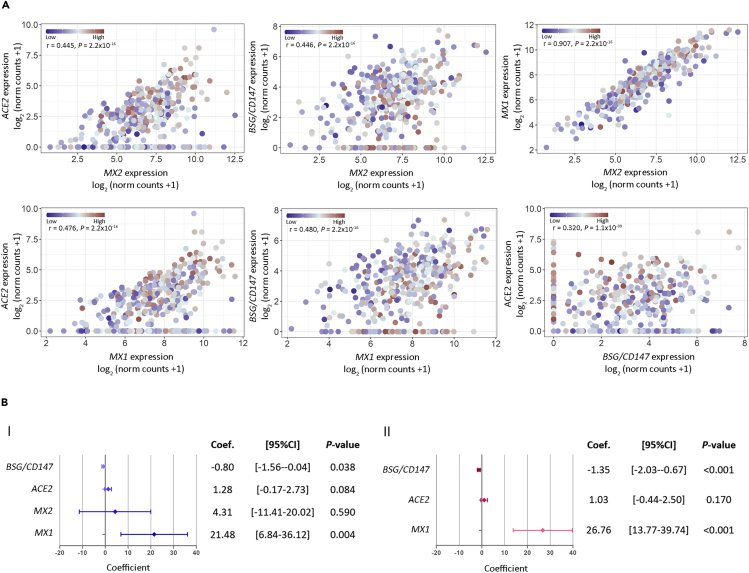
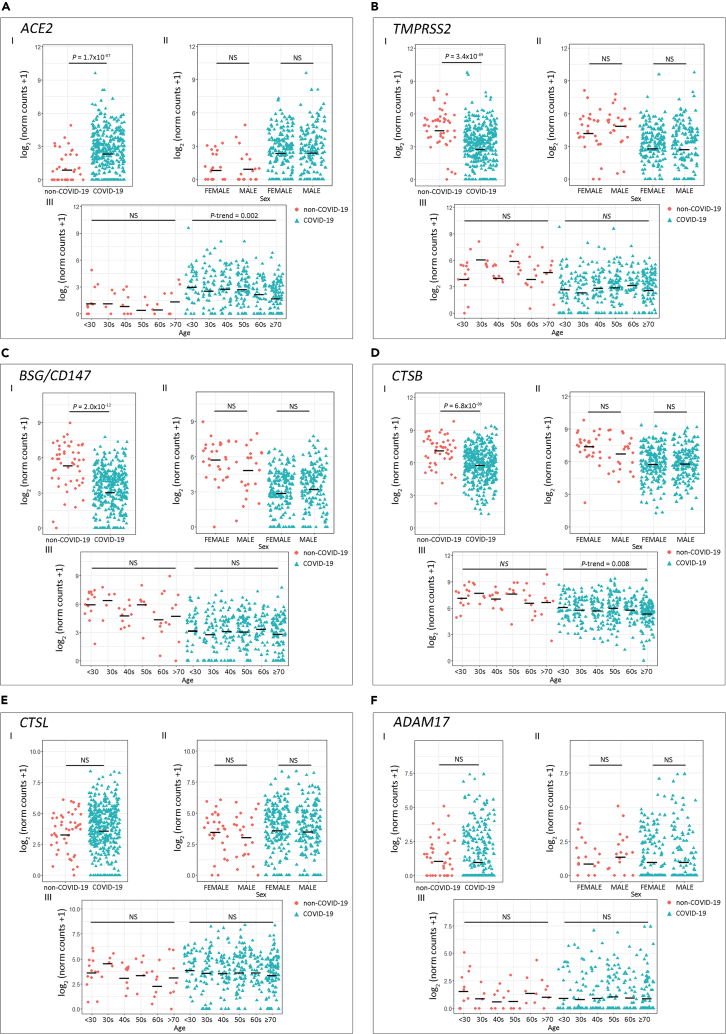
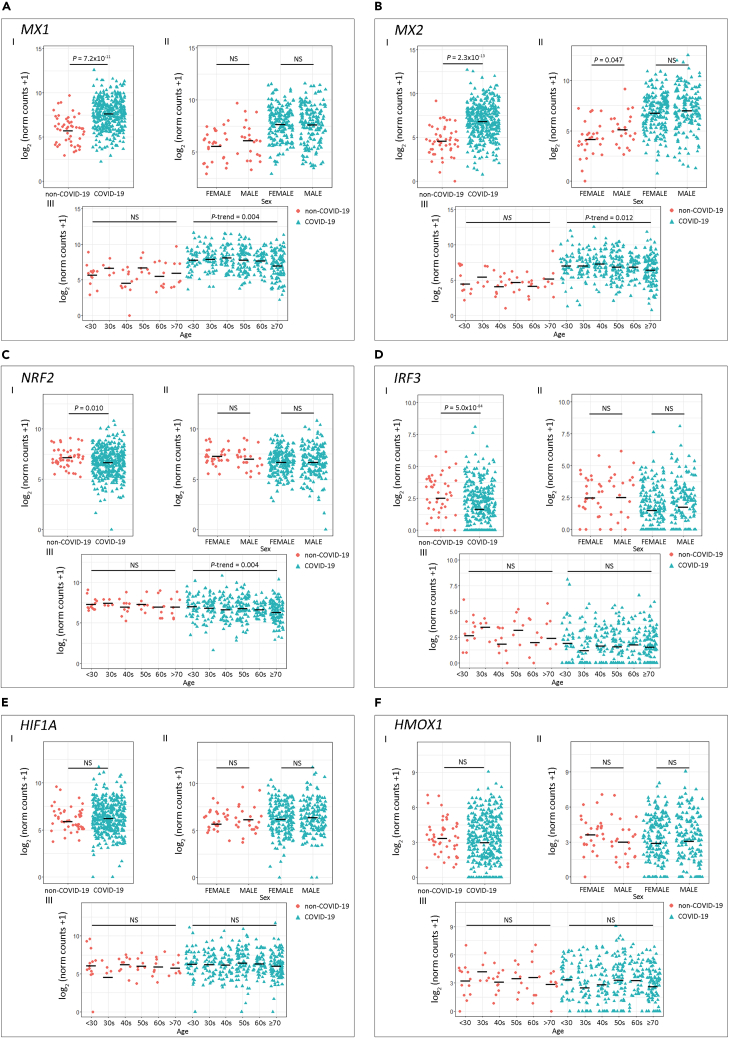
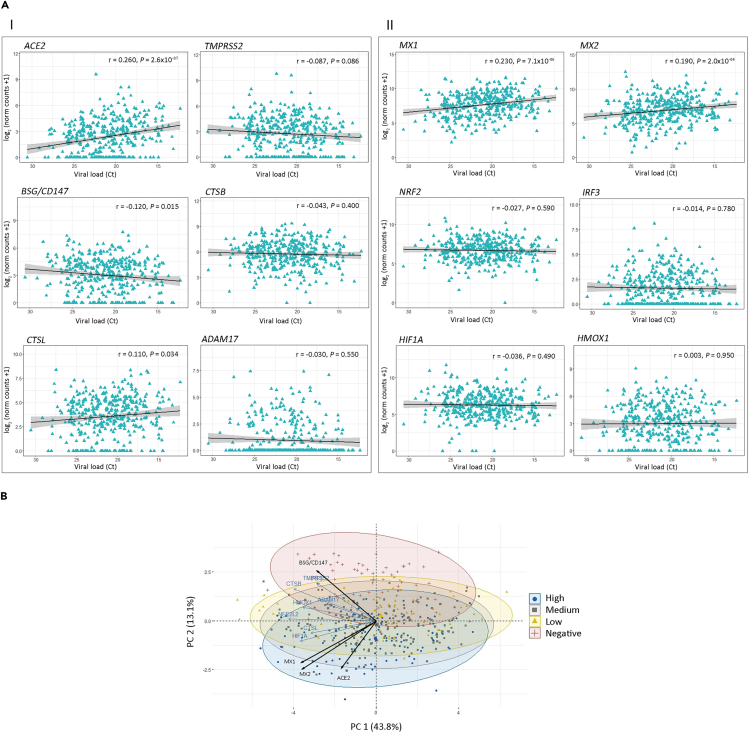
In a published case-control study (GSE152075) from SARS-CoV-2-positive (n = 403) and -negative patients (n = 50), we analyzed the response to infection assessing gene expression of host cell receptors and antiviral proteins. The expression analysis associated with reported risk factors for COVID-19 was also assessed. SARS-CoV-2 cases had higher , but lower , and expression compared with negative cases. COVID-19 patients' age negatively affected expression. and were higher in COVID-19 patients. A negative trend for and was observed as patients' age increased. Principal-component analysis determined that , , , and expression was able to cluster non-COVID-19 and COVID-19 individuals. Multivariable regression showed that expression significantly increased for each unit of viral load increment. Altogether, these findings support differences in , , , and expression between COVID-19 and non-COVID-19 patients and point out to as a critical responder in SARS-CoV-2 infection.
在一项已发表的病例对照研究(GSE152075)中,该研究涉及SARS-CoV-2阳性患者(n = 403)和阴性患者(n = 50),我们分析了宿主细胞受体和抗病毒蛋白的基因表达,以评估对感染的反应。还评估了与报告的COVID-19风险因素相关的表达分析。与阴性病例相比,SARS-CoV-2病例的[具体基因1]表达较高,但[具体基因2]、[具体基因3]和[具体基因4]表达较低。COVID-19患者的年龄对[具体基因5]表达有负面影响。COVID-19患者的[具体基因6]和[具体基因7]较高。随着患者年龄的增加,观察到[具体基因8]和[具体基因9]呈负趋势。主成分分析确定,[具体基因1]、[具体基因2]、[具体基因3]和[具体基因4]的表达能够区分非COVID-19和COVID-19个体。多变量回归显示,病毒载量每增加一个单位,[具体基因10]表达显著增加。总之,这些发现支持了COVID-19和非COVID-19患者在[具体基因1]、[具体基因2]、[具体基因3]和[具体基因4]表达上的差异,并指出[具体基因10]是SARS-CoV-2感染中的关键反应者。