Department of Epidemiology, Johns Hopkins University Bloomberg School of Public Health , Baltimore, USA.
Department of Pathology, Johns Hopkins School of Medicine , Baltimore, USA.
Am J Drug Alcohol Abuse. 2020 Nov 1;46(6):805-811. doi: 10.1080/00952990.2020.1807558. Epub 2020 Sep 29.
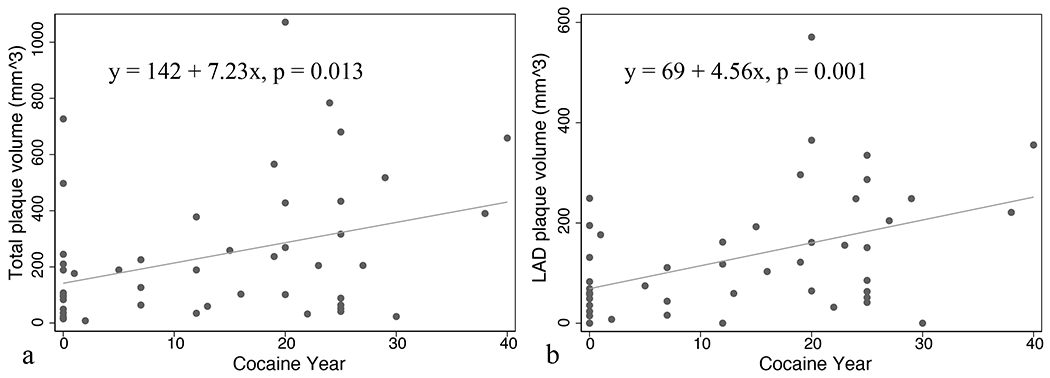
: There is a lack of research regarding whether prolonged use of cocaine would lead to increase of coronary plaque burden. : To study the effects of cocaine use on the coronary artery plaque volume. We hypothesize the longer the cocaine use, the greater the plaque burden. : We used coronary computed tomography angiography to evaluate plaque volumes. The study included chronic (N = 33 with 27 HIV+) and non-cocaine users (N = 15 with 12 HIV+). Chronic cocaine use was defined as use by any route for at least 6 months, administered at least 4 times/month. The Student's t-test was used to compare the plaque volumes between chronic and non-cocaine users. Multivariable regression analysis adjusted for age, sex, body mass index, HIV status, cigarette smoking, diabetes, and total cholesterol was performed to determine the relationship between years of cocaine use and plaque volumes. : The total plaque volumes between groups showed no difference (p = .065). However, the total left anterior descending artery (LAD) plaque volume in the chronic cocaine group was significantly higher than that in the non-cocaine group (p = .047). For each year increase in cocaine use, total plaque volume and total LAD plaque volume increased by 7.23 mm (p = .013) and 4.56 mm (p = .001), respectively. In the multivariable analyses, both total plaque volume and total LAD plaque volume were significantly associated with years of cocaine use (p = .039 and 0.013, respectively). : Prolonged cocaine use accelerates the development of sub-clinical atherosclerosis.
长期使用可卡因是否会导致冠状动脉斑块负担增加,这方面的研究还很缺乏。
研究可卡因使用对冠状动脉斑块体积的影响。我们假设可卡因使用时间越长,斑块负担越大。
我们使用冠状动脉计算机断层血管造影来评估斑块体积。研究包括慢性(N=33 例,均为 HIV+)和非可卡因使用者(N=15 例,均为 HIV+)。慢性可卡因使用定义为任何途径使用可卡因至少 6 个月,每月至少使用 4 次。使用学生 t 检验比较慢性和非可卡因使用者的斑块体积。多变量回归分析调整了年龄、性别、体重指数、HIV 状态、吸烟、糖尿病和总胆固醇,以确定可卡因使用年限与斑块体积之间的关系。
两组之间的总斑块体积没有差异(p=0.065)。然而,慢性可卡因组的总左前降支(LAD)斑块体积明显高于非可卡因组(p=0.047)。可卡因使用年限每增加 1 年,总斑块体积和总 LAD 斑块体积分别增加 7.23mm(p=0.013)和 4.56mm(p=0.001)。在多变量分析中,总斑块体积和总 LAD 斑块体积均与可卡因使用年限显著相关(p=0.039 和 0.013)。
长期使用可卡因会加速亚临床动脉粥样硬化的发展。