Tao Hong, Nagano Kazuya, Tasaki Ikkei, Zhang Tian-Qi, Ishizaka Takuya, Gao Jian-Qing, Harada Kazuo, Hirata Kazumasa, Tsujino Hirofumi, Higashisaka Kazuma, Tsutsumi Yasuo
Graduate School of Pharmaceutical Sciences, Osaka University, 1-6 Yamadaoka, Suita, Osaka, 565-0871, Japan.
Graduate School of Medicine, Osaka University, 2-2 Yamadaoka, Suita, Osaka, 565-0871, Japan.
Nanoscale Res Lett. 2020 Sep 29;15(1):187. doi: 10.1186/s11671-020-03421-x.
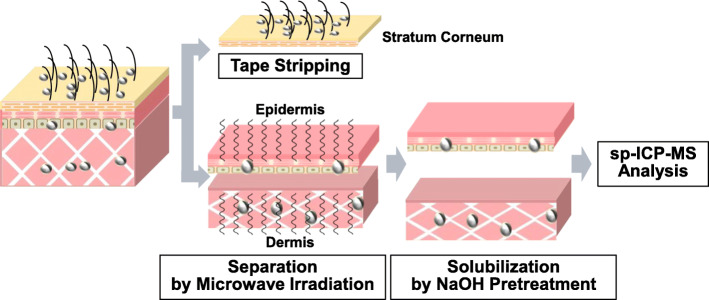
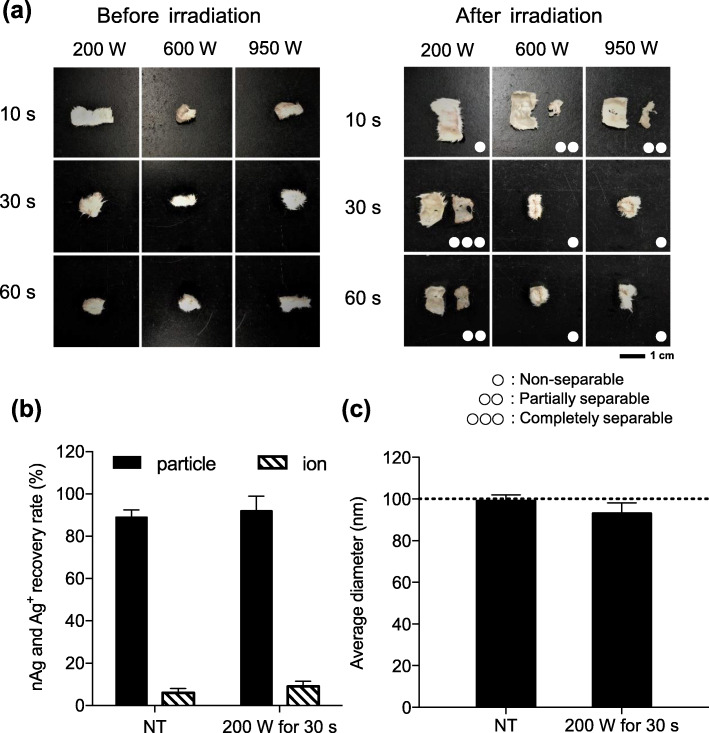
In order to ensure the safe usage of silver nanoparticles (nAgs) in cosmetics, it is necessary to reveal the physical properties of nAgs inside the skin, as these properties may change during the process of percutaneous absorption. In this study, we aimed to establish an analytical system based on single particle inductively coupled plasma mass spectrometry (sp-ICP-MS) to determine the physical properties of nAgs in the skin. First, we optimized a pretreatment method for solubilizing the skin samples and then showed that most of the nAgs were recovered by sodium hydroxide treatment while remaining in particle form. For separating the skin into the epidermis and dermis, we screened several conditions of microwave irradiation. The sp-ICP-MS analysis indicated that the application of 200 W for 30 s was optimal, as this condition ensured complete separation of skin layers without changing the physical properties of the majority of nAgs. Finally, we evaluated the in vivo application by analyzing the quantity as well as the physical properties of Ag in the epidermis, dermis, and peripheral blood of mice after exposing the skin to nAgs or Ag. Subsequent sp-ICP-MS analysis indicated that nAgs could be absorbed and distributed into the deeper layers in the ionized form, whereas Ag was absorbed and distributed without a change in physical properties. This study indicates that in order to obtain a comprehensive understanding of the response of skin following exposure to nAgs, it is essential to consider the distribution and particle size of not only nAgs but also Ag released from nAgs into the skin.
为确保银纳米颗粒(nAgs)在化妆品中的安全使用,有必要揭示其在皮肤内的物理性质,因为这些性质在经皮吸收过程中可能会发生变化。在本研究中,我们旨在建立一种基于单颗粒电感耦合等离子体质谱(sp-ICP-MS)的分析系统,以测定皮肤中nAgs的物理性质。首先,我们优化了一种用于溶解皮肤样品的预处理方法,然后表明大多数nAgs通过氢氧化钠处理得以回收,且仍保持颗粒形式。为了将皮肤分离为表皮和真皮,我们筛选了几种微波辐射条件。sp-ICP-MS分析表明,200 W照射30 s是最佳条件,因为该条件能确保皮肤层完全分离,同时不会改变大多数nAgs的物理性质。最后,我们通过分析小鼠皮肤暴露于nAgs或Ag后表皮、真皮和外周血中Ag的量及物理性质,评估了其体内应用情况。随后的sp-ICP-MS分析表明,nAgs能够以离子形式被吸收并分布到更深层,而Ag被吸收和分布时物理性质未发生变化。本研究表明,为了全面了解皮肤暴露于nAgs后的反应,不仅要考虑nAgs的分布和粒径,还要考虑从nAgs释放到皮肤中的Ag的分布和粒径。