Saratov Branch of Kotel'nokov Institute of Radioengineering and Electronics of Russian Academy of Sciences, Saratov, Russia.
Institute of Higher Nervous Activity and Neurophysiology of RAS, Moscow, Russia.
PLoS One. 2020 Sep 29;15(9):e0239125. doi: 10.1371/journal.pone.0239125. eCollection 2020.
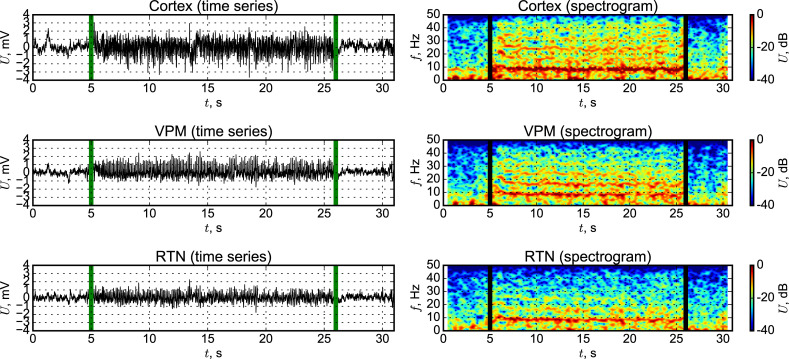
A mesoscale network model is proposed for the development of spike and wave discharges (SWDs) in the cortico-thalamo-cortical (C-T-C) circuit. It is based on experimental findings in two genetic models of childhood absence epilepsy-rats of WAG/Rij and GAERS strains. The model is organized hierarchically into two levels (brain structures and individual neurons) and composed of compartments for representation of somatosensory cortex, reticular and ventroposteriomedial thalamic nuclei. The cortex and the two thalamic compartments contain excitatory and inhibitory connections between four populations of neurons. Two connected subnetworks both including relevant parts of a C-T-C network responsible for SWD generation are modelled: a smaller subnetwork for the focal area in which the SWD generation can take place, and a larger subnetwork for surrounding areas which can be only passively involved into SWDs, but which is mostly responsible for normal brain activity. This assumption allows modeling of both normal and SWD activity as a dynamical system (no noise is necessary), providing reproducibility of results and allowing future analysis by means of theory of dynamical system theories. The model is able to reproduce most time-frequency changes in EEG activity accompanying the transition from normal to epileptiform activity and back. Three different mechanisms of SWD initiation reported previously in experimental studies were successfully reproduced in the model. The model incorporates also a separate mechanism for the maintenance of SWDs based on coupling analysis from experimental data. Finally, the model reproduces the possibility to stop ongoing SWDs with high frequency electrical stimulation, as described in the literature.
提出了一个介观网络模型,用于皮质-丘脑-皮质(C-T-C)回路中棘波和尖波放电(SWD)的发展。该模型基于两种儿童失神癫痫的遗传模型(WAG/Rij 和 GAERS 大鼠)的实验发现。该模型分为两个层次(大脑结构和单个神经元)进行组织,并由躯体感觉皮层、网状和腹后内侧丘脑核的隔室组成。皮质和两个丘脑隔室包含四个神经元群体之间的兴奋性和抑制性连接。建模了两个连接的子网,它们都包括负责 SWD 产生的 C-T-C 网络的相关部分:一个较小的子网用于发生 SWD 的焦点区域,一个较大的子网用于周围区域,这些区域只能被动地参与 SWD,但主要负责正常的大脑活动。该假设允许将正常和 SWD 活动作为动力系统进行建模(不需要噪声),从而提供结果的可重复性,并允许通过动力系统理论进行未来分析。该模型能够重现伴随从正常到癫痫样活动以及恢复的 EEG 活动的大多数时频变化。在实验研究中,成功重现了三种先前报道的 SWD 起始的不同机制。该模型还结合了基于来自实验数据的耦合分析的 SWD 维持的单独机制。最后,该模型再现了文献中描述的用高频电刺激停止正在进行的 SWD 的可能性。