Sairanen Viljami, Tokola Anna, Tikkanen Ritva, Laine Minna, Autti Taina
HUS Medical Imaging Center, Radiology, University of Helsinki and Helsinki University Hospital, 00029 Helsinki, Finland.
Department of Computer Science, University of Verona, 37134 Verona, Italy.
Brain Sci. 2020 Sep 27;10(10):677. doi: 10.3390/brainsci10100677.
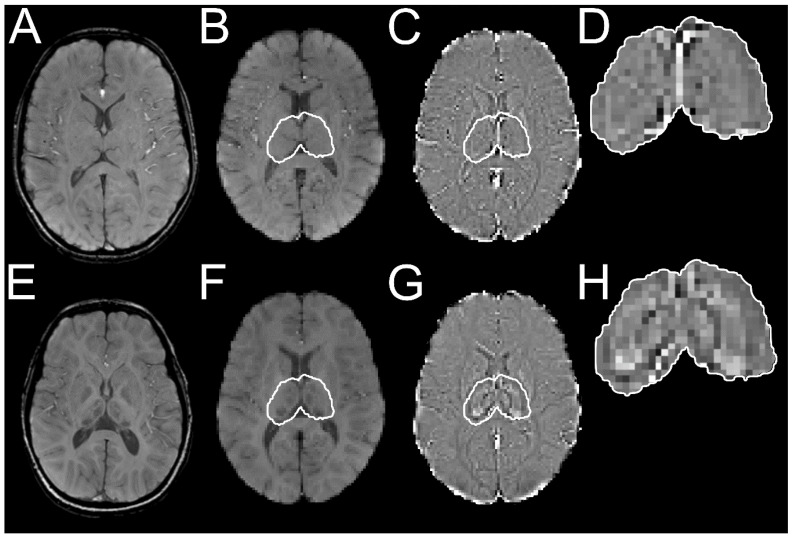
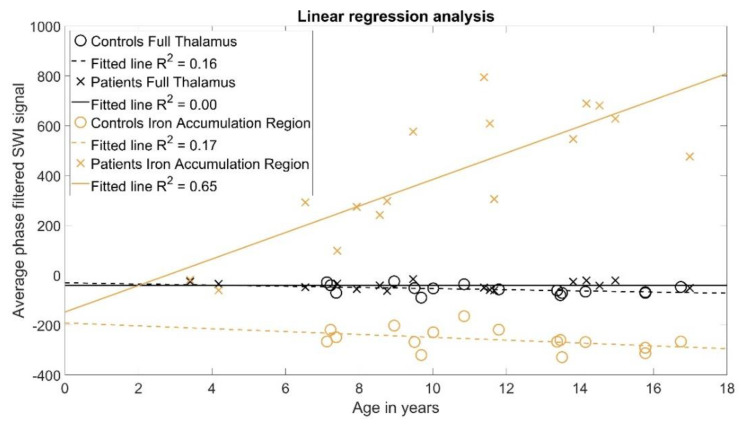
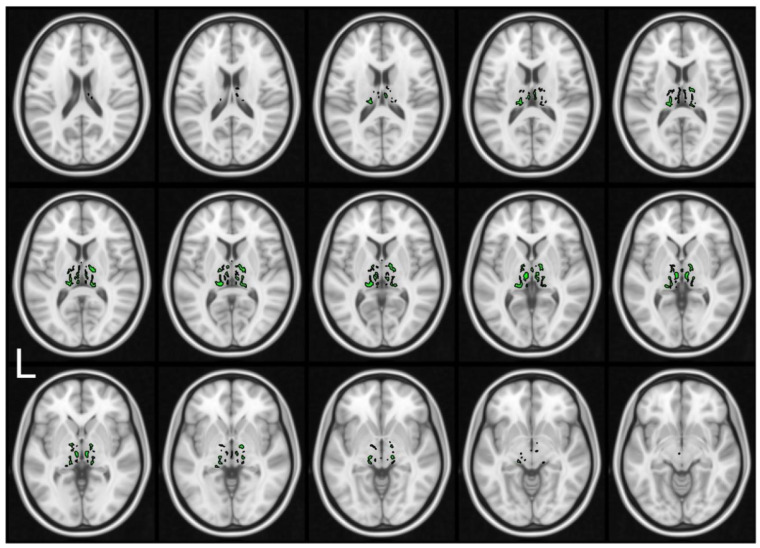
Aspartylglucosaminuria (AGU) is a rare lysosomal storage disorder causing developmental delay, intellectual disability, and eventual death. A distinct feature in AGU is iron accumulation within the thalamus. Our aim is to demonstrate that susceptibility-weighted images (SWI) could be used as an MRI biomarker to evaluate the response within the AGU population to newly evolving treatments. SWI from 16 patients with AGU and 16 age-matched controls were used in the analysis. Thalamic volume with an iron accumulation was identified using a permutation test. Group differences were investigated for both the complete thalamus and the iron accumulation regions. Group-wise age correlation within these volumes were assessed with analysis of variance and multivariate regression. We found a statistically significant and large difference (-value = 0.01, Cohen's D = 0.97) for the whole thalamus comparison and an even greater difference in the iron accumulation regions (-value < 0.01, Cohen's D = 3.52). Furthermore, we found strong evidence for iron accumulation as a linear function of age with R = 0.65 only for AGU. The statistical analysis of SWI provides tools for assessing the degree of iron accumulation. This method could be used to study the response to treatments, in that a successful treatment would be expected to result in a decline in iron accumulation.
天冬氨酰葡糖胺尿症(AGU)是一种罕见的溶酶体贮积病,可导致发育迟缓、智力残疾并最终导致死亡。AGU的一个显著特征是丘脑内铁蓄积。我们的目的是证明,敏感性加权成像(SWI)可作为一种磁共振成像生物标志物,用于评估AGU患者群体对新出现治疗方法的反应。分析中使用了16例AGU患者和16例年龄匹配对照的SWI。使用排列检验确定有铁蓄积的丘脑体积。对整个丘脑和铁蓄积区域进行组间差异研究。通过方差分析和多元回归评估这些体积内的组内年龄相关性。我们发现,整个丘脑比较存在统计学上显著的巨大差异(P值=0.01,科恩D值=0.97),铁蓄积区域的差异更大(P值<0.01,科恩D值=3.52)。此外,我们发现有强有力的证据表明,仅在AGU中,铁蓄积是年龄的线性函数,R=0.65。SWI的统计分析为评估铁蓄积程度提供了工具。该方法可用于研究对治疗的反应,因为成功的治疗预期会导致铁蓄积减少。