Araszkiewicz Andrzej, Kiliszek Damian
Faculty of Civil Engineering and Geodesy, Military University of Technology, gen. S. Kaliskiego 2, 00-908 Warsaw, Poland.
Sensors (Basel). 2020 Sep 27;20(19):5536. doi: 10.3390/s20195536.
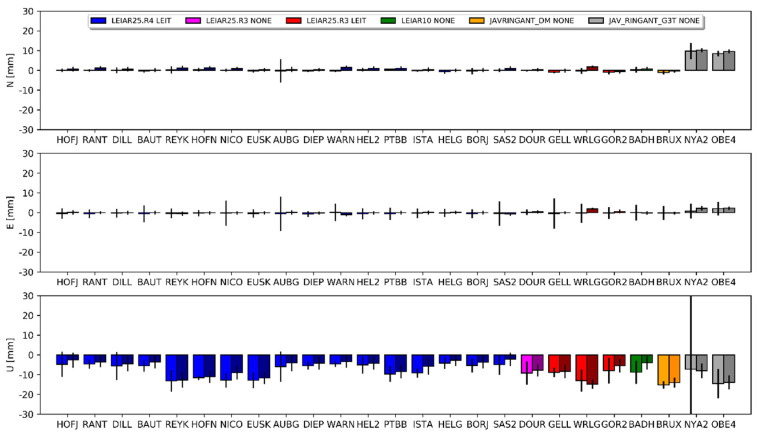
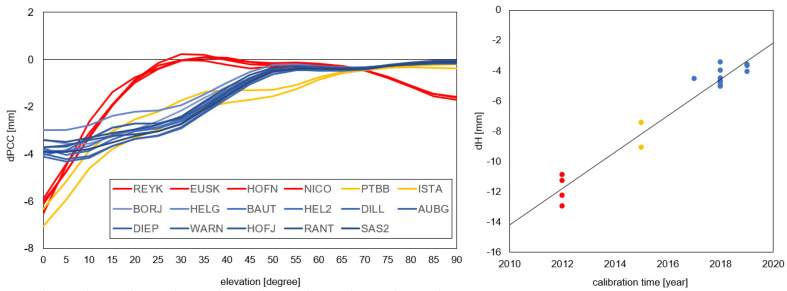
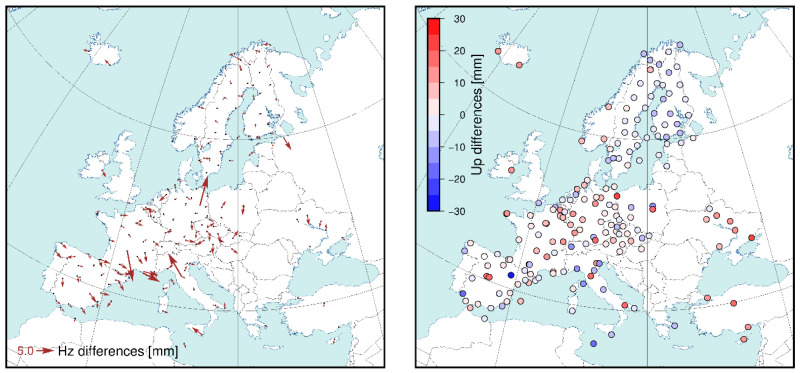
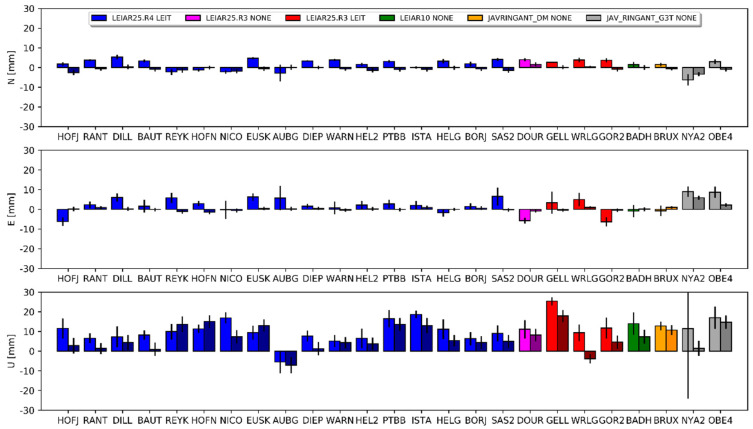
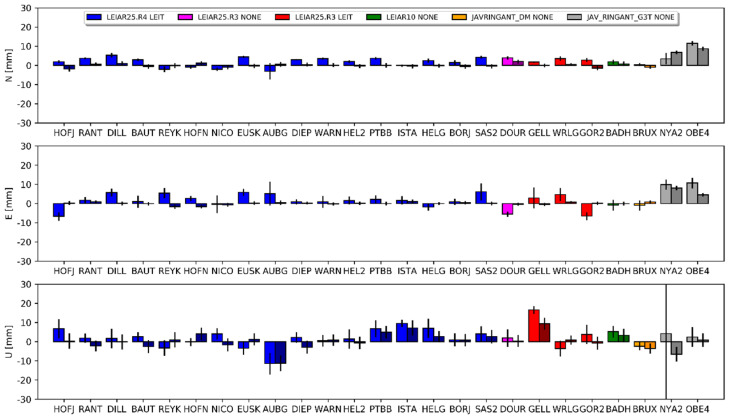
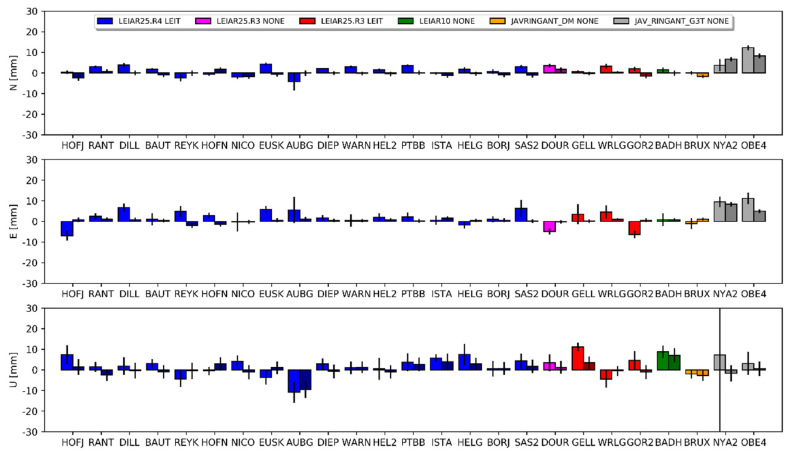
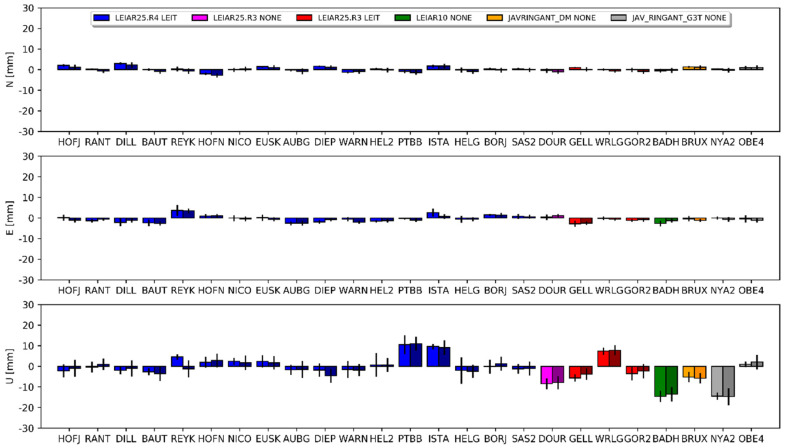
Knowledge of Global Navigation Satellite System (GNSS) antenna phase center variations plays a key role in precise positioning. Proper modeling is achieved by accessing antenna phase center corrections, which are determined in the calibration process. For most receiver antenna types, the International GNSS Service provides such corrections for two GPS and GLONASS carrier signals. In the case of Galileo, access to phase center corrections is difficult; only antennas calibrated in the anechoic chambers have available corrections for Galileo frequencies. Hence, in many of the studies, GPS-dedicated corrections are used for these Galileo frequencies. Differential analysis was conducted in this study to evaluate the impact of such change. In total, 25 stations belonging to the EUREF Permanent Network and equipped with individual calibrated antennas were the subject of this research. The results for both the absolute and relative positioning methods are clear: using GPS L2 corrections for Galileo E5a frequency causes a bias in the estimated height of almost 8 mm. For the horizontal component, a significant difference can be noticed for only one type of antenna.
全球导航卫星系统(GNSS)天线相位中心变化的知识在精确定位中起着关键作用。通过获取天线相位中心校正来实现恰当的建模,这些校正是在校准过程中确定的。对于大多数接收机天线类型,国际GNSS服务为两个GPS和GLONASS载波信号提供此类校正。在伽利略系统的情况下,获取相位中心校正很困难;只有在电波暗室中校准的天线才有伽利略频率的可用校正。因此,在许多研究中,针对这些伽利略频率使用的是GPS专用校正。本研究进行了差分分析,以评估这种变化的影响。共有25个属于欧洲参考框架永久网络且配备了单独校准天线的站点参与了本研究。绝对定位和相对定位方法的结果都很明确:对伽利略E5a频率使用GPS L2校正会导致估计高度出现近8毫米的偏差。对于水平分量,仅在一种天线类型上能注意到显著差异。